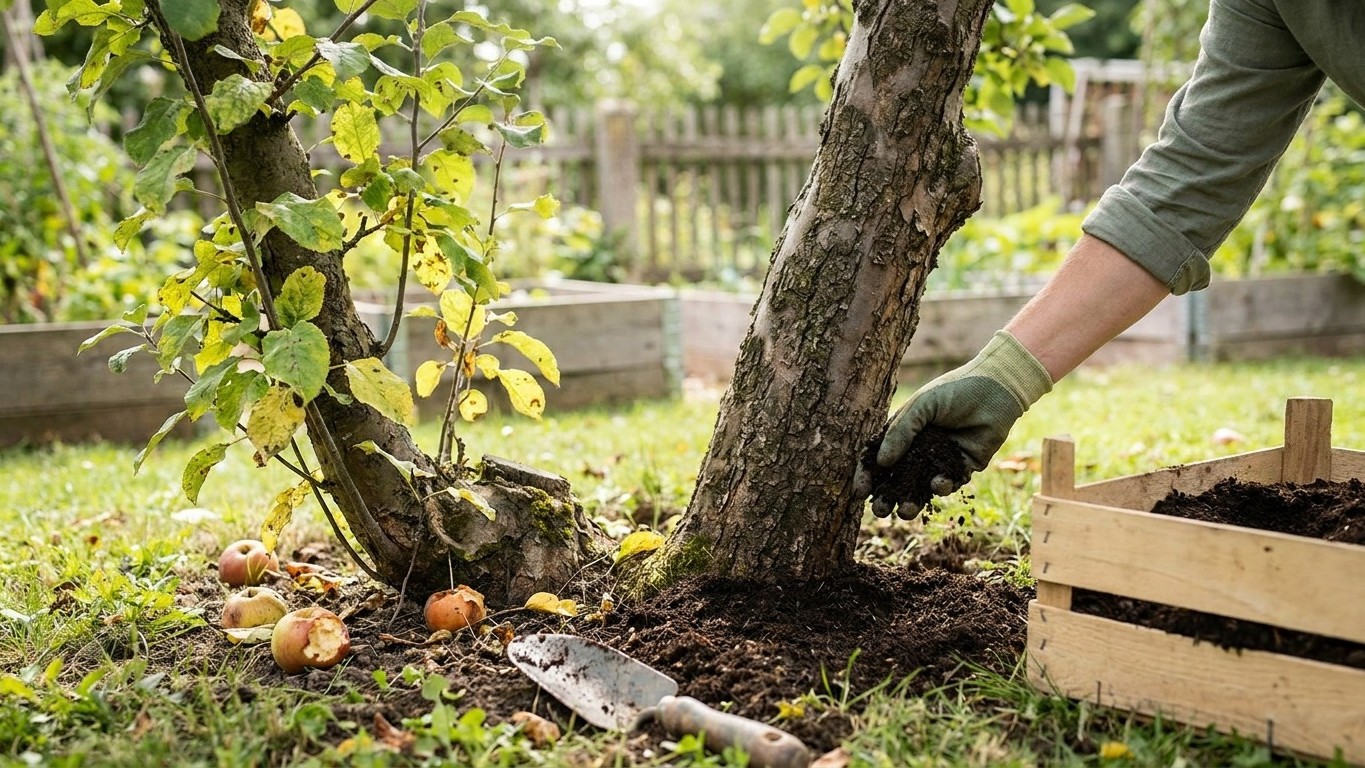

Dormancy through green tip is the narrow stretch when a handful of nitrogen actually does something useful for an apple tree — before buds swell, before leaves start competing with roots for what you’ve just spread. Miss that window and timing stops mattering less than age does: a young tree still building its scaffold branches wants that nitrogen to bulk up wood for pruning, while a tree already cropping well usually doesn’t need it at all, and feeding it anyway is how healthy trees get hurt.
Why it matters
A young tree, in its first three or four years of building scaffold branches, needs enough nitrogen to put on the season’s growth that winter pruning will later shape. Skip feeding at that stage and the tree grows slowly, dragging out the years before it fills its framework. Once a tree starts bearing fruit, the calculus flips. A mature, cropping tree rarely benefits from routine feeding, and the trees most often damaged by fertilizer are ones that were already growing just fine without it.
The stage that matters is dormancy through green tip, before the buds have swollen open. That’s when roots take up nitrogen without competing against active leaf or flower growth, and it’s the only window where feeding actually lines up with what the tree can use rather than working against it.
Rootstock decides how much tree you’re feeding
The rootstock, not the variety grafted onto it, fixes how large the tree gets and how much root system is drawing on the soil. USU Extension’s Apple Production and Variety Recommendations for the Utah Home Garden lists mature heights by rootstock:
| Rootstock | Mature height (USU Extension) | Typical vigor class |
|---|---|---|
| M.9 | 8-12 feet | Dwarfing |
| M.26 | 12-15 feet | Dwarfing |
| G.11 | 12-15 feet | Dwarfing |
| G.30 | 18-20 feet | Semi-dwarf |
| M.7 | 18-20 feet | Semi-dwarf |
| M.106 | 25-30 feet | Semi-vigorous |
| MM.111 | 30-35 feet | Vigorous |
| Seedling | 35-40 feet | Vigorous |
A tree on a dwarfing rootstock like M.9 carries a small root system relative to its crop load, so it responds fast to nitrogen, for better or worse. A tree on MM.111 or a seedling rootstock has enough root volume to scavenge most of what it needs from ordinary garden soil and rarely needs supplemental feeding once established. If you’re still choosing a rootstock, that decision belongs upstream of feeding, back in Growing Apples.
When to do it
Feed at dormancy or at green tip, the stage when buds swell and show just a ring of green at the tip, before they open into leaf or blossom. Wait until pink, when the unopened flower buds show color, or into bloom itself, and the fertilizer arrives right as the tree should be putting its energy into flowers and fruit set instead of new shoots.
What moves that window is the same thing that moves every other stage on the tree: a cold spring holds bud swell back for weeks, a warm one pulls it forward just as fast. A fixed date is useless here. Walk out and look at the buds instead of checking a calendar, because the stage tells you the day and the calendar never does.
Established trees run on last year’s growth, not this year’s plan
For a tree past its third or fourth leaf, the better guide is what happened last season, not what’s coming. Look at the shoot growth from the previous year on the leaders: short, stubby growth points toward a real shortfall, while long, whip-like shoots with few flower buds point toward too much nitrogen already in the soil. If growth looked normal and the tree cropped well, skip feeding that year entirely.
A soil test through your extension service, not a yearly habit, should decide whether the tree needs anything added at all. And if the tree was pruned hard that winter, hold off on nitrogen, since a heavy pruning cut already signals the tree to push new growth on its own. See Pruning an Apple Tree in Winter: Where to Cut for what counts as a hard cut versus a light one.
How to do it

Start with a soil test before you assume a shortfall exists. A tree already growing in the soil an apple tree needs, with decent organic matter and drainage, often needs nothing added at all, and a test is the only way to know instead of guess.
Reading the tree before you feed it
Walk the tree in late winter and look at last season’s growth before you decide anything. Pale, small leaves and thin, short shoots suggest the tree is running short on nitrogen. Dark green leaves on long, vigorous shoots with almost no flower buds suggest the opposite, and feeding that tree again would only make the imbalance worse.
Applying it
- Broadcast fertilizer evenly under the branch spread, starting a foot or two out from the trunk and continuing to just past the drip line, where the feeder roots actually sit.
- Keep it off the trunk itself. Fertilizer piled against bark holds moisture against the collar and invites rot.
- Water it in if rain isn’t due soon, so the nutrients move down into the root zone instead of sitting on dry surface soil.
- Match the footprint to the rootstock. A tree on M.9 spreads its roots across a far smaller circle than one on MM.111 or a seedling rootstock, so feed a correspondingly smaller area rather than the same blanket circle for every tree in the row.
Once it’s down and watered in, the job is finished until next dormancy. There’s no benefit to a second application later in the season on an established tree, and as the next section covers, a second round is usually where the damage starts.
What goes wrong
Long, whip-like shoots with dark green leaves and almost no flower buds the following spring are the classic sign of too much nitrogen on a tree that didn’t need feeding at all. That soft new growth is also exactly what fire blight bacteria infect first, so an over-fed tree in a wet bloom season can lose whole branches to a disease that a leaner tree would have shrugged off.
Feeding right at planting is a second common mistake. A newly planted tree has almost no root system to take up fertilizer, and concentrated nitrogen sitting near bare or newly settled roots can scorch them before the tree has even started growing, showing up as brown, crisped leaf margins within a couple of weeks. Wait a full growing season before feeding a newly planted tree at all.
Late feeding and biennial bearing
Fertilizer applied after bloom or during petal fall pushes a flush of late, soft growth that hasn’t hardened off by the time cold weather arrives, and that unhardened wood is what dies back first in a hard winter. It also draws energy away from the fruit already set on the tree, which shows up as smaller apples at harvest.
Underfeeding shows up differently: pale, small leaves, thin annual shoot growth, and a tree that swings between a heavy crop one year and almost nothing the next. That alternating pattern, known as biennial bearing, has other causes too, particularly a heavy crop left unthinned, but a genuinely starved tree makes it worse because it lacks the vigor to build flower buds for the following year even after a light crop.
Piling fertilizer against the trunk is the mistake that costs a tree rather than a crop. It holds nitrogen and moisture against the bark, and the collar rot that follows can girdle and kill a young tree outright.
What changes where you are
The stages here, dormancy, green tip, pink, bloom, petal fall, hold everywhere apples grow. What shifts by climate is how long the tree sits at each stage, how much organic matter is already in the soil, and how much of any nitrogen you apply actually stays in the root zone instead of washing straight through.
Soil and rootstock together decide the schedule
Sandy, fast-draining soil holds far less nitrogen between rains than a heavier loam does, so a tree growing in it may need a split application, part at dormancy and part after fruit set, rather than one feeding for the whole year. Soil already rich in organic matter from years of mulching or compost may need no supplemental nitrogen at all, and a soil test settles that question far better than a guess. The Soil an Apple Tree Needs, and Drainage Above All covers how to judge what you’re starting with before you add anything.
Rootstock choice interacts with climate too. A vigorous rootstock like MM.111 or a seedling tree carries more reserve through a hard winter or a dry year than a dwarfing rootstock like M.9 or G.11 does, which is one more reason the smaller trees need closer watching rather than heavier feeding. Check with your own state extension service for the chill hours, frost dates and soil conditions specific to your county before settling on a feeding schedule, since none of those figures hold the same from one region to the next.
Common questions
Can I fertilize a tree I just planted this spring?
Hold off for the first full growing season. A newly planted tree has a limited root system, and fertilizer applied too close to bare or newly settled roots can scorch them before the tree has a chance to establish. Water it well instead, and save feeding for the following dormancy or green tip stage.
My tree is loaded with leaves but hardly any blossoms. Is that a feeding problem?
It often is. Heavy leaf growth with few flower buds is the classic sign of too much nitrogen, usually from feeding a tree that didn’t need it in the first place. Skip feeding entirely next year and watch whether flowering recovers before changing anything else.
Do I need to feed my apple tree every year?
No, and most established trees don’t. Base the decision on a soil test and on how much the tree actually grew the previous season, not on a yearly habit. A tree cropping well with moderate shoot growth needs nothing added.
Can I use the same fertilizer rate on a dwarf tree and a full-size one?
No. A tree on a dwarfing rootstock such as M.9 or M.26 has a much smaller root system than one on a vigorous rootstock like MM.111 or a seedling, so the rate that suits a full-size tree can overwhelm a dwarf one. Scale the amount and the footprint to the tree’s actual root spread, not to a single blanket rate for the whole orchard.