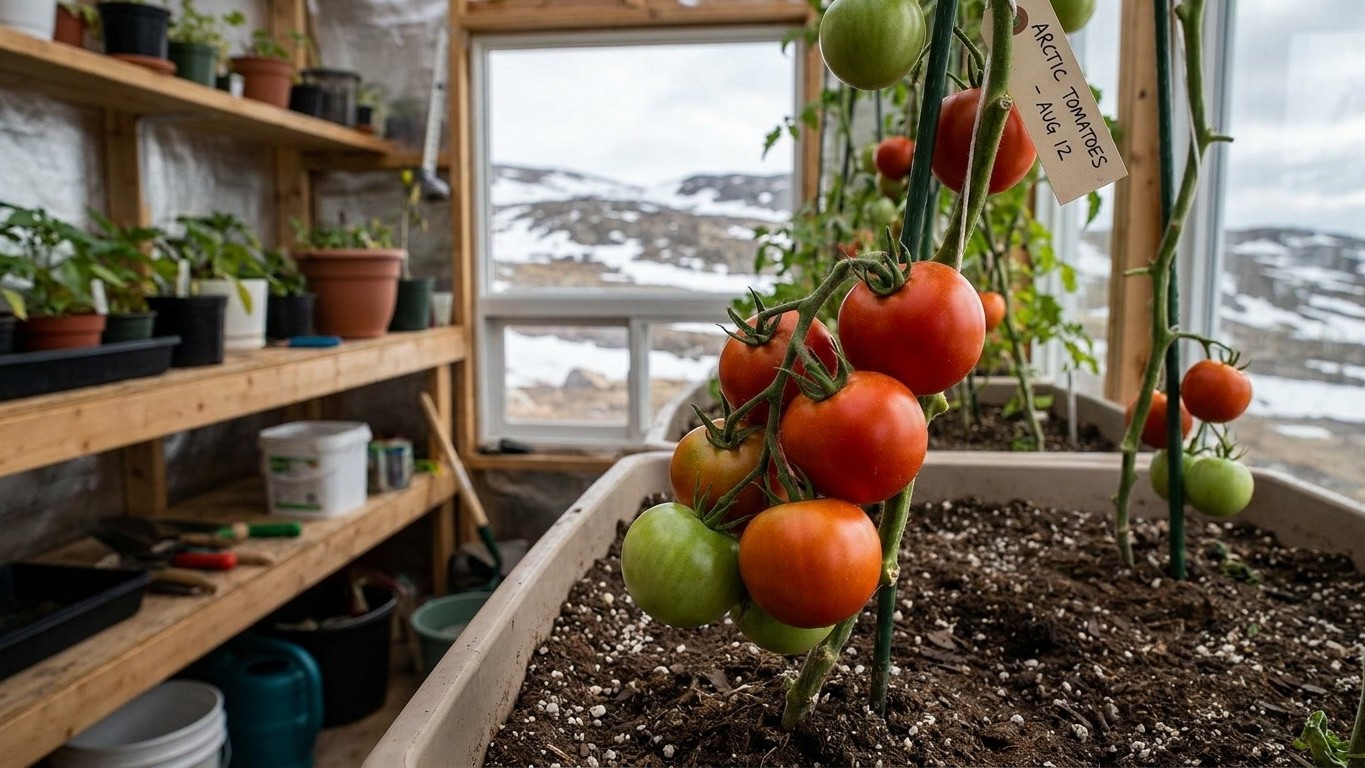

Tomatoes can be grown in Nunavut, but only with a head start indoors and a season-extending structure outside. Environment and Climate Change Canada’s 1981-2010 Canadian Climate Normals for Rankin Inlet A put the average frost-free window at just 85 days, running from a mean last spring frost on June 19 to a mean first fall frost on September 13. Start seed indoors in mid-to-late May, and plan to transplant into a warmed bed or greenhouse in early July, choosing from Tomato Varieties That Ripen in Time in Nunavut that ripen in under 65 days from transplant.
When to plant Tomatoes in Nunavut

Every date in this section comes from one weather station: Rankin Inlet A, on the west coast of Hudson Bay, tracked by Environment and Climate Change Canada over the 1981-2010 period. The station’s Canadian Climate Normals put the average last spring frost at June 19 and the average first fall frost at September 13, for an average frost-free season of 85 days. Communities farther north or away from the coast, and inland sites at higher elevation, run colder and later than Rankin Inlet. Treat every figure here as a starting point to check against your own community’s conditions, not as a fact that applies territory-wide.
The June 19 figure is a mean, not a promise. Environment and Climate Change Canada calculates it as the midpoint of decades of frost records, which means in roughly half of those years, the last frost actually fell after June 19. That is why the catalog set-out guidance for every tomato variety in this piece is early July, not mid-June. Waiting two extra weeks past the mean date buys a buffer against the year when frost lingers, and it also gives the soil time to warm past the point where tomato roots stall.
Counting back to a seed-starting date
Tomato seed is typically started 6 to 8 weeks before transplanting outdoors, a rule that holds regardless of latitude because it reflects how fast a tomato seedling develops true leaves and a workable root system. Tomato Planting Dates in Nunavut: Counting Back From Your Frost Window shows that an early July transplant date puts indoor sowing at mid-to-late May. That is a narrow window, so mark it on a calendar as soon as you have decided which variety you’re growing, since starting even a week late eats directly into the margin before the mean September 13 frost.
Hardening off matters more here than in milder climates. Seedlings raised entirely indoors under grow lights need 7 to 10 days of graduated outdoor exposure, and this is also the moment to start watching for early signs of trouble covered in Tomato Pests in Nunavut, since young plants first exposed to outdoor conditions are especially vulnerable.ure, starting with an hour in a sheltered, shaded spot and building up to a full day, before they go into the ground or a greenhouse bed permanently. Wind is the bigger stressor in Nunavut, more than cold, so choose a hardening-off spot with a windbreak. Skipping or shortening hardening off is the single most common reason transplants stall for two weeks after going out, and two weeks is exactly what a short-season variety like Sakura or Edox cannot spare.
Because the frost-free season averages only 85 days at Rankin Inlet, most successful Nunavut tomato growing happens under some kind of cover: a hoop house, a small polytunnel, or a heated greenhouse rather than open ground. For a sense of how different this timeline looks farther south, Growing Tomatoes in Ontario: Planting Dates, Varieties and Ripening Before Frost covers a season several times longer, and the contrast is worth reading if you are used to gardening advice written for temperate zones. Broader growing notes for other crops suited to short Arctic seasons are gathered in our Nunavut guides.
Soil and site preparation
Full sun is non-negotiable, but in Nunavut “full sun” also means near-continuous daylight around the summer solstice, which helps photosynthesis but does not by itself raise soil or air temperature. Site your bed or greenhouse against a south-facing wall or a light-colored, reflective surface that bounces extra heat back onto the plants, and put a solid windbreak between the tomatoes and any open exposure. Wind chill does more damage to young tomato foliage here than a few degrees of air temperature.
Native tundra soils are shallow, cold, and frequently sit over a permafrost table that keeps roots wet and chilled even in July. Raised beds or large containers filled with imported, compost-rich growing medium outperform in-ground beds almost everywhere in the territory, because they warm faster in spring and drain away meltwater that would otherwise pool above the frozen subsoil. A bed depth of at least 12 inches gives tomato roots room to run without hitting cold, saturated ground.
Work compost or well-aged manure into the growing medium two to three weeks before transplanting, not on planting day, so the material has time to stabilize and stop competing with roots for nitrogen as it finishes breaking down. Laying black plastic or landscape fabric over the bed for those same two to three weeks warms the soil several degrees before the tomatoes ever go in, which matters more here than almost anywhere else covered on this site.
Space indeterminate varieties 24 to 36 inches apart if you are growing more than one plant in a bed, since the growing season is too short to recover from the disease pressure that crowding invites. Determinate, bushier types can sit closer, but give every plant its own container if you are growing in pots, since shared containers dry out and compete for the limited daylight-driven growth window.
Varieties that suit Nunavut
With an average of only 85 frost-free days at Rankin Inlet, the trait that matters most is days to maturity counted from transplant, not from seed. A variety that needs 72 days from transplant to first ripe fruit is using nearly the entire average season just to produce its first tomato, leaving no room for a cold week or a late spring. Varieties rated 55 to 60 days from transplant carry the most real margin against the mean September 13 frost, while anything past 65 days should only be attempted under a heated greenhouse or with black plastic and a tunnel adding extra weeks of warmth.
Disease resistance matters differently here than in a humid, pest-heavy garden. Greenhouse growing concentrates humidity and can favor fungal problems like early blight even in a climate too cold for most field pathogens, so resistance codes on the seed packet are still worth checking. Determinate varieties tend to hold up better to wind and take up less vertical space in a small hoop house, while indeterminate varieties need a trellis or stake system but keep producing as long as the season allows.
The table below shows the catalog days-to-maturity figure for each variety alongside the transplant timing and first-ripe estimate calculated for this territory: transplanting in early July and counting forward by the catalog’s days-to-maturity number. These are catalog figures, and they shift by a week or two either direction depending on how warm the actual season runs, so treat “first ripe” as a range, not a date.
| Variety | Days to maturity | Type | Notable resistance | Margin before mean frost |
|---|---|---|---|---|
| Sakura | 55 | Indeterminate | Nematodes, Tomato Mosaic Virus, Fusarium Wilt 1&2 | ~17 days |
| Edox | 55 | Indeterminate | Nematodes, Tomato Mosaic Virus, Fusarium Wilt 1&2 | ~17 days |
| Valentine | 55 | Indeterminate | Early Blight (intermediate) | ~17 days |
| Glacier | 55 | Determinate | None listed | ~17 days |
| Sun Gold | 57 | Indeterminate | Tobacco Mosaic Virus, Fusarium Wilt 1 | ~15 days |
| Supersweet 100 | 60 | Indeterminate | Verticillium Wilt, Fusarium Wilt 1 | ~12 days |
| Juliet | 60 | Indeterminate | Late Blight, Early Blight (intermediate) | ~12 days |
| Jasper | 60 | Indeterminate | Late Blight (high), Early Blight (intermediate) | ~12 days |
| Black Cherry | 64 | Indeterminate | None listed | ~8 days |
| Amalfi | 68 | Determinate | Nematodes, Late Blight, Early Blight | ~4 days |
| Cherokee Purple | 72 | Indeterminate | None listed | 0 days |
| Big Beef Plus | 72 | Indeterminate | Nematodes, Gray Leaf Spot, Tomato Mosaic Virus | 0 days |
| Firebird | 72 | Determinate | Gray Leaf Spot, Alternaria Stem Canker, Tomato Spotted Wilt Virus | 0 days |
| STM 2255 | 72 | Determinate | Gray Leaf Spot, Alternaria Stem Canker, Tomato Spotted Wilt Virus | 0 days |
Cherry and small-fruited types dominate the low end of that table for a reason: Sakura, Edox, Sun Gold, Supersweet 100 and Black Cherry all set fruit quickly and ripen in clusters, which suits a season where you want a harvest window rather than one big flush. Larger slicers like Cherokee Purple and Big Beef Plus are worth attempting only in a heated greenhouse or with extra weeks of warmth.
What to plant alongside
Basil is the companion most often paired with tomatoes, and the honest answer is that the evidence for pest deterrence is thin, though the two plants share water and feeding needs closely enough that growing them in the same bed or container causes no real conflict. If you are growing tomatoes in a small greenhouse in Nunavut, basil is a reasonable use of the same warm, sheltered space rather than a pest-control strategy.
Marigolds draw in pollinators and are sometimes credited with suppressing root-knot nematodes in soil, an effect shown mainly in Warm-Climate field trials rather than in cold-climate containers, so treat it as a modest, unproven bonus rather than a reason to plant them. Borage is claimed to improve tomato flavor and vigor by folklore alone. There is no controlled evidence behind that claim, though borage does draw pollinators, which matters more in Nunavut than in most gardens since wild bee activity is limited and short-lived, and greenhouse-grown tomatoes especially benefit from any extra pollinator traffic or from hand-pollination with a small brush.
- Good neighbors: basil, marigold, borage, chives (share space without competing for the same soil resources)
- Avoid nearby: potatoes and other nightshades (share blight and pest pressure), brassicas like cabbage and kale (heavy feeders that compete for the same nutrients in a small bed)
In a greenhouse or hoop house setting, which is how most tomatoes in this territory actually get grown, companion planting matters less for pest confusion and more for making efficient use of scarce heated growing space. Fill gaps between tomato plants with quick, shallow-rooted crops rather than anything that competes hard for the same warmth and light.
Watering, feeding and support
Raised beds and containers dry out faster than in-ground plots, and the nearly continuous summer daylight at this latitude pushes water use higher than a grower used to temperate zones would expect. Water deeply at the base of the plant rather than little and often, aiming to wet the full root depth and then letting the top inch of medium dry before watering again. A drip line or soaker hose set on a timer removes the guesswork, especially useful if you cannot check the greenhouse daily.
Feeding on a short timeline
Apply a balanced fertilizer at transplant to get roots established, then shift to a phosphorus-and-potassium-leaning feed once flowers appear, since excess nitrogen late in the season pushes leafy growth at the expense of fruit set, a trade you cannot afford when every one of the varieties in the table above is racing a mean frost date. Feed every two weeks through the growing period rather than once at the start, since containers and light growing media leach nutrients faster than garden soil.
Mulch the surface of the bed once the soil has fully warmed, using black plastic if you are also using it to warm the soil pre-transplant, or straw once temperatures are reliably up, to hold moisture and buffer root temperature against the swings that come with 24-hour daylight and clear Arctic nights.
Every indeterminate variety in the table above, Sakura through Black Cherry, needs a stake, cage or trellis string from early in its life, since indeterminate plants keep growing and setting fruit until frost stops them and will sprawl and rot on the ground otherwise. The determinate types, Glacier, Amalfi, Firebird and STM 2255, stay more compact and manage with a simple cage, which also gives them better wind resistance in an exposed site. Remove suckers, the small shoots that form in the joint between the main stem and a leaf branch, on indeterminate varieties throughout the season. Pruning suckers redirects the plant’s limited energy into ripening the fruit already set rather than growing more foliage it will not have time to turn into a harvest.
Common problems

Blossom end rot
Blossom end rot shows up as a flat, sunken, brown-to-black patch on the bottom of the fruit while the rest of the tomato looks healthy. It comes from a calcium delivery problem, almost always tied to inconsistent watering rather than a true calcium shortage in the soil. In Nunavut’s container and raised-bed growing, uneven watering is common because growing media dries faster than garden soil, so the fix is a steady watering rhythm rather than a calcium supplement.
Cracking
Cracks radiating from the stem end or circling the shoulder of the fruit happen when a dry spell is followed by a sudden heavy watering or a rain event, and the fruit’s flesh grows faster than its skin can stretch. Even watering, and picking fruit as soon as it colors rather than leaving it to fully ripen on the vine during a wet stretch, both reduce cracking.
Poor fruit set
Tomato flowers need nighttime temperatures in a fairly narrow band to set fruit, and cold nights, common through most of the growing season this far north, are the most likely cause of flowers dropping without ever becoming a tomato. A greenhouse or tunnel buffers this better than open ground. Because pollinator traffic is thin in the Arctic summer, gently shaking flowering trusses by hand, or brushing them with a small paintbrush, once a day improves pollination in a sheltered structure where wind cannot do the job for you.
Wilt and leaf disease
Wilting that starts with yellowing on the lower leaves and moves upward often points to a soilborne fungus like fusarium or verticillium, both of which persist in growing media reused year after year. This is exactly why the resistance codes in the variety table matter: Sun Gold, Sakura, Edox and Supersweet 100 all carry fusarium resistance, which removes one entire failure mode from the list of things that can go wrong in a short season you cannot afford to lose.
Aphids and whitefly
Small, soft-bodied aphids clustering on new growth and the undersides of leaves, or tiny white insects that flutter up when a leaf is disturbed, are the pests most likely to build up inside a warm, sheltered greenhouse, since the same structure that protects tomatoes from cold also protects pests from the cold that would otherwise kill them outdoors. Check the undersides of leaves weekly, and treat early with insecticidal soap, since a greenhouse infestation left unchecked spreads faster than an outdoor one would.
Ripening before the frost comes back
This is the question that decides whether a Nunavut tomato crop succeeds at all. Environment and Climate Change Canada’s Rankin Inlet A normals put the average frost-free season at 85 days, bookended by a mean last spring frost on June 19 and a mean first fall frost on September 13. Transplanting in early July, as recommended above to buffer against a late spring frost, already uses up roughly two of those weeks before a single tomato plant is even in the ground, leaving something closer to 10 to 11 weeks of real growing time before the mean fall frost arrives.
Set against that window, the catalog days-to-maturity figures in the table above sort cleanly into two groups. Varieties rated 55 to 60 days from transplant, Sakura, Edox, Valentine, Glacier, Sun Gold, Supersweet 100, Juliet and Jasper, finish with 12 to 17 days of margin before the mean frost date, enough buffer to absorb a cooler-than-average July without losing the crop entirely. Black Cherry, at 64 days, lands with about 8 days to spare, still workable but tighter.
Amalfi, at 68 days, finishes only about 4 days ahead of the mean frost date, and the four 72-day varieties, Cherokee Purple, Big Beef Plus, Firebird and STM 2255, finish with essentially zero margin against that mean. Remember that a mean frost date is not a guarantee. In roughly half of all years the actual first fall frost at Rankin Inlet lands after September 13, but in the other half it lands before it, which means a zero-margin variety is a coin flip on whether it ripens at all in an average year, and a loss in a colder one.
Three things buy extra weeks against that math: starting seed indoors slightly earlier than the 6-to-8-week rule to get a larger transplant into the ground the moment conditions allow, covering the bed with black plastic and a low tunnel to add several degrees of soil and air warmth through the season, and moving the whole operation into a heated greenhouse where the outdoor frost dates barely apply. Growers further south working with a season several times longer face a different version of this same calculation, laid out in Growing Tomatoes in Alberta: Planting Dates, Varieties and Ripening Before Frost, where the margins are measured in months rather than days.
Harvest and end of season
Pick tomatoes as soon as they show full color rather than waiting for them to soften on the vine, since fruit left out through a cold Arctic night loses flavor and texture even if it survives the temperature. A tomato that has started to blush, even lightly, will keep ripening indoors at room temperature and does not need to reach full color outdoors to finish well.
Ripening indoors
Lay mature green or blushing fruit in a single layer, stem end up, somewhere at normal room temperature and out of direct sun, checking every day or two and pulling ripe fruit as it colors. A few fruits placed near a ripe banana or apple speed the process, since those fruits release ethylene gas that pushes tomatoes toward ripeness faster.
As the season winds down and the calendar approaches Environment and Climate Change Canada’s mean first fall frost date of September 13 for the Rankin Inlet area, watch the forecast rather than the date itself, since that figure is an average and the actual frost in any given year can arrive well before or after it. When a hard frost is forecast, strip the plant of every mature green fruit, even fully unripe ones the size of a golf ball, since a frozen tomato on the vine is a lost tomato, while the same fruit brought indoors still has a reasonable chance of ripening over the following weeks.
At the true end of season, pull spent plants from beds and containers rather than leaving them to break down in place, since Nunavut’s cold, slow decomposition means diseased plant matter can persist through winter and reinfect the same growing medium the following year. Clean containers and any greenhouse surfaces before storing them for winter.
Local help
Nunavut does not run a standalone provincial extension office with its own public site, so for general growing guidance and information on soil testing, check Agriculture and Agri-Food Canada’s site. For frost dates and growing conditions specific to your own community, your local hamlet office or a nearby community greenhouse society is usually the more current source.
Common questions
Can I grow tomatoes outdoors in Nunavut without any kind of cover?
It is possible in a very sheltered, south-facing microclimate, but the odds are against you. With an average frost-free season of only 85 days at Rankin Inlet, and cool nights common even in July, open-ground tomatoes struggle to set fruit reliably. Most successful Nunavut tomato crops come out of a greenhouse, hoop house or at minimum a cold frame.
What happens if my last frost runs later than June 19 this year?
Nothing catastrophic, since June 19 is only the average last frost date recorded at Rankin Inlet, and roughly half of all years run later than that. This is exactly why the transplant guidance in this piece points to early July rather than right after the mean date, building in a buffer for the years frost lingers.
Do I need to start seed indoors even for the fastest varieties like Sakura or Edox?
Yes. Even a 55-day variety needs those days counted from transplant, not from seed, and direct-sown tomato seed in Nunavut’s climate would never accumulate enough warm days to reach transplant size before the season closed. Starting indoors 6 to 8 weeks ahead of an early July transplant is standard practice regardless of how fast the variety matures.
Will a heated greenhouse let me grow any variety I want?
A heated greenhouse removes the outdoor frost date from the equation almost entirely, which does open the door to longer-season varieties like Cherokee Purple or Big Beef Plus that show zero margin against the mean outdoor frost date. It does not remove the need for adequate light, since a greenhouse with poor light exposure through Nunavut’s shifting daylight hours will still produce weak, slow-fruiting plants regardless of temperature.
My tomato plant grew huge leaves but barely any fruit. What went wrong?
This usually points to too much nitrogen relative to phosphorus and potassium, which pushes the plant into leafy growth at the expense of flowering and fruit set. It can also follow from consistently cold nights preventing pollination even when flowers are present. Cut back on high-nitrogen feed once flowering starts, and if you’re growing under cover, try hand-pollinating flower trusses to rule out a pollination gap.
Related guides
- Growing Tomatoes in Northwest Territories: Planting Dates, Varieties and Ripening Before Frost
- Growing Tomatoes in Manitoba: Planting Dates, Varieties and Ripening Before Frost
- Growing Tomatoes in Ontario: Planting Dates, Varieties and Ripening Before Frost
- When to Pick Tomatoes in Nunavut, and Ripening the Rest
- Nunavut Planting Calendar
- The Nunavut Apple Calendar, Stage by Stage