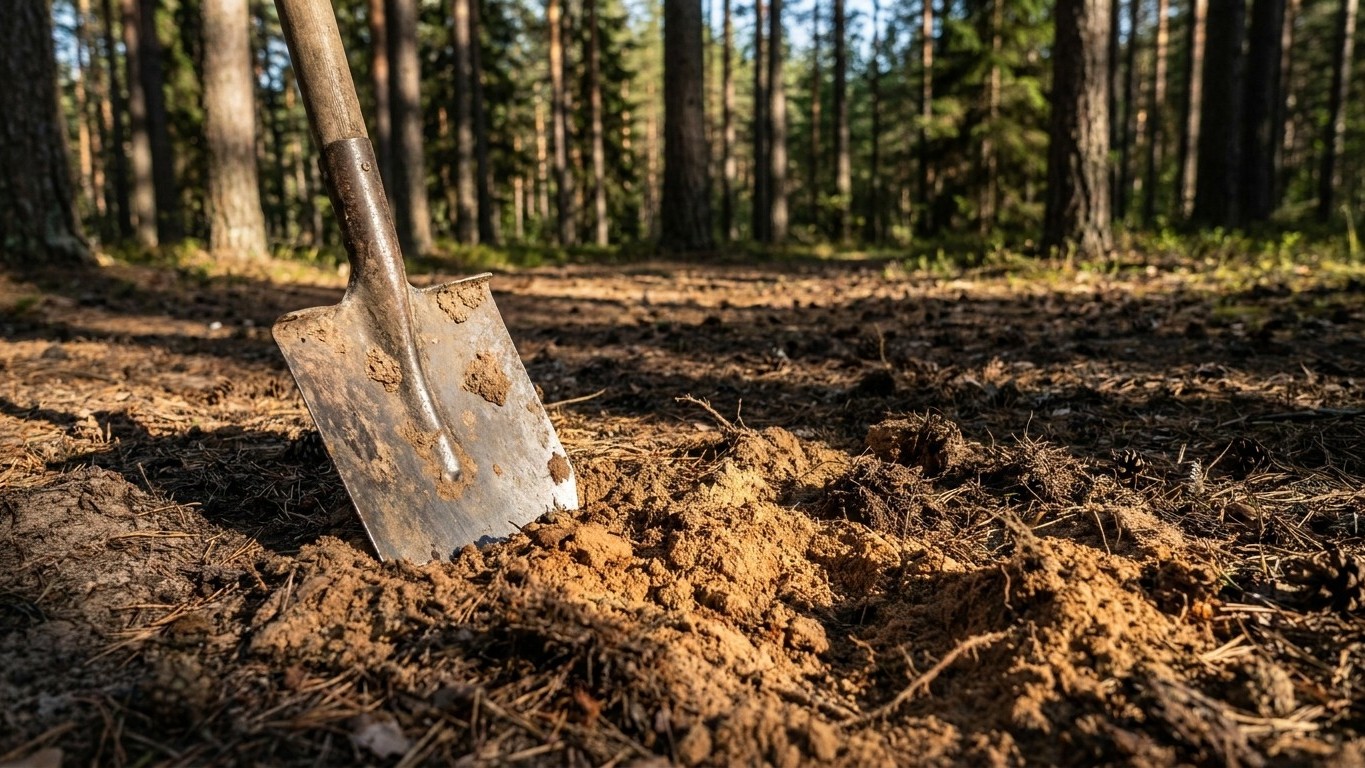

Dig a shovel into ground almost anywhere in the Lower Peninsula’s pine country and there’s a decent chance you’re standing on a cousin of the Kalkaska series, Michigan’s official state soil. It’s sandy, acid, and drains fast. But your backyard might be nothing like it, so here’s how to find out what’s actually under your boots.
What is under your garden

Michigan’s state soil is the Kalkaska series, a Spodosol formed under conifer forests over thousands of years of leaching. Cold winters, sandy parent material left behind by glaciers, and a heavy needle-drop combined to strip minerals downward, leaving a soil that’s easy to dig but stingy with nutrients unless you feed it.
The numbers USDA soil scientists have measured on the surface horizon of the major Kalkaska components are specific, and worth knowing exactly as recorded, not rounded off:
| Reading | Value |
|---|---|
| Surface pH | about 4.7 (strongly acid) |
| Sand | 86 percent |
| Clay | 5 percent |
| Silt | 9 percent |
| Organic matter | about 75.0 percent |
| Drainage class | somewhat excessively drained |
That organic-matter figure looks startling next to a typical garden bed, and there’s a reason for it. This reading comes from the mapped surface of a natural forest floor, which in the Kalkaska series is often a thin, undisturbed litter layer, not a cultivated topsoil. A vegetable bed that’s been tilled, planted, and fed for a few seasons will never carry that much organic matter. Treat the figure as a description of undisturbed forestland, not a target for your raised bed.
Here’s the honest caveat that matters more than any single number: Kalkaska is the soil chosen by Michigan law in 1990 to represent the state, not a prediction of what’s under your tomatoes. Michigan holds hundreds of mapped soil series. River-bottom ground along the Grand or the Kalamazoo runs heavier and often less acid. Southern Michigan farmland sits on soils with far more clay. And if a builder ever scraped, graded, or filled your lot, the layer you’re now gardening in may bear no resemblance to any natural series at all. It’s construction subsoil with a lawn on top.
Read your own soil in five minutes
Two quick checks tell you more about your actual garden than any state average. First, the ribbon test: take a moist handful of soil, squeeze it between thumb and forefinger, and push it upward into a ribbon. Sandy soil won’t hold a ribbon at all and feels gritty. Clay-rich soil forms a long, smooth ribbon over an inch or two before breaking. Second, the jar test: fill a clear jar a third full of soil, top it with water, shake hard, and let it sit overnight. Sand settles first and forms the bottom layer, silt settles next, and clay stays suspended longest, forming a thin cap on top. The thickness of each layer, compared by eye, tells you roughly what you’re working with.
Testing before you amend
Guessing at soil amendments is one of the most common ways gardeners waste money and time. Dumping lime on ground that’s already neutral, or piling on sulfur where it isn’t needed, can push a soil in the wrong direction and leave nutrients locked up for a full growing season. A lab test costs little and tells you what your eyes simply can’t: exact pH, available phosphorus and potassium, and often organic matter content.
Given the regional pattern, a Michigan gardener working sandy, wooded, or previously forested ground can reasonably expect acidic conditions somewhere in the same direction as that state soil reading. But expecting isn’t knowing, and plenty of Michigan yards, especially those built on old farm fields or lakebed clay, sit at a very different pH entirely.
Sampling correctly matters as much as sending the sample in at all. Follow these steps standing in the garden with a trowel:
- Pick 8 to 10 spots scattered across the bed or lawn area, avoiding spots right next to a foundation, driveway, or old brush pile.
- At each spot, dig a small core down to about 6 to 8 inches, the depth where most vegetable and lawn roots actually feed.
- Drop each core into a clean plastic bucket, breaking up clumps and removing rocks, mulch, and roots as you go.
- Mix the cores together thoroughly so no single spot dominates the sample.
- Pull out about two cups of the mixed soil, let it air dry if it’s wet, and bag it for the lab with your garden’s location and current use noted.
The results come back with a pH number, nutrient levels, and usually a plain-language recommendation. That single sheet of paper replaces every guess with a number specific to your own dirt.
Amending it
Michigan’s soils split into two very different camps, and the right fix depends entirely on which one you’re standing in. There’s no single “Michigan fix,” only a direction pointed at by your test results.
If your soil tests acid, below about 5.5
This is the territory the state soil itself sits in, at a strongly acid 4.7. On ground like this, lime is the lever, not sulfur. Sulfur would only push an already-acid soil further in the wrong direction. Acid soil locks up phosphorus so plants can’t use it even when it’s present in the ground, and it makes life hard for brassicas like broccoli and cabbage, which prefer conditions closer to neutral. Lime raises pH gradually as it reacts with soil moisture, and it works over seasons, not weeks. Apply it in fall so it has all winter to break down before spring planting.
If your soil tests alkaline, above about 7.3
On this ground, lime must never be applied. It would only make an already high pH worse. The slow, honest route here is elemental sulfur combined with regular additions of organic matter, both of which nudge pH downward gradually. High pH locks iron out of reach of plant roots, and that’s exactly what yellow leaves with dark green veins, especially on shrubs and trees, are telling you. That’s iron chlorosis, and it’s a pH problem wearing a nutrient-deficiency disguise.
If your soil is heavy clay
The fix is organic matter, worked in a little at a time over multiple seasons. Never add sand to clay hoping to lighten it; the two combine into something closer to concrete than loam. Never work clay soil while it’s wet, since that compacts it into clumps that can take years to break down. Expect this correction to take two to three seasons before the texture noticeably improves.
If your soil is sandy, like the Kalkaska series itself
Organic matter again does the heavy lifting, holding water and nutrients that would otherwise wash straight through. Because sandy soil drains so fast, plan on shorter, more frequent watering rather than deep occasional soaks. A single season of compost additions can make a visible difference in a sandy bed’s ability to hold moisture, faster than clay ever improves.
Drainage and compaction
Water tells you almost everything about a soil’s character, and the Kalkaska series is rated somewhat excessively drained, meaning water passes through it quickly and rarely lingers. Gardens on similar sandy ground rarely puddle after rain, but they also dry out fast enough to stress shallow-rooted plants during a dry July.
Testing your own drainage takes twenty minutes. Dig a hole about a foot deep and a foot wide, fill it completely with water, and let it drain once. Then fill it a second time and time how long it takes to drop. A drop of an inch or more per hour suggests good drainage suited to most garden plants. Slower than that, and you’re dealing with a soil that holds water longer than most vegetables prefer.
Compaction is a separate problem from drainage, though the two often show up together. Repeated foot traffic, riding mowers, and heavy equipment press soil particles together, squeezing out the air pockets roots need. Double digging, once the standard fix, has fallen out of favor because it disturbs soil biology and often compacts the layer just below where the shovel stops. On soil that’s both compacted and poorly drained, a raised bed is frequently the more honest answer than years of amendment. Sometimes it’s simply the better bet, and there’s no shame in admitting the native ground won’t cooperate on a garden’s timeline.
What the drainage class means in practice:
- On excessively drained sandy ground: water more often, add organic matter, and choose drought-tolerant plants for the driest corners.
- On slow-draining, compacted ground: avoid walking on garden beds, add coarse organic matter, and consider raised beds for anything shallow-rooted.
- For plants that hate wet feet, like most root vegetables: skip low spots entirely and move them to the highest, best-drained part of the yard.
Local help
Michigan State University Extension runs the state’s soil testing program through its outreach network, and a standard test remains an affordable way to get a real number instead of a guess. Samples typically go through a partner lab, and county offices help interpret the results with the gardener directly rather than just mailing back a form. Find your nearest office through the MSU Extension outreach directory.
Common questions
Is all Michigan soil sandy and acidic like the state soil?
No. The Kalkaska series represents forested, sandy regions, but southern Michigan farmland and river-bottom areas often carry more clay and a higher pH. Only a local soil test confirms what’s actually under your own garden.
How often should I retest my soil?
Every two to three years for an established garden, or yearly while you’re actively correcting a pH problem, since amendments like lime and sulfur take time to show their full effect.
Can I skip testing and just add compost every year?
Compost helps almost any soil and rarely causes harm, but it won’t fix a serious pH imbalance on its own. Testing tells you whether you also need lime, sulfur, or a specific nutrient.
Why does my soil feel sandy but drain poorly?
That usually points to compaction rather than texture. Sandy soil should drain fast; if it doesn’t, a construction fill layer or years of foot traffic may have compressed it beneath the surface, and a percolation test will confirm it.
Related guides
- Indiana Soil: What You Are Digging Into, and How to Improve It
- Wisconsin Soil: What You Are Digging Into, and How to Improve It
- Minnesota Soil: What You Are Digging Into, and How to Improve It
- Massachusetts Soil: What You Are Digging Into, and How to Improve It
- Washington Soil: What You Are Digging Into, and How to Improve It