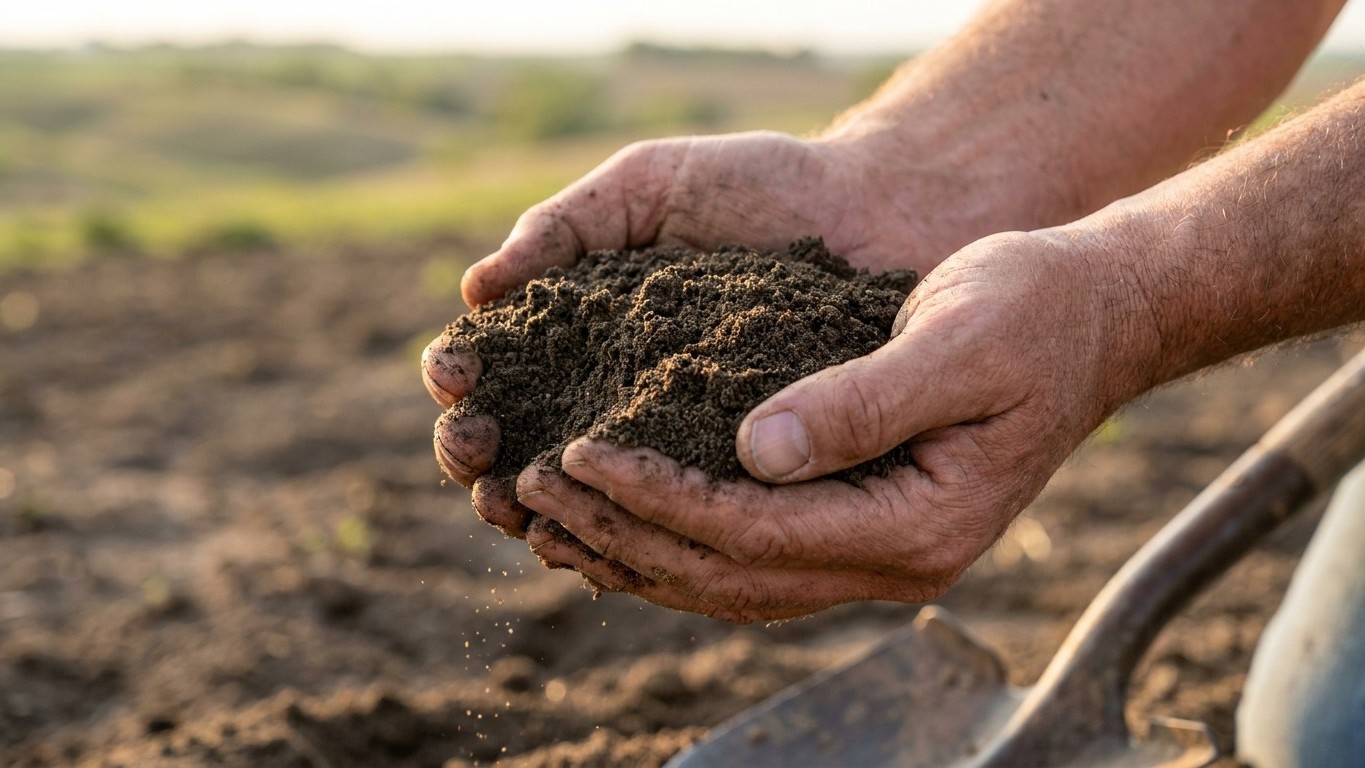

Missouri’s official state soil is the Menfro series, a silty, well-drained Alfisol formed under forest cover across the loess hills that run along the Missouri River. Knowing its numbers gives you a starting point, but your own garden almost certainly needs its own test before you spend a dime on amendments.
What is under your garden

The Menfro series is Missouri’s designated state soil, an Alfisol, which in plain terms means a forest-derived soil of moderate natural fertility that does a reasonable job holding onto nutrients rather than letting them wash straight through. It formed in loess, wind-deposited silt, mostly along the bluffs and uplands bordering the Missouri River, and it’s the ground USDA points to when it needs one soil to stand in for the state.
Here are the representative surface values USDA NRCS records for the Menfro series, drawn from 319 mapped components:
| Reading | Value |
|---|---|
| Surface pH | about 6.2 (slightly acid) |
| Sand | 4 percent |
| Clay | 19 percent |
| Silt | 77 percent |
| Organic matter | about 2.0 percent |
| Drainage class | well drained |
Look at that texture again: 77 percent silt. That’s not clay, not sand, it’s a fine, floury soil that feels almost soapy between your fingers when it’s damp. This is what gives the Menfro series its reputation as a productive farm and garden soil across the loess hills, and also its one weak spot, which we’ll get to under drainage and compaction.
Here’s the honest caveat, and it matters more than the numbers do: this is the soil chosen to represent Missouri, not the soil sitting under every Missouri garden. The state holds hundreds of mapped soil series. River-bottom ground along the Mississippi behaves nothing like a loess bluff. Ozark hill country sits on thin, rocky ground over limestone. And if a builder scraped topsoil off your lot before pouring a foundation, or trucked in fill fifteen years ago, you may be gardening in something that has no relationship to any native series at all.
Reading your own soil in five minutes
You don’t need a lab to get a rough read. Two quick checks tell you a lot:
- The ribbon test: Wet a small handful of soil until it’s moist but not sticky wet, then squeeze it between thumb and forefinger, pushing it upward into a ribbon. Clay-heavy soil forms a long, shiny ribbon over 2 inches before breaking. Silty soil forms a shorter, duller ribbon. Sandy soil won’t ribbon at all, it just crumbles.
- The jar test: Fill a clear jar about a third full of soil, top it off with water, shake hard, and let it sit overnight. Sand settles within minutes on the bottom, silt forms a middle layer over the next few hours, and clay stays suspended longest, settling as the finest layer on top.
Run both tests and you’ll be able to say out loud, with reasonable confidence, whether you’re dealing with something closer to Menfro’s fine silt, a heavier clay pan, or a sandy patch that drains too fast to hold water for long.
Testing before you amend
Guessing at soil amendments is one of the more expensive habits a gardener can pick up. Lime that ground doesn’t need locks up micronutrients for years. Sulfur applied to soil that’s already acidic pushes pH down further and can hurt root growth. A real soil test costs little and tells you what your eyes, and even the ribbon and jar tests, cannot: actual pH, phosphorus and potassium levels, and often organic matter percentage.
Given that the Menfro series runs about 6.2 at the surface, a gardener on similar loess-derived ground in Missouri can reasonably expect a starting point somewhere in the slightly acid range. That’s an expectation, not a fact about your yard. Expecting isn’t knowing, and the only way to know is to pull a sample and send it in.
Sampling correctly matters as much as sampling at all. A single scoop from one spot can mislead you if that spot happens to sit near an old ash pile, a foundation, or a low wet corner.
- Choose one planting area at a time, don’t mix a vegetable bed sample with a lawn sample.
- Pull 8 to 10 small cores from scattered spots across that area, using a trowel or soil probe.
- Dig to the depth roots actually occupy, roughly 6 inches for vegetable beds, 4 inches for lawns.
- Mix the cores together in a clean bucket, breaking up clumps and removing rocks or roots.
- Let the mixed sample air dry on newspaper for a day if it’s wet, then bag about 2 cups for the lab.
- Label the bag with the area name and drop it or mail it to your county extension office.
When results come back, the pH number tells you which direction to correct, the phosphorus and potassium levels tell you whether you need a balanced fertilizer or just nitrogen, and the organic matter percentage tells you how much compost work lies ahead.
Amending it
Missouri’s representative soil sits at pH 6.2, which is close enough to neutral that many vegetables and ornamentals will do fine with no correction at all. But plenty of real Missouri gardens run more acidic than that, especially in the Ozarks, and plenty of others, particularly over limestone-heavy ground or where concrete debris has leached into the soil, run distinctly alkaline. The correction depends entirely on which side of neutral your test comes back on.
If your soil tests below about 5.5: lime, not sulfur
Acid soil below roughly 5.5 locks up phosphorus, making it unavailable to roots even when soil tests show plenty is present. Brassicas, in particular, cabbage, broccoli, and their relatives, struggle in ground this acidic and become more susceptible to clubroot disease. The fix is agricultural lime, worked into the top 6 inches, and the mistake to avoid here is reaching for sulfur, which pushes pH the wrong direction entirely. Lime is slow. It works over a season or two as it reacts with soil moisture, not overnight, so apply it in fall for a spring garden and don’t expect dramatic change in a matter of weeks.
If your soil tests above about 7.3: sulfur and organic matter, never lime
On the alkaline side, lime must never go anywhere near this ground, it will only make the problem worse. Elemental sulfur, worked in gradually over multiple seasons, along with regular additions of organic matter like compost and aged manure, is the slow, honest route to bringing pH down. At high pH, iron becomes chemically locked out of reach for roots even when the soil contains enough of it, and that’s exactly what’s behind the classic symptom of yellow leaves with green veins, known as iron chlorosis, showing up on plants like blueberries, azaleas, and some fruit trees.
If your soil is heavy clay: organic matter, and patience
Clay-heavy ground, closer to 19 percent clay or higher, holds nutrients well but drains slowly and compacts easily. Organic matter, compost, shredded leaves, aged manure, worked in every season, is the fix. Never work sand into clay hoping to lighten it; the two combine into something closer to concrete than loam. And never work clay soil while it’s wet, doing so destroys its structure and can set you back years. This is a three-season fix, not a one-season one.
If your soil is sandy: organic matter, and shorter waterings
Sandy soil drains so fast that nutrients and water both wash through before roots can use them. Organic matter again does the heavy lifting here, but watering strategy matters too: shorter, more frequent waterings serve sandy soil better than the deep, infrequent soakings that work on clay, because nothing stays put long enough to benefit from a big single dose.
Drainage and compaction
The Menfro series carries a well-drained classification, which for a silty soil this fine is a meaningful trait, water moves through it steadily rather than pooling or racing away. Silt-heavy ground like this has a particular weakness, though: it compacts under foot traffic and equipment far more readily than sandier ground does, and once compacted, that same fine texture that made it drain well starts shedding water off the surface instead of letting it soak in.
You can check your own ground’s drainage with a simple percolation test. Dig a hole about a foot deep and a foot wide, fill it completely with water, and let it drain once. Then fill it again and time how fast the water level drops. A drop of 1 to 3 inches per hour is generally considered good drainage for most garden plants. Faster than that, and water may pass through too quickly for roots to use it. Slower than an inch an hour, and you’re looking at standing water that will drown roots and encourage root rot.
Compaction from repeated foot traffic, wheelbarrows, or equipment is the other half of the drainage story, and it’s why double digging, once the standard advice for breaking up compacted beds, has fallen out of favor. Digging deep and turning heavy silty or clay soil disrupts its structure and often makes compaction worse over time rather than better, especially if the bed gets walked on again shortly after.
On ground that drains slower than an inch an hour, or that sees heavy compaction from a driveway grade or old construction traffic, a raised bed is often the honest answer rather than three years of amendment work. Filling a raised frame with a proper garden mix sidesteps the underlying drainage problem entirely instead of fighting it season after season.
Depending on what your percolation test shows, here’s how to respond:
- Fast drainage (over 3 inches/hour): add organic matter, water more often in smaller amounts, mulch heavily to slow evaporation.
- Good drainage (1 to 3 inches/hour): proceed normally, this ground supports most vegetables and ornamentals without special measures.
- Slow drainage (under 1 inch/hour): avoid deep tilling when wet, consider a raised bed, and steer moisture-sensitive plants like most root vegetables elsewhere.
Local help
The University of Missouri Extension runs the state’s soil testing program through county offices, reading results alongside gardeners rather than just mailing back a printout. You bring or send in a sample following the steps above, and county staff can walk you through what the numbers mean for your specific planting plans. Find your local office through University of Missouri Extension.
Common questions
Is Missouri soil good for gardening?
The state’s representative soil, the Menfro series, is a productive, well-drained silt loam with moderate fertility, well suited to gardening. But soil quality varies enormously across the state depending on location and whether ground has been disturbed by construction.
How do I know if my Missouri soil is acidic or alkaline?
Only a soil test gives you a real number. The state’s representative soil runs slightly acid at about 6.2, but Ozark hill country and limestone-heavy areas can run more alkaline, and some acidic pockets exist too.
What’s the biggest soil problem for Missouri gardeners?
Compaction is common, especially on silty and clay-heavy ground, because fine-textured soil packs down easily under foot traffic and equipment. Raised beds are often a faster fix than years of amendment.
How often should I test my garden soil?
Every 2 to 3 years for an established garden is typical, though it’s worth testing sooner if you notice yellowing leaves, stunted growth, or if you’ve added fill dirt or done construction work nearby.