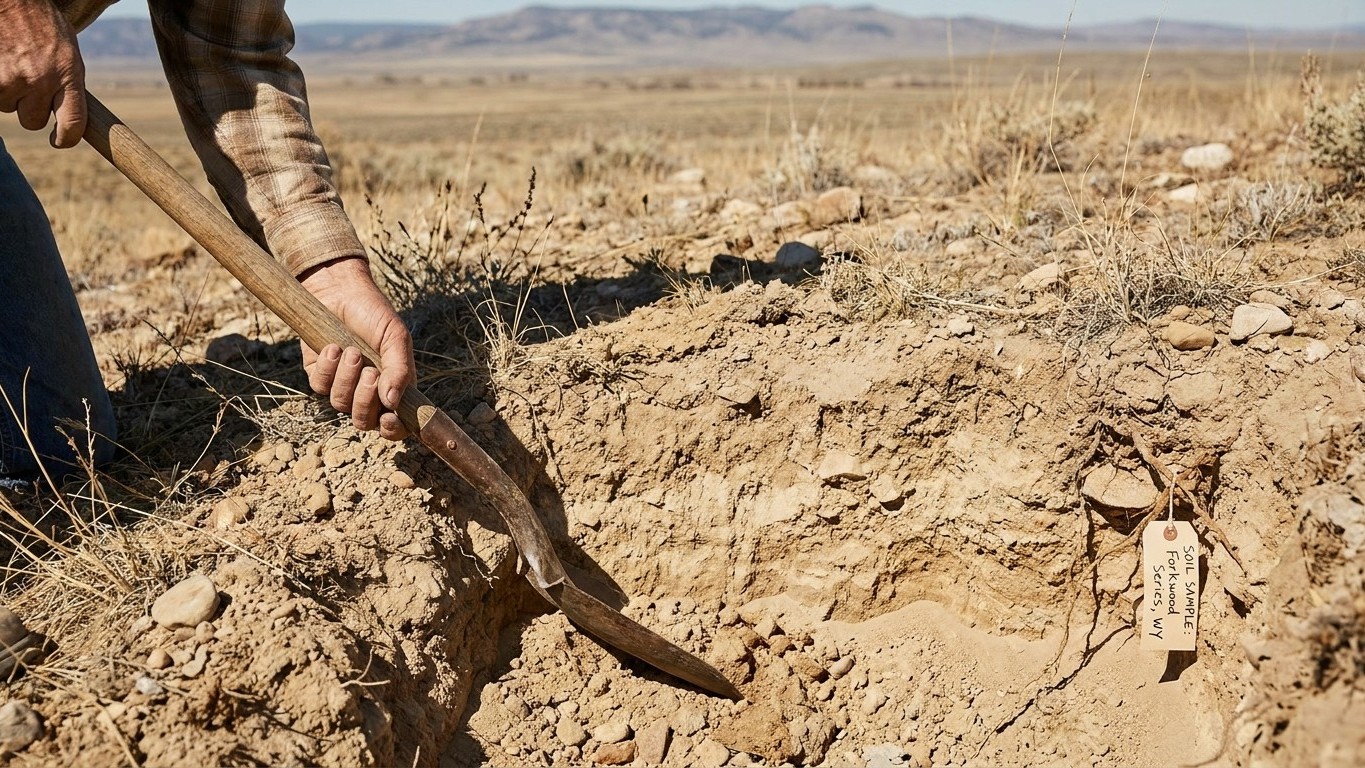

Dig a spade into Wyoming ground and there’s a good chance you’re standing on the Forkwood series, the soil USDA lists as representative of the state. It’s a dry-climate soil, close to neutral on the surface but built to run alkaline underneath, with a loam-to-silt texture that drains well but holds little organic matter. Knowing this before you plant tells you what you’re fighting and what you’re not.
What is under your garden

The Forkwood series is the soil USDA’s National Cooperative Soil Survey names as representative of Wyoming. It’s classified as an Aridisol, the soil order that forms in dry climates and tends toward alkaline chemistry, sometimes carrying salts near the surface. That single word, Aridisol, tells you most of what you need to know before you ever pick up a trowel: this ground didn’t form under heavy rainfall, so it never developed the acidity that forests and wet meadows produce elsewhere in the country.
The measured numbers back that up. USDA’s Soil Data Access records a surface pH of about 7.2, which sits right at neutral but leans toward the alkaline side. The texture comes in at 42 percent sand, 20 percent clay, and 38 percent silt, a loam-to-silt mix that’s neither sticky clay nor loose beach sand. Organic matter sits low, around 1.5 percent, which is typical for a soil that formed under sparse grass and low rainfall rather than dense woodland leaf litter. Drainage is rated well drained, meaning water generally moves through it without pooling.
| Reading | Value |
|---|---|
| Surface pH | about 7.2 |
| Sand | 42% |
| Clay | 20% |
| Silt | 38% |
| Organic matter | about 1.5% |
| Drainage class | well drained |
Here’s the honest caveat that matters more than any single number above: Forkwood is the series USDA picked to represent Wyoming on paper, not a guarantee about the dirt behind your house. The state stretches from river bottoms to high plains to mountain foothills, and a lot of residential lots sit on ground a builder scraped, graded, or filled with subsoil during construction. That fill dirt has none of the history the Forkwood profile carries. It might compact hard, drain poorly, or carry almost no topsoil at all.
Reading your own soil in five minutes
Two quick checks tell you more than any state average. First, the ribbon test: wet a small handful of soil until it holds together, then squeeze it between thumb and forefinger, pushing it upward into a ribbon. Clay-heavy soil forms a long, shiny ribbon over an inch or two before breaking. Sandy soil barely holds a shape at all. Loam falls in between, forming a short, crumbly ribbon.
Second, the jar test. Fill a clear jar about a third full of soil, add water nearly to the top, shake hard, and let it sit overnight. Sand settles first and forms the bottom layer within minutes. Silt follows, forming a middle layer over an hour or two. Clay stays suspended longest and settles as the finest top layer, sometimes taking a full day. Measure the layers and you’ve got a rough percentage breakdown of your own yard, no lab required.
Testing before you amend
Guessing at soil chemistry is how gardeners waste money on the wrong bag of amendment. Your eyes can tell you a soil looks pale or feels heavy, but they can’t tell you the actual pH, the phosphorus level, or how much organic matter is really in there. A lab test costs a few dollars and removes the guesswork entirely.
The regional pH figure for Wyoming’s representative soil, that 7.2 reading, gives you a reasonable expectation going in: most of this state’s ground leans neutral to alkaline, not acidic. But expecting isn’t knowing. Fill dirt, heavy irrigation with hard water, or years of wood ash on a compost pile can all push a specific garden bed well outside that expectation, in either direction.
Taking a sample correctly matters as much as sending it in at all. Here’s the process:
- Choose 6 to 8 spots scattered across the garden bed, avoiding unusual areas like old fence lines or compost dump sites.
- At each spot, dig a small core 6 to 8 inches deep, the depth where most vegetable and flower roots actually feed.
- Drop each core into a clean bucket, breaking up clumps and removing rocks or roots as you go.
- Mix all the cores together thoroughly so the sample represents the whole bed, not one lucky or unlucky spot.
- Scoop out about two cups of the mixed soil, let it air dry on newspaper if it’s damp, and bag it for the lab.
When results come back, focus on three numbers first: pH, organic matter percentage, and phosphorus. Those three tell you more about what to amend than a dozen micronutrient readings most home gardens never need to worry about.
Amending it
Correcting Wyoming’s representative soil means working with a near-neutral pH that tends to drift alkaline, a texture that’s reasonably balanced but thin on organic matter, and drainage that’s generally good but can vary sharply on disturbed ground. The fix depends entirely on which direction your own test results point.
If your test comes back above 7.3: sulfur and organic matter, never lime
If your soil test lands above about 7.3, the rule is simple and non-negotiable: lime must never go on this ground. Lime raises pH, and pushing already-alkaline soil higher only makes things worse. The honest correction is elemental sulfur, worked into the top few inches, along with steady additions of organic matter like compost or aged manure. Sulfur works slowly, converting to sulfuric acid through soil bacteria over a season or more, not overnight. High pH also locks iron out of reach of plant roots, which is exactly what’s happening when you see yellow leaves with green veins on azaleas, blueberries, or other acid-loving plants. That symptom is a pH problem, not a fertilizer problem, and no amount of iron fertilizer fixes it permanently if the pH stays high.
If your test comes back below 5.5: lime, not sulfur
Less common on Wyoming’s representative ground but still possible in isolated pockets, particularly where organic mulch has built up for years, acid soil below 5.5 calls for lime, and sulfur would be the wrong move entirely. Acid soil ties up phosphorus so plants can’t use it, and it stresses brassicas like broccoli and cabbage, which prefer closer to neutral conditions. Lime works over seasons, not weeks, so apply it in fall for a spring bed and don’t expect a quick pH swing.
Working with the texture: 20 percent clay, 42 percent sand
The measured texture, 20 percent clay and 42 percent sand, isn’t heavy clay soil, but a bed that tests higher in clay than that benefits from organic matter worked in every season, never sand mixed into clay. Sand into clay creates something closer to concrete than loam. If your own soil test or ribbon test shows a sandier profile than the state average, organic matter still helps, but expect to water shorter and more often since sandy ground drains fast and nutrients wash through quickly. Texture fixes land gradually. Expect three seasons of steady compost additions before a heavy or thin soil starts behaving like a healthy loam. pH corrections, by contrast, can show measurable movement within a single season if you’re using the right amendment.
Drainage and compaction
The Forkwood series carries a well drained rating, which in plain terms means water moving into the ground doesn’t linger long at the surface after a normal rain. That’s good news for root rot prevention, but it’s a mapped average, and disturbed residential lots often behave nothing like it, especially where heavy equipment compacted the subsoil during construction.
Testing your own drainage takes fifteen minutes and a garden hose. Dig a hole about a foot deep and a foot across, fill it completely with water, and let it drain once. Then fill it a second time and time how long it takes to drop an inch. A rate faster than an inch an hour suggests fast-draining, sandy ground that will need more frequent watering. A rate slower than half an inch an hour signals compacted or clay-heavy soil where standing water can suffocate roots.
- Fast drainage (over 1 inch/hour): water more often in smaller amounts, and add organic matter to help the soil hold moisture between waterings.
- Moderate drainage (about 0.5 to 1 inch/hour): generally workable for most vegetables and perennials without special adjustment.
- Slow drainage (under 0.5 inch/hour): avoid deep-rooted plants that hate wet feet, and consider raised beds rather than fighting the native soil.
Compaction from foot traffic, parked equipment, or repeated tilling packs soil particles together and squeezes out the air pockets roots need. Double digging, once the standard fix, has fallen out of favor because it disturbs soil biology and often doesn’t hold up past a season or two of normal foot traffic. On genuinely compacted or poorly drained ground, particularly on a lot where the topsoil was scraped away during building, a raised bed filled with quality soil is the faster, more honest answer than three years spent amending native dirt that may never fully cooperate.
Local help
The University of Wyoming Extension runs the state’s soil testing program and reads results alongside the gardener who submitted them, county by county. Reach out through the University of Wyoming Extension to find your local county office, ask about current test pricing, and get help interpreting what your particular patch of ground actually needs.
Common questions
Is Wyoming soil good for gardening?
It can be, once you know its tendencies. The representative Forkwood series drains well and has a workable loam-to-silt texture, but low organic matter (about 1.5 percent) means most gardens benefit from regular compost additions regardless of pH.
Why does my soil test alkaline when I didn’t add anything?
Dry-climate soils like Wyoming’s Aridisols naturally trend alkaline because low rainfall never leaches out the calcium and other minerals that raise pH. It’s the climate, not something you did.
Can I use wood ash to fix acidic soil in Wyoming?
Only if a soil test actually shows acidic conditions, which is uncommon on this state’s representative ground. Adding ash or lime to already-neutral or alkaline soil pushes pH in the wrong direction and can create nutrient lockout.
How often should I retest my garden soil?
Every two to three years for an established bed, or immediately after any major change like new fill dirt, construction nearby, or a sudden shift in plant health that suggests a nutrient problem.