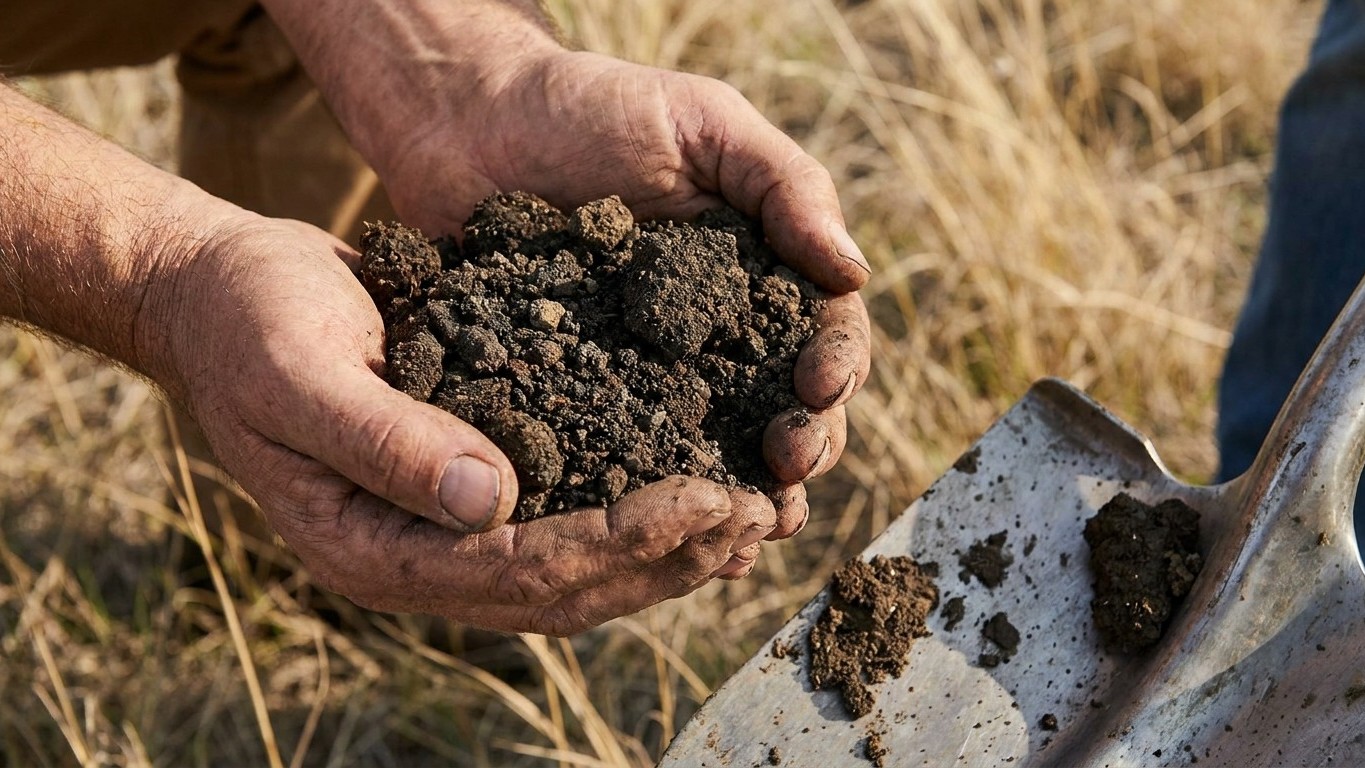

Dig a shovel into most of Montana’s dryland prairie and you’ll hit dark, crumbly ground that holds together in a ball but doesn’t turn to concrete. That’s the Scobey series talking, the state’s official soil. Here’s what it actually contains, how to test what’s under your own feet, and what to do about it.
What is under your garden

Montana’s official state soil is the Scobey series, a Mollisol, which is the same broad soil order that built the Corn Belt further east. Mollisols form under prairie grasses over centuries, and what makes them valuable is right there in the name: dark, deep, mineral-rich topsoil that took a long time to accumulate. The Scobey series is Montana’s representative of that story, and the state legislature made it official in 2015 as part of the USDA NRCS State Soils program.
The numbers matter more than the poetry, so here they are as USDA NRCS Soil Data Access records them for the surface horizon:
| Reading | Value |
|---|---|
| Surface pH | about 7.0 (near neutral) |
| Sand | 35 percent |
| Clay | 31 percent |
| Silt | 34 percent |
| Organic matter | about 2.0 percent |
| Drainage class | well drained |
That’s a clayey soil, texturally, with sand, silt and clay close enough to even split that it behaves as a workable loam-clay rather than a sticky mess. Near-neutral pH means most vegetables and ornamentals won’t fight the chemistry. Two percent organic matter is respectable for a natural prairie surface, though it’s not high, and it’s a figure worth remembering when you get to amending it later.
None of this is a promise about your particular yard. The Scobey series is what represents Montana on a map, not what’s necessarily under your tomatoes. A river-bottom garden, a hillside lot, or anything a contractor scraped and re-graded before your house went up can be a completely different animal, texturally and chemically, from the state soil. Treat these figures as a regional tendency, not a personal diagnosis.
Reading your own ground in five minutes
Two quick checks tell you more than staring at the dirt ever will. First, the ribbon test: take a moist handful, work it between thumb and forefinger, and push it out into a ribbon. Clay-heavy soil forms a long, slick ribbon before it breaks. Sandy soil won’t ribbon at all, it just crumbles. Loam falls somewhere in between, forming a short, rough ribbon.
Second, the jar test: fill a clear jar about a third full of soil, top it off with water, shake it hard, and let it sit overnight. Sand settles first and sits on the bottom within minutes. Silt follows in a middle layer over the next hour or two. Clay stays suspended longest and forms the top layer, sometimes still cloudy the next morning. Measure the layers and you’ve got a rough texture breakdown of the specific soil in your yard, no lab required.
Testing before you amend
Guessing at soil chemistry is how people spend money on lime they didn’t need, or sulfur that made things worse. A soil test tells you the pH, nutrient levels and organic matter of your actual bed, not the county average, and it costs far less than a season of misapplied amendments. The regional near-neutral pH the Scobey series carries gives you a reasonable expectation for untouched Montana prairie ground, but expecting isn’t knowing, especially once irrigation, old fertilizer, wood ash or years of compost have shifted things.
Taking a sample correctly matters as much as sending it in. Follow these steps standing in the garden with a trowel:
- Choose 8 to 10 spots scattered across the bed, avoiding unusual areas like old paths, compost dumping spots or right next to a foundation.
- At each spot, dig a small hole to the depth where roots actually grow, typically 6 to 8 inches for vegetable beds.
- Take a thin slice of soil from the side of the hole at that depth, not just the surface crust.
- Combine all the slices in a clean plastic bucket and mix thoroughly.
- Let the composite sample air-dry, then package about a pint of it according to your lab’s instructions.
- Label it with the bed location and submit it with the standard nutrient and pH test requested.
When results come back, the pH number tells you which direction to push, if any, and the nutrient levels tell you whether you need fertilizer at all or whether you’d just be feeding weeds. Organic matter percentage on the report tells you how far your particular bed sits from that 2.0 percent baseline the state soil carries.
Amending it
The correction that matters here depends on which side of neutral your own test lands on, because the Scobey series baseline of pH 7.0 sits right at the tipping point where lime and sulfur do opposite jobs.
If your soil tests acidic (below about 5.5)
Acidic ground below pH 5.5 locks up phosphorus and makes life hard on brassicas like broccoli and cabbage, which prefer closer to neutral. Lime is the correct lever here, not sulfur, which would push the problem the wrong direction. Apply agricultural lime according to your test’s recommendation, and expect it to work over seasons, not weeks. Lime moves slowly through soil, so a fall application pays off the following spring and summer, not the week after you spread it.
If your soil tests alkaline (above about 7.3)
On the alkaline side, lime must never go on this ground. It would make an already tight nutrient situation worse. Elemental sulfur, applied over multiple seasons, along with steady additions of organic matter, is the slow and honest route to nudging pH down. High pH also locks iron out of reach for plant roots, which is exactly what yellow leaves with green veins, a condition called iron chlorosis, are telling you. Chelated iron products offer a faster patch, but sulfur and organic matter address the underlying chemistry.
If your soil runs heavy clay
With clay near the Scobey series’ 31 percent, organic matter is the fix, worked in as compost or well-rotted manure over multiple seasons. Never add sand to clay soil hoping to loosen it; the two together can set up something closer to concrete than loam. And never work clay soil while it’s wet, since that compacts the structure you’re trying to improve and can take years to undo.
If your soil runs sandy
Sandy ground needs organic matter too, but for a different reason: it holds neither water nor nutrients well, so both wash through fast. Shorter, more frequent watering beats a deep soak that just drains past the root zone. Compost added yearly builds the water-holding capacity sand lacks on its own.
Texture fixes like these take two to three seasons of consistent organic matter additions to show real change. A pH correction with lime or sulfur can shift measurably within one growing season if the imbalance wasn’t severe, but don’t expect either job to finish in a single pass.
Drainage and compaction
The Scobey series carries a well-drained rating, meaning water moves through it at a reasonable pace rather than pooling on the surface or vanishing overnight. In practice, that means a Montana garden built on ground resembling this series shouldn’t have standing water an hour after a hard rain, though a heavy clay component still means water lingers longer than it would in a sandier bed nearby.
You can check your own bed’s drainage with a simple percolation test. Dig a hole about a foot deep and a foot wide, fill it completely with water, and let it drain once. Then fill it a second time and time how long it takes to drop. An inch per hour or faster is good drainage for most vegetables and ornamentals. Under half an inch per hour signals a drainage problem worth addressing before you plant anything that hates wet feet.
Compaction is a separate issue from drainage, and it’s usually caused by foot traffic, wheelbarrows, or construction equipment pressing down on the soil structure. Double digging, once the standard fix, has fallen out of favor because it disturbs soil biology and structure more than it helps, and the compaction often returns within a season or two anyway. A few practical rules cover most situations:
- Stay off garden beds when the soil is wet, since that’s when compaction does the most damage.
- Use permanent paths so foot traffic never touches the growing area.
- Where percolation is consistently under half an inch per hour and the ground has been driven over or heavily trafficked, a raised bed is the honest answer rather than three years of amendment that may not fully fix a compacted subsoil layer.
- Save native, unamended ground for drought-tolerant perennials and grasses that don’t need the deep, loose root zone vegetables want.
Local help
Montana State University Extension runs soil testing recommendations and connects gardeners to labs through county offices statewide. Reach the program through Montana State University Extension, where the county office can walk you through sampling and read the results with you once they come back, translating a lab report into an actual plan for your bed.
Common questions
Is the Scobey series the soil in my backyard?
Not necessarily. It’s the soil chosen to represent Montana as a whole, but the state has hundreds of mapped soil series, and river bottoms, hillsides, and any lot that’s been graded or filled can differ completely from it.
Do I need lime if my soil is already near neutral?
No. Lime is only for acidic soil below about pH 5.5. Adding it to neutral or alkaline ground can push pH higher than it should be and create new nutrient problems.
Why are my plants’ leaves yellow with green veins?
That pattern, called iron chlorosis, typically shows up in alkaline soil where high pH locks iron out of reach for roots. It points toward sulfur and organic matter as a long-term fix, or a chelated iron product for a faster patch.
How often should I retest my soil?
Every two to three years for an established garden bed is reasonable, or sooner if you’re actively amending pH and want to track progress before adding more lime or sulfur.
Related guides
- North Dakota Soil: What You Are Digging Into, and How to Improve It
- South Dakota Soil: What You Are Digging Into, and How to Improve It
- Nebraska Soil: What You Are Digging Into, and How to Improve It
- Will Carrots Fork in Montana Soil
- Growing Cucumbers in Montana
- The Montana Apple Calendar, Stage by Stage
- Oregon Soil: What You Are Digging Into, and How to Improve It
- Alabama Soil: What You Are Digging Into, and How to Improve It