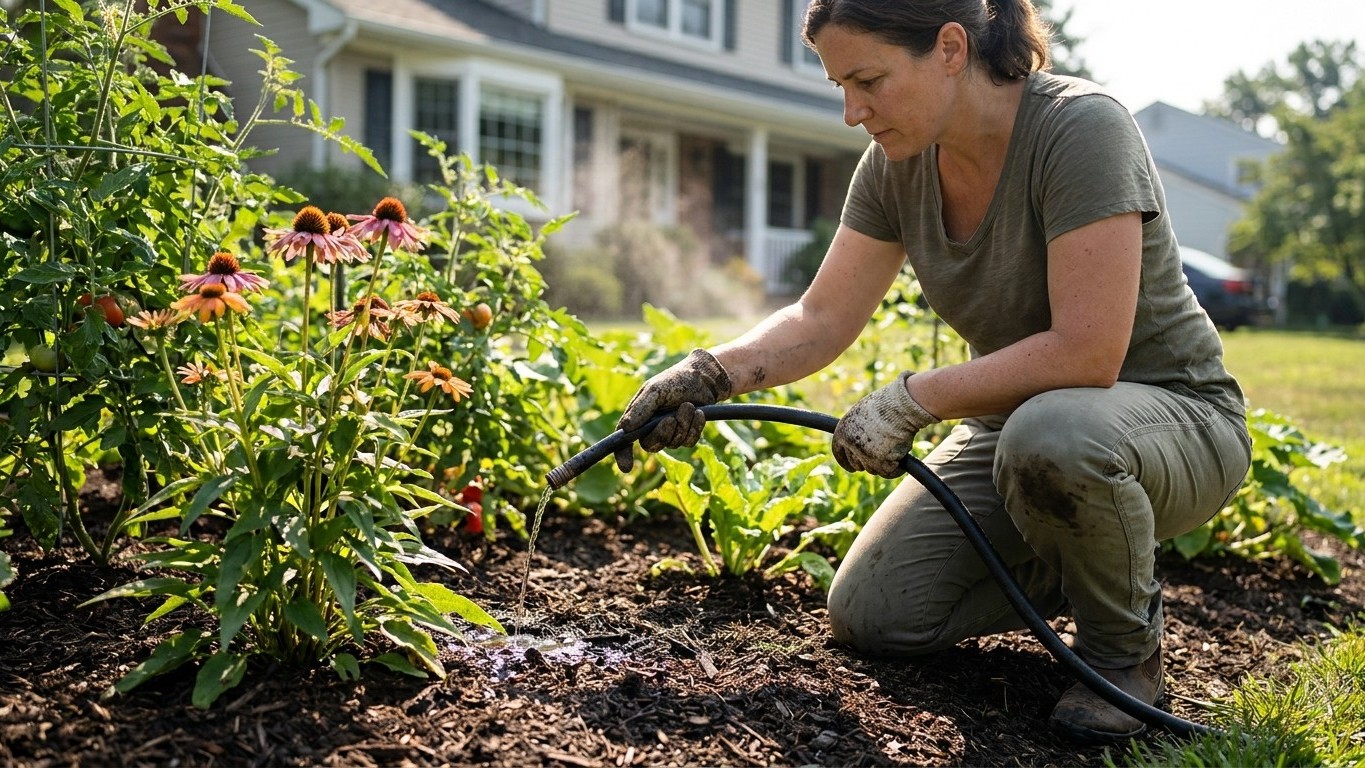

New Jersey gardens need roughly an inch of water a week during the growing season, delivered deep and infrequent rather than in daily sips, and exactly how much of that job falls to you depends on your soil, your county’s rainfall that particular week, and whether your water utility has a restriction in place. Here’s how to work it out for your own yard.
What the climate asks of you

Start with the number that decides how brutal a New Jersey summer gets on a garden bed: an average of 20.8 days a year reach 90°F or higher, based on the 1991-2020 climate normals measured at the Newark reference station. That’s not a heat wave here and there. That’s roughly three full weeks, spread mostly across July and August, when evaporation from soil and leaves runs well ahead of anything a light watering can replace.
Monthly rainfall totals for New Jersey summers vary sharply by county and by year, since the state runs from the sandy coastal plain and Pine Barrens in the south to heavier clay-loam soils across the northern and central counties, and no single figure honestly describes both. What holds true almost everywhere is that summer rain tends to arrive as thunderstorms, not steady soaking rain, so a garden bed can go a week or more with nothing, then take an inch in twenty minutes that mostly runs off instead of soaking in.
That unevenness is the whole problem. A garden bed wants close to an inch of water spread evenly across seven days. A single thunderstorm dumping most of that in one burst doesn’t accomplish the same thing as a slow inch delivered gradually, because a lot of it sheets off the surface rather than reaching root depth. On sandy coastal-plain soil, whatever does soak in also drains through fast, so a stretch with no rain can turn a bed bone-dry within two or three days even after a decent storm, which is exactly the scenario covered in Watering Through a Dry Spell in New Jersey. Pots and raised containers drain even faster than sandy ground and dry out that much sooner, a distinct enough problem that it’s worth reading Watering Pots and Containers in New Jersey separately. On the state’s heavier clay ground, the same rain can sit near the surface for a week, which cuts the need to irrigate but raises the risk of waterlogged roots if you add more on top of it.
Growing season length matters too
New Jersey’s frost dates set the boundary on either end of this watering window. At the Newark reference station, the last spring frost typically falls between March 29 and April 6, and the first fall frost between November 4 and November 16. Suburban and rural gardens away from that airport station usually see frost arrive later in spring and earlier in fall, sometimes by one to two weeks, more at elevation, so treat those dates as a starting point and check your own county’s extension data. The state spans USDA zones 6a to 7b, another range rather than one number. A garden in the warmer coastal south is doing different math than one in the cooler northwest highlands.
How much, how often
The rule that matters most is deep and infrequent, not a little bit every day. Shallow, daily watering trains roots to stay near the surface, right where the sun bakes them and where the plant has the least buffer during that stretch of 90°F days. A deep soaking pushes roots down into cooler, moister ground where they can ride out a dry week without wilting.
Skip the calendar and check the ground instead. Push a finger, or a trowel, about two inches into the soil near the base of the plant. If it’s dry at that depth, water. If it’s still damp, wait another day and check again. This single habit does more to prevent both overwatering and underwatering than any fixed schedule ever will, because it responds to what your particular bed is doing that week rather than what a generic gardening calendar assumes.
Here’s a sequence that works across most New Jersey soils:
- Check soil moisture two inches down at the base of the plant before watering at all, using a finger or a small trowel.
- Water early morning, ideally before 9 a.m., so moisture has time to soak in before the day’s heat and evaporation peak.
- Aim water at the base of the plant, not the leaves, to cut down on fungal disease that spreads on wet foliage overnight.
- Apply roughly an inch’s worth in one session rather than splitting it into several light waterings across the week.
- On sandy, fast-draining ground (common across the coastal plain and Pine Barrens), shorten the interval and water more often in smaller amounts, since the soil simply can’t hold a full week’s worth.
- On heavy clay (more typical in the northern and central counties), stretch the interval and never water or work the soil while it’s still wet from the last rain or session, since compacted, saturated clay suffocates roots.
The 20.8 days a year that push past 90°F are the days this schedule gets tested hardest. On those days, morning watering isn’t a nicety, it’s what keeps the plant from wilting by mid-afternoon regardless of how deep the previous soaking went.
Restrictions and rules
Watering restrictions are common across New Jersey’s water utilities and municipalities, particularly during drought conditions or peak summer demand, but the specific rules (which days, which hours, what’s exempt) vary by water provider and change from year to year depending on reservoir and aquifer conditions. Some systems restrict outdoor watering to odd or even days tied to house number, others limit it to early morning or evening hours, and some add outright bans during declared drought emergencies. None of that is fixed enough to state here as a blanket rule for the whole state.
What is worth building into your routine is checking before you set a timer or start a sprinkler schedule. Your local water utility or municipal website is the authority on current restrictions, and Rutgers Cooperative Extension tracks drought and water-use guidance relevant to home gardeners statewide.
Given how unevenly summer rain falls here, and how many of those 20.8 hot days cluster in the driest stretches of July and August, restrictions are more likely to show up exactly when your garden needs water most. Checking your provider’s current rules before that stretch hits, rather than during it, saves a scramble later.
Using less
Cutting water use in a New Jersey garden doesn’t mean neglecting it. A handful of changes reduce how much you need to carry out there in the first place, and most of them pay off within a single season.
- Mulch, two to three inches deep, around beds and shrubs. It slows evaporation from the soil surface, which matters most on the sandy coastal-plain ground that drains fast to begin with.
- Drip irrigation or soaker hoses deliver water directly to the root zone instead of spraying it into the air, where a good share evaporates before it ever reaches the soil, especially on the hottest of those 20.8 days a year.
- Group plants by water need rather than scattering thirsty annuals among drought-tolerant perennials, so you’re not overwatering the tough plants just to keep the thirsty ones alive.
- Work organic matter into the soil, compost especially, which helps sandy soil hold moisture longer and helps heavy clay drain a bit better, addressing both ends of the state’s soil range at once.
- Rain barrels, where local rules allow them, catch runoff from a roof for later use. As a rough figure, an inch of rain falling on a thousand square feet of roof yields about 600 gallons of runoff. In practice, that means a single New Jersey thunderstorm can fill and overflow a standard 50- to 75-gallon barrel in minutes, while a stretch of the state’s driest summer weeks, the same weeks that tend to bring the most 90-degree days, can leave that barrel sitting empty for a week or more. A barrel helps most as a supplement between storms, not as a sole source through a dry spell.
None of these replace watering altogether. They shrink the gap between what the sky delivers and what the garden actually needs, which on New Jersey’s uneven thunderstorm-and-drought summer pattern is usually a wider gap than gardeners expect.
Common questions
What time of day should I water in New Jersey?
Early morning, before roughly 9 a.m., gives water time to soak into the root zone before the day’s heat drives evaporation, and it lets any moisture on the leaves dry off before evening, which cuts down on fungal disease.
Does New Jersey have a statewide watering restriction?
There’s no single statewide rule that applies everywhere. Restrictions are set at the utility or municipal level and change with drought conditions, so check with your local water provider or your municipality directly for current rules.
How do I tell if my soil is sandy or clay?
Squeeze a handful of moist soil. Sandy soil falls apart immediately and feels gritty; clay holds its shape, feels smooth or sticky, and can be rolled into a ribbon between your fingers. New Jersey has both, often within the same county.
What USDA hardiness zone is New Jersey in?
New Jersey spans USDA zones 6a to 7b, with the warmer end along the coast and southern counties and the cooler end in the northwestern highlands. Check your specific county or use the reference city closest to you rather than assuming one zone for the whole state.