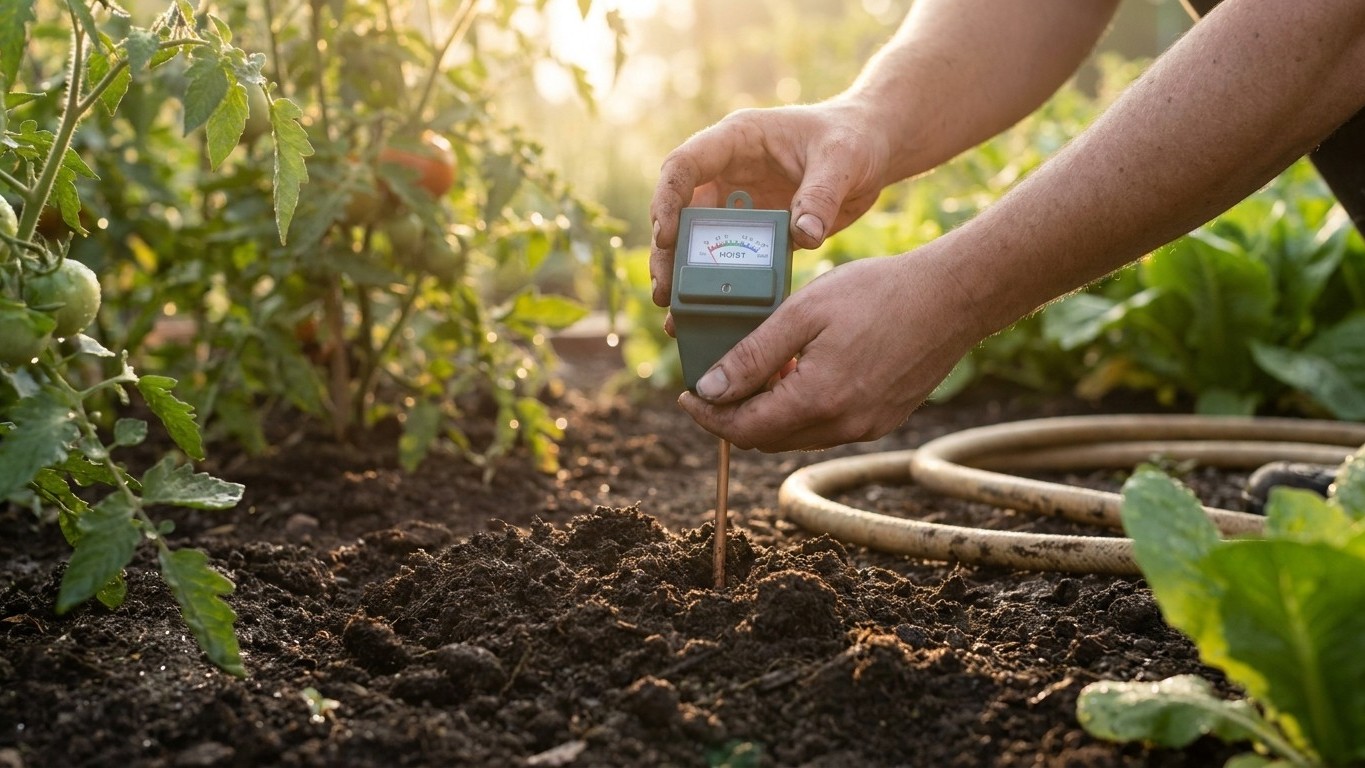

New Jersey gardeners get through a dry spell by watering deeply once or twice a week rather than lightly every day, checking soil moisture two inches down before turning on the hose, and timing every soak for early morning so the water reaches roots instead of evaporating off the leaf surface.
What changes here

Two numbers set the terms for New Jersey’s driest stretch. August, the driest summer month, averages 4.15 inches of rain. And the region logs 20.8 days a year at or above 90F. Put together, that’s a month where the sky delivers a fair amount of water on paper, but heat load is high enough to burn through it fast. A 90F afternoon pulls moisture out of soil and leaf tissue at a rate that a single evening thunderstorm doesn’t offset, even in a state that isn’t short on rainfall overall.
Run the arithmetic and the gap becomes concrete. A vegetable bed or a young shrub wants roughly an inch of water a week. August’s 4.15 inches, spread across roughly 4.4 weeks in the month, works out to about 0.94 inch of rain in an average week, spread over three growing months (June 4.34 inches, July 4.66 inches, August 4.15 inches) that add up to about 13.2 inches for the summer, out of 46.6 inches for the full year. On paper that 0.94 inch nearly covers the weekly inch a bed needs. In practice it rarely does, because that rain doesn’t arrive as a gentle inch spread over seven days. It shows up as one or two storms, often with runoff, and the rest of the week the bed dries under 90-degree heat with nothing replacing what evaporates.
Soil texture decides how much of that gap the gardener actually has to fill. On sandy ground, water drains through within hours, so even a decent rain event leaves little in reserve by midweek. On heavy clay, the same inch can sit in the top layer for several days, which sounds like an advantage until the same clay holds water long enough to suffocate roots if a second soaking arrives before the first has drained. Neither soil type lets a gardener treat the monthly average as a schedule. It’s a baseline, and the actual watering decision comes down to what’s happening in the top few inches of a specific bed on a specific week, not what the reference station recorded over three decades.
How to water when it matters
The goal during a dry spell isn’t to keep the soil surface damp. It’s to keep water available at the depth where roots are actually working, which for most vegetables, perennials and shrubs is four to eight inches down. Shallow, frequent watering trains roots to stay near the surface, where they’re the first thing to bake when a 90-degree day hits. Deep, infrequent watering pushes roots downward, into soil that stays cooler and holds moisture longer between soakings.
Morning is the right time for a specific reason: leaves and soil surface dry off within an hour or two of sunrise-watering, which starves the fungal spores that need standing moisture overnight to germinate. Evening watering leaves foliage wet for eight or ten hours in warm, still air, which is close to ideal conditions for powdery mildew and leaf spot to take hold.
Checking soil moisture before watering matters more than following any fixed calendar. A finger pushed two inches into the soil, or a trowel pulled up for a quick look, tells the truth that the surface color doesn’t. Soil that looks dark and damp on top can be bone dry an inch below, especially in sandy ground, and soil that looks pale and dusty on top can still be moist just below the crust.
- Push a finger or trowel two inches down before assuming the bed needs water; if it’s still moist, wait another day.
- On sandy soil, water in shorter, more frequent sessions, since it holds little reserve and dries fastest under 90F heat.
- On heavy clay, water less often but more slowly, letting it soak in fully; don’t add more until the top few inches have dried out again.
- Apply water at the base of the plant, not overhead, using a soaker hose, drip line, or the base of a watering can rather than a sprinkler.
- Water in the early morning, ideally before 9 a.m., so foliage and soil surface dry before evening.
- Start with roughly one inch of water a week as a baseline, then adjust up or down based on what the finger-check shows on your own soil.
That one-inch figure is a starting point, not a rule. A raised bed with fast-draining mix, a container, and a mature shrub rooted three feet down all need different amounts, and the only way to know is checking the soil directly rather than trusting a generic number.
What goes wrong
“I water a little every evening, just to be safe”
A light daily sprinkle wets the top inch of soil and nothing below it. Roots follow the moisture, staying shallow instead of reaching down, which leaves the whole plant more vulnerable the next time a 90F day shows up. The plant ends up more dependent on daily watering, not less, which is the opposite of what a dry spell calls for.
“I water in the evening because it’s cooler”
Cooler air feels like the safer choice, but it means foliage stays wet all night. In New Jersey’s humid summer air, that overnight moisture is exactly what fungal diseases need to spread. Morning watering, even in full heat, dries faster and leaves plants healthier.
“It rained yesterday, so the bed’s fine”
A summer thunderstorm can dump half an inch in twenty minutes and still leave the soil dry two inches down, especially if much of it ran off a hard or sloped surface. Checking with a finger, rather than trusting that rain fell, is the only way to know whether that storm actually reached root depth.
“I don’t bother with mulch”
Bare soil loses water to evaporation almost as fast as it’s applied, particularly on the hottest days New Jersey logs nearly 21 times a year on average. A two- to three-inch layer of mulch keeps that moisture in the ground instead of returning it to the air within hours of watering.
“I water on a fixed schedule, storms or not”
The reverse mistake shows up after a wet stretch: watering on autopilot when the ground is still saturated from recent rain. On clay soil especially, adding water before the last round has drained pushes out the oxygen roots need and can do more damage than a few dry days would.
Local help
Rutgers Cooperative Extension is New Jersey’s land-grant extension service and the best source for soil testing, plant-specific watering guidance, and drought updates tailored to the state. Local water utilities and municipalities set their own outdoor watering restrictions, and those rules shift by district and by season, so check with your own water provider before planning a summer watering routine. Find Rutgers’ resources at njaes.rutgers.edu.
Common questions
How often should I water during a New Jersey dry spell?
Start with about one inch of water a week, split into one or two deep sessions rather than daily light watering, then adjust based on a finger-check two inches into the soil.
Is early morning really better than evening for watering?
Yes. Morning watering lets foliage and soil surface dry within a couple of hours, while evening watering leaves leaves wet overnight, which favors fungal disease in New Jersey’s humid summer air.
Does New Jersey get enough summer rain to skip watering?
August, the driest summer month, averages 4.15 inches, close to an inch a week on paper. But it usually arrives as isolated storms rather than steady rainfall, and days at or above 90F (20.8 a year on average) pull moisture out faster than a single storm replaces it.
How do I know if my soil is sandy or clay-heavy?
A simple squeeze test works: damp sandy soil falls apart when squeezed, while clay soil holds a ball shape and feels sticky. Rutgers Cooperative Extension offers formal soil testing if a clearer answer is needed.