
Zero point two degrees Fahrenheit — that’s the average coldest night a Fargo winter delivers, not some rare deep freeze but the normal minimum, year after year. Most planting advice talks about record lows, as if surviving one brutal night were the test. It isn’t. North Dakota’s flowers have to survive that number every single winter, which rules out half of what garden catalogs call hardy and quietly favors a shorter, tougher list.
What thrives in North Dakota

Any flower that survives here first has to survive the winter. The USDA Plant Hardiness Zone Map places North Dakota in zones 3a to 4b, and NOAA’s 1991-2020 climate normals put the mean minimum temperature of the coldest month at Fargo at just 0.2°F. That figure, not the record low on some winter’s worst night, is what decides whether roots make it through to spring. A perennial rated hardy only to zone 5 or 6 on its nursery tag is gambling with a North Dakota winter, whatever the label promises.
Cold hardiness comes first
Plants that carry a true zone 3 or zone 4 rating are the safest bets: garden peonies (Paeonia lactiflora), Siberian iris (Iris sibirica), daylilies (Hemerocallis), and most Rudbeckia and Echinacea species. These belong to plant families built for continental climates: the aster family, the peony family, and the iris family all include species that evolved through cycles of hard freeze and short summer. A flower’s listed hardiness zone matters more than its listed bloom color or height when deciding what to plant here.
Heat and drought are secondary stresses
Summers in North Dakota are shorter and cooler than in much of the country. NOAA’s 1991-2020 normals record only 11.7 days a year reaching 90°F or higher at Fargo, so genuine heat stress is a minor problem compared with winter survival. Even so, dry stretches between rains happen, and flowers with deep taproots or narrow, silvery foliage, like Russian sage, blanket flower, and most sedums, hold up better than shallow-rooted, broad-leaved bedding plants. Tender tropicals such as impatiens and hibiscus, the kind that thrive year-round in a warm state like Florida, are grown here strictly as annuals and need replacing every spring.
The short growing season matters as much as the cold does. NOAA’s normals put Fargo’s last spring freeze in the range of May 4 to May 15, and the first fall freeze between September 25 and October 5, a frost-free window of roughly four months. Flowers that need a long run to reach full bloom size, like some dahlias or ornamental gourds, need to go in as started plants rather than direct-sown seed if they are going to perform before frost ends the season.
Native plants worth the space
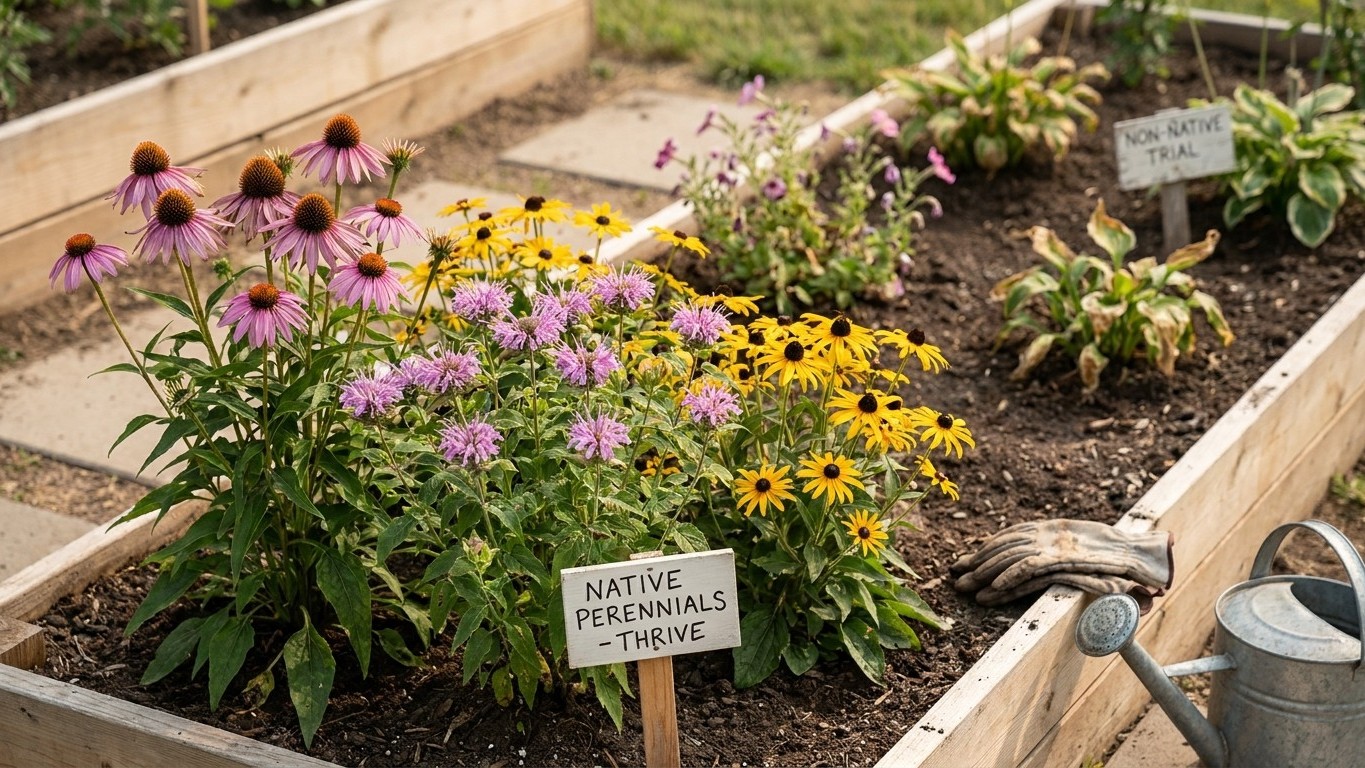
Native and regionally adapted wildflowers spend less time sulking and more time blooming, because they already match the local freeze-thaw cycle and rainfall pattern. Once established, most natives need no supplemental water beyond a normal North Dakota summer, which cuts down on hauling a hose to a border in a dry August.
Species worth growing
- Purple coneflower (Echinacea purpurea): native across the wider Great Plains, blooms midsummer, seed heads feed goldfinches into fall.
- Black-eyed Susan (Rudbeckia hirta): short-lived but self-seeds readily, native through much of the central and northern prairie.
- Blanket flower (Gaillardia aristata): drought-tolerant native of the northern plains, blooms from early summer through frost.
- Wild bergamot (Monarda fistulosa): native prairie mint, draws bumblebees and hummingbird moths.
- Butterfly milkweed (Asclepias tuberosa): native host plant for monarch caterpillars, slow to establish but long-lived once it takes.
- Prairie smoke (Geum triflorum): low native groundcover with feathery seed heads that catch light through early summer.
These plants are native to the wider northern Great Plains region rather than to any single North Dakota county, and a straight species bought from a regional native plant nursery is a more reliable genetic match for local conditions than a named cultivar bred elsewhere for garden habit.
Pollinators benefit more from straight native species than from most hybridized bedding plants. Many double-flowered cultivars have been bred for petal count at the expense of the pollen and nectar structures native bees and butterflies rely on. A patch of straight-species coneflower or blazing star (Liatris pycnostachya) does more for a local bumblebee population than a bed of ornamental double coneflowers bred purely for show.
Natives are not maintenance-free the first year. Give them one full growing season of regular watering while roots establish, then step back and let them fend for themselves. A native planted too shallow, or watered heavily every year like a bedding annual, never develops the deep root system that makes it worth growing in the first place.
Perennials that come back

A tag that says “perennial” is not a promise it will survive a North Dakota winter. It only means the plant is perennial somewhere in the country. The zone number on that tag is what counts here, and it needs to read zone 4 or lower to be a safe bet across most of the state.
Reading a plant tag against zone 3a-4b
Lavender (Lavandula angustifolia) is a good example of the trap. English lavender is usually rated to zone 5, sometimes zone 4 with a specific cultivar, which means it survives reliably in much of Ohio (see our guide to flowers that thrive in Ohio) but is a gamble at best in North Dakota, dead more winters than not without heavy mulch and a sheltered south-facing spot. Grow it here as an annual, or accept it as a short-lived perennial that needs replacing every few years.
| Perennial | Typical tag zone | Reliable in ND (zone 3a-4b)? |
|---|---|---|
| Peony (Paeonia lactiflora) | Zone 3 | Yes, decades in the ground |
| Daylily (Hemerocallis) | Zone 3-4 | Yes, most cultivars |
| Siberian iris (Iris sibirica) | Zone 3 | Yes |
| Russian sage (Perovskia atriplicifolia) | Zone 4 | Yes, in well-drained soil |
| Delphinium (Delphinium elatum) | Zone 3-4 | Marginal, dislikes wet winters |
| English lavender (Lavandula angustifolia) | Zone 5 | No, grow as an annual or replace often |
Drainage decides as many winter deaths as cold does. A perennial rated hardy to zone 3 can still rot out over winter if it sits in heavy clay that holds meltwater against the crown. Raised beds, or a handful of coarse sand worked into the planting hole, solve this for borderline plants like delphinium.
Sedum ‘Autumn Joy’ and most hostas grown in part shade also come back reliably at this hardiness level, though hostas want protection from afternoon sun and wind that an open prairie garden does not always offer.
Putting a border together
Height comes first. Put tall plants like delphinium, tall garden phlox, or hollyhock at the back of a bed against a fence or wall, mid-height perennials like coneflower and daylily in the middle, and low edging plants like blanket flower or creeping phlox at the front. A border planted flat, all one height, reads as a smear of color instead of a shape.
Bloom succession across a short season
Because the frost-free window runs only from roughly early May into early October at Fargo, a border needs plants queued up so something is always in flower rather than front-loading everything into July.
- Early spring: tulips and daffodils, planted as bulbs the prior fall.
- Late spring to early summer: peony, Siberian iris, columbine.
- Summer: coneflower, daylily, black-eyed Susan, blanket flower.
- Late summer into fall: sedum ‘Autumn Joy’, Russian sage, aster.
Repeat at least one plant three or more times through a border rather than buying one of everything. A single coneflower here and a single Russian sage there reads as clutter. Three peonies spaced along the back, or a drift of five daylilies, gives the eye a pattern to follow and makes the whole bed look intentional even before anything else is in bloom.
Leave real space at planting, even though a new perennial bed looks sparse the first year. A mature peony needs roughly three feet of room, and crowding it now to fill a gap means digging and dividing everything two summers from now. Fill temporary gaps with an annual like cosmos or zinnia instead of planting perennials too close together out of impatience.
Match soil and sun exposure before matching color. A border plan built entirely around a color scheme falls apart if half the chosen plants want shade and the site is full sun. Walk the spot through a full day first and note where the sun actually falls before picking a single plant, then group plants with similar water needs together so the bed does not need spot-watering all season.
Local help
The NDSU Extension Service publishes plant lists and hardiness guidance built for specific counties, and its offices run the state’s Master Gardener program, training volunteers who answer plant questions for free. Call your county extension office or check the NDSU Extension site before buying a full flat of anything untested, since the Fargo figures used throughout this piece will differ from what a garden in the Badlands or the Turtle Mountains experiences. For more on gardening elsewhere in the state, see our North Dakota guides.
Common questions
Can I grow roses in North Dakota?
Some types survive, but not all. Shrub roses bred for cold hardiness, like the Explorer series and most rugosa roses, tolerate North Dakota winters when the graft union is buried below soil level or the rose is grown on its own roots. Hybrid tea roses, the kind sold for cut flowers, rarely survive a Fargo-area winter without full removal and indoor storage.
Why did my perennials from a big box store die over winter even though the tag said they were hardy?
Check what zone the tag actually listed. Many national retailers stock the same perennial inventory across a wide swath of the country, and a plant tagged hardy to zone 5 or 6 will often die in a North Dakota zone 3a-4b winter even though the label technically calls it a perennial somewhere in the country.
Do I need to deadhead everything to keep flowers blooming?
No, but it helps some plants more than others. Coneflower and black-eyed Susan rebloom faster if spent flowers are removed, while others, like peony, bloom once a season regardless of deadheading. Leave the last flush of blooms standing on echinacea and rudbeckia into fall if you want seed heads for finches and other birds.
When is it actually safe to plant flowers outside in spring?
Wait until after your own area’s last frost, not the date printed on a seed packet. NOAA’s 1991-2020 climate normals put Fargo’s last spring freeze in the range of May 4 to May 15, and gardens outside the city, especially low-lying or rural sites, often see frost later than that. Check your own county’s typical last frost through the NDSU Extension Service before setting out anything tender.
Related guides
- Flowers That Actually Thrive in Minnesota, and the Ones That Struggle
- Flowers That Actually Thrive in South Dakota, and the Ones That Struggle
- Flowers That Actually Thrive in Ohio, and the Ones That Struggle