
Northwest Territories gardens need less water than gardens down south, but they need it at the right depth and the right time. With a growing season that averages just 116 days between the last spring frost and the first fall frost, and a climate that almost never hits 90°F, the goal is deep, infrequent soakings timed to a short window rather than daily light watering that never reaches the roots.
How much, how often

Shallow, daily watering trains roots to stay near the surface, where they dry out fast and cook in any warm spell. Deep, infrequent watering pushes roots down into cooler, moister soil that holds up better between sessions. The trick is knowing when the soil is actually dry at root depth, not just dry on top.
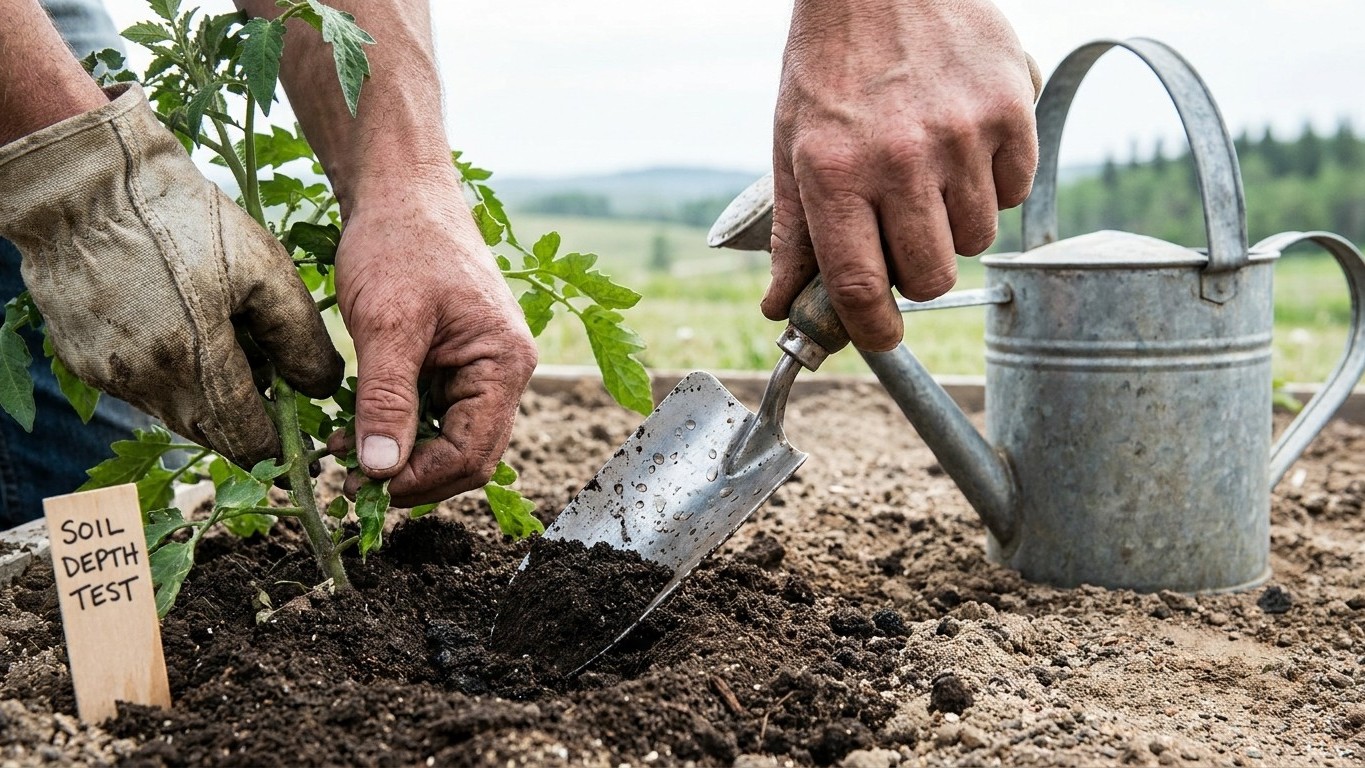
Push a finger or a trowel two inches into the soil near the base of the plant. If it’s still cool and damp at that depth, wait. If it’s dry, it’s time to water, and to water thoroughly rather than a quick splash.
What that means in practice depends heavily on the ground itself. Sandy soil, common in parts of the territory, drains fast and holds little moisture, so it needs shorter, more frequent soakings rather than one big drink a week. Heavy clay is the opposite problem: it can hold a week’s worth of water, but if you water it again before it’s dried out, or work it while it’s still wet, you compact it and suffocate the roots. Clay gardens should be watered less often, but each session should soak in slowly and deeply. Gardeners relying on pots and raised containers face their own set of rules, since containers dry out much faster than garden beds; see Watering Pots and Containers in Northwest Territories for guidance specific to that setup.
The territory’s cool summers, with essentially zero days a year reaching 90°F at the Yellowknife reference station, mean evaporative demand is much lower here than in a hot southern garden. That’s a real advantage: water applied in the morning has time to soak in before the heat of the day would otherwise pull it back out. It doesn’t mean you can skip watering, since the growing season itself is short and every week of moisture matters for plants racing to mature before the average first fall frost around September 18.
A simple watering sequence
- Check the soil two inches down at the base of the plant before assuming it needs water.
- Water early in the morning, so moisture soaks in before any midday warmth and foliage dries before evening.
- Apply water directly to the soil at the base, never over the leaves, to cut down on fungal problems.
- For sandy soil, water in smaller amounts every two to three days rather than one large weekly soak.
- For clay soil, water deeply but space sessions out, letting the top few inches dry before the next watering.
- Increase attention during a dry spell, when quick action matters most — see Watering Through a Dry Spell in Northwest Territories for a closer look at managing those stretches.est stretches of the short growing season, since there’s little margin to make up for a missed week later.
Restrictions and rules
Watering restrictions are common across Canada during dry spells, and they shift from year to year and community to community depending on local water supply and infrastructure. Some municipalities set specific days or hours for outdoor watering during summer; others only step in when reservoirs or wells run low. There’s no single territory-wide watering schedule that applies to every yard in the Northwest Territories, and rules that apply in Yellowknife won’t necessarily match those in a smaller community relying on a different water system.
Given how short and, in many years, dry the growing season can run, it’s worth checking local rules before setting up any regular watering routine or an automatic timer. A restriction that limits watering to certain days or a certain time window can quietly undo a carefully planned deep-watering schedule if you’re not aware of it.
The most reliable move is to contact your local water authority or municipal office directly for current rules, since these can change mid-season in response to weather. For general growing guidance suited to the territory’s conditions, the Government of the Northwest Territories agriculture services page is a useful starting point, though it won’t list municipal water restrictions, which live with your local utility, not with the territorial government.
If you’re on a private well rather than municipal water, restrictions may not apply the same way, but that doesn’t mean unlimited watering is a good idea. Wells in some parts of the territory recharge slowly, and pulling heavily from one during a dry stretch can affect both your own supply and a neighbor’s.
Using less
Using water efficiently matters more in a place with a short growing season, where every dry week eats into the limited time plants have to mature. A handful of techniques do most of the work, and they’re worth treating separately rather than lumping together, since each saves water in a different way.
- Mulch: A two-to-three-inch layer of mulch around plants slows evaporation from the soil surface, meaning the deep watering you already did lasts longer between sessions, which matters most on sandy soil that drains quickly.
- Drip irrigation or soaker hoses: Delivering water at soil level instead of spraying it into the air cuts losses to wind and evaporation, and it keeps foliage dry, which lowers disease risk in a climate with cool, sometimes damp evenings.
- Grouping plants by water need: Putting thirsty vegetables together and drought-tolerant perennials elsewhere means you’re not overwatering the tough plants just to satisfy the thirsty ones nearby.
- Organic matter in the soil: Compost worked into sandy soil helps it hold moisture longer between waterings; worked into clay, it improves drainage so water doesn’t pool and drown roots.
- Rain barrels, where locally permitted: As a rule of thumb, an inch of rain falling on a thousand square feet of roof yields roughly 600 gallons of runoff. In a territory with a short summer and a growing season squeezed between a late-May average frost and a mid-September average frost, that runoff has to be captured, used, and refilled repeatedly within a compressed window rather than stored for months, so a barrel is best treated as a top-up for dry stretches, not a season-long reserve.
None of these replace good judgment about soil type and timing. But together, mulch and drip irrigation alone can cut how often you need to turn on a hose, which matters in any community where watering days are limited or where a well is the only source.
Common questions
Do I need to water every day in the Northwest Territories?
No. With essentially no days a year reaching 90°F at the Yellowknife reference station, evaporative demand is low compared to warmer regions, and daily watering usually does more harm than good by keeping roots shallow. Check soil moisture two inches down before watering rather than watering on a fixed daily schedule.
When should I stop worrying about frost and start regular watering?
The average last spring frost at Yellowknife A is May 25, but that’s a midpoint, not a guarantee. In half of all years, frost arrives later than that. Wait until the soil has warmed and the frost risk has clearly passed in your specific area before committing tender plants to a regular watering routine.
How do I know if there’s a watering restriction in my community?
Contact your local municipal office or water utility directly, since restrictions vary by community and change based on local supply conditions. There’s no single territory-wide rule, so a schedule that applies in one community may not apply in another.
Is my soil sandy or clay, and does it matter for watering?
It matters a lot. Sandy soil feels gritty and falls apart easily when squeezed, draining fast and needing more frequent, lighter watering. Clay feels sticky and holds a shape when squeezed, retaining water longer but risking root damage if watered again before it dries or worked while wet. A simple squeeze test in your own garden tells you which approach to follow.