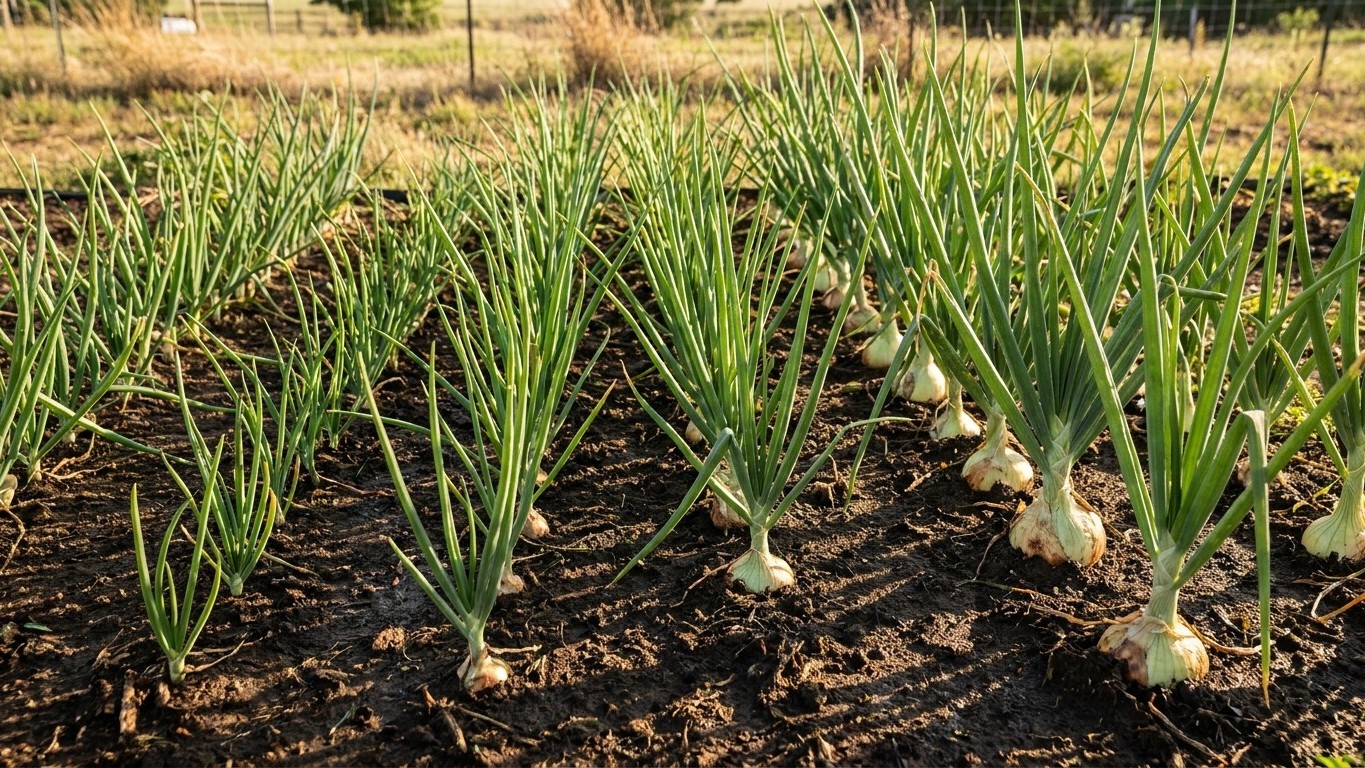

Oklahoma City sits at 35.39 degrees north, and on the longest day of the year the sun gives it 14 hours and 24 minutes of daylight. That single number decides which onions will bulb in an Oklahoma garden and which ones will simply sit there making leaves. Short-day types work in the south of the state, a wide band of intermediate-day varieties covers most of it, and a couple of long-day types can squeak by. But plenty of popular long-day onions never get the daylight they need here, and this page names them.
How long your longest day is

Everything on this page comes back to two numbers: 35.39 degrees north, the latitude of Oklahoma City, and 14 hours 24 minutes, the length of daylight there on the summer solstice. Onions don’t bulb because the weather warms up. They bulb because the day gets long enough to trigger it, and that threshold is genetic. Short-day varieties start switching from leaf growth to bulb growth once the day reaches roughly 12 hours, according to Clemson Cooperative Extension’s HGIC guide to onions. Long-day varieties hold off until the day stretches to 14 or 16 hours. At 14 hours 24 minutes, Oklahoma’s longest day clears the short-day threshold with room to spare, sits comfortably inside the intermediate-day range, and just barely reaches the low end of what some long-day types demand.
That puts Oklahoma in an unusual middle position. Most of the U.S. South never gets enough daylight for long-day onions at all. Most of the northern tier gets so much summer daylight that short-day onions bulb too early and stay small. Oklahoma’s 14 hours 24 minutes is long enough to satisfy short-day and intermediate-day types, and it lands right at the edge of what a handful of long-day varieties need.
The catch is that 35.39 degrees describes one city, not the whole state. Oklahoma stretches from the Panhandle near 36.9 degrees north down to the Red River around 33.6 degrees, a spread of more than three degrees of latitude. That difference changes the longest day by roughly 15 to 20 minutes across the state. A gardener in Boise City or Guymon gets noticeably more June daylight than one in Ardmore or Idabel. If you’re near either edge of the state, look up your own latitude before trusting a variety list built around Oklahoma City’s numbers, because a variety that just barely reaches its threshold in the Panhandle may fall short in the far south, and vice versa.
Which varieties bulb in Oklahoma
Thirteen varieties documented on this site have published latitude ranges that cover Oklahoma City’s 35.39 degrees north, and they’re broken down in full in The Best Onion Varieties for Oklahoma. Most are intermediate-day types, which is exactly what you’d expect given a 14-hour-24-minute longest day. A couple of long-day varieties also make the cut, since their publ, and once you know which varieties suit your area, When to Plant Onions in Oklahoma covers the timing that gets them off to the right startished ranges start right around this latitude.
- Bridger (long-day, 35-50N)
- Cabernet (intermediate-day, 35-45N)
- Calibra (intermediate-day, 35-45N)
- Candy (intermediate-day, 33-40N)
- Elsye (intermediate-day, 32-45N)
- Expression (intermediate-day, 32-45N)
- Monastrell (intermediate-day, 35-46N)
- Red Long of Tropea (intermediate-day, 35-48N)
- Red Rock (short-day, 30-36N)
- Scout (intermediate-day, 32-46N)
- Sierra Blanca (intermediate-day, 32-45N)
- Walla Walla Sweet (long-day, 35-55N)
- White Castle (short-day, 30-38N)
Five more sit within a degree and a half of a published boundary, which puts them in what’s really a continuum rather than a hard cutoff: Gabriella, Madalyn, Red Sensation, Texas Grano 1015Y, and Vidora, all short-day types with ranges that top out around 35 degrees. These may bulb in Oklahoma, especially in the southern half of the state, but they’re at the edge of their documented range, not solidly inside it. Treat them as a gamble worth trying in a small bed, not a guaranteed crop.
The varieties that will not bulb here
This is the list that actually matters if you’ve ever bought a bag of onion sets at a big-box store and ended up with a bed of thick green stalks and no onions underneath. Thirteen varieties documented on this site have published ranges that start well north of Oklahoma, and none of them will bulb in Oklahoma City’s 14 hours 24 minutes of summer daylight:
- Ailsa Craig (long-day, 38-60N)
- Barolo (long-day, 38-55N)
- Blush (long-day, 38-55N)
- Frontier (long-day, 40-50N)
- New York Early (long-day, 38-50N)
- Patterson (long-day, 38-55N)
- Powell (long-day, 43-47N)
- Red Carpet (long-day, 40-45N)
- Red Long of Florence (intermediate-day, 38-50N)
- Redwing (long-day, 43-65N)
- Rossa di Milano (long-day, 38-50N)
- Safrane (long-day, 42-50N)
- Talon (long-day, 42-50N)
Plant one of these in Oklahoma and here’s what happens: the plant grows a healthy set of leaves through spring, because leaf growth doesn’t need any particular day length. Then summer arrives, the day length peaks at 14 hours 24 minutes, and that threshold never reaches the 15 to 16 hours these varieties are waiting for. No bulbing switch gets flipped. The plant keeps pushing out leaves into the heat of July, the leaves eventually flop and yellow from stress rather than maturity, and what’s under the soil is a thin, undeveloped neck, not a bulb. Left in the ground, it rots. It’s not a smaller onion. It’s no onion at all, and this is the single most common reason a first-time Oklahoma onion grower ends up disappointed.
When to plant onions in Oklahoma
Planting timing follows straight from that day-length math, and it’s the reason the calendar looks different from state to state. In places with mild winters, growers plant short-day onions in fall so the plants build root systems and a few leaves before the days shorten, then resume growing in late winter well ahead of the summer bulbing trigger. Oklahoma’s winters are cold enough that fall planting of tender sets is riskier, so most Oklahoma gardeners plant in late winter to early spring instead, timed around the last frost rather than the first one.
NOAA’s 1991-2020 climate normals for the Oklahoma City station put the last spring frost between March 28 and April 10, and the first fall frost between October 29 and November 8. Onion sets and transplants tolerate a light frost reasonably well, which is why growers often go in three to four weeks ahead of that spring window, rather than waiting for the frost-free date the way you would for tomatoes.
Those frost dates are averages built from three decades of station data, not a promise for any single spring. They come from one airport weather station, and suburban and rural gardens routinely see later last frosts and earlier first frosts than the station reports, sometimes by one to two weeks, more if you’re at higher elevation or in a low-lying cold pocket. Treat late March through early April as the middle of the target window, not a green light, and keep row cover on hand for a cold snap that arrives after you’ve already planted.
Because Oklahoma spans real latitude range, growers in the Panhandle should expect both frost dates to run earlier than the Oklahoma City averages, while those near the Red River should expect a longer frost-free season on both ends. Check your own county’s normals rather than assuming the capital’s numbers apply to your yard.
Sweet onions or onions that keep
Oklahoma’s daylight numbers point toward one honest trade-off: what you can grow well here leans sweet, and sweet onions don’t last. University of Missouri Extension puts it plainly: “As a rule, ‘sweet’ onions do not store as well as the more pungent types.” That’s not a marketing quirk, it’s chemistry. The bite in a pungent onion comes from volatile sulfur compounds, and those same compounds act as a natural preservative, slowing the bulb’s breakdown in storage. A sweet variety has fewer of them, which makes it milder and better eaten fresh, but also means it starts breaking down within weeks rather than months.
Day length lines up with this almost exactly. Short-day and intermediate-day types, the ones that actually bulb reliably at Oklahoma’s 14-hour-24-minute solstice, tend to run sweeter and shorter-keeping. Long-day types, which need a summer daylight window Oklahoma barely reaches or doesn’t reach at all, tend to run sharper and store into winter. That’s why northern gardens can fill a root cellar with onions that last until spring, while a southern or middle-latitude garden gets a shorter, sweeter harvest window instead.
What that means for an Oklahoma pantry is straightforward: expect to eat most of your onion harvest within a couple of months of pulling it, not to stack it in a cool corner and forget about it until March. Candy, Sierra Blanca, and the other intermediate-day varieties suited to this latitude will give you good, mild bulbs through summer and into early fall, but they’re not the kind you tuck away for winter soups. If long storage matters more to you than sweetness, Walla Walla Sweet is the one long-day option in the list above with a range reaching down to 35 degrees, though its name gives away where its real strength lies, and it’s still on the milder, shorter-keeping side of the long-day spectrum. For most Oklahoma gardens, the realistic plan is smaller batches, eaten sooner, with the sharpest and longest-keeping bulbs staying out of reach unless you’re gardening at the far northern edge of the state.