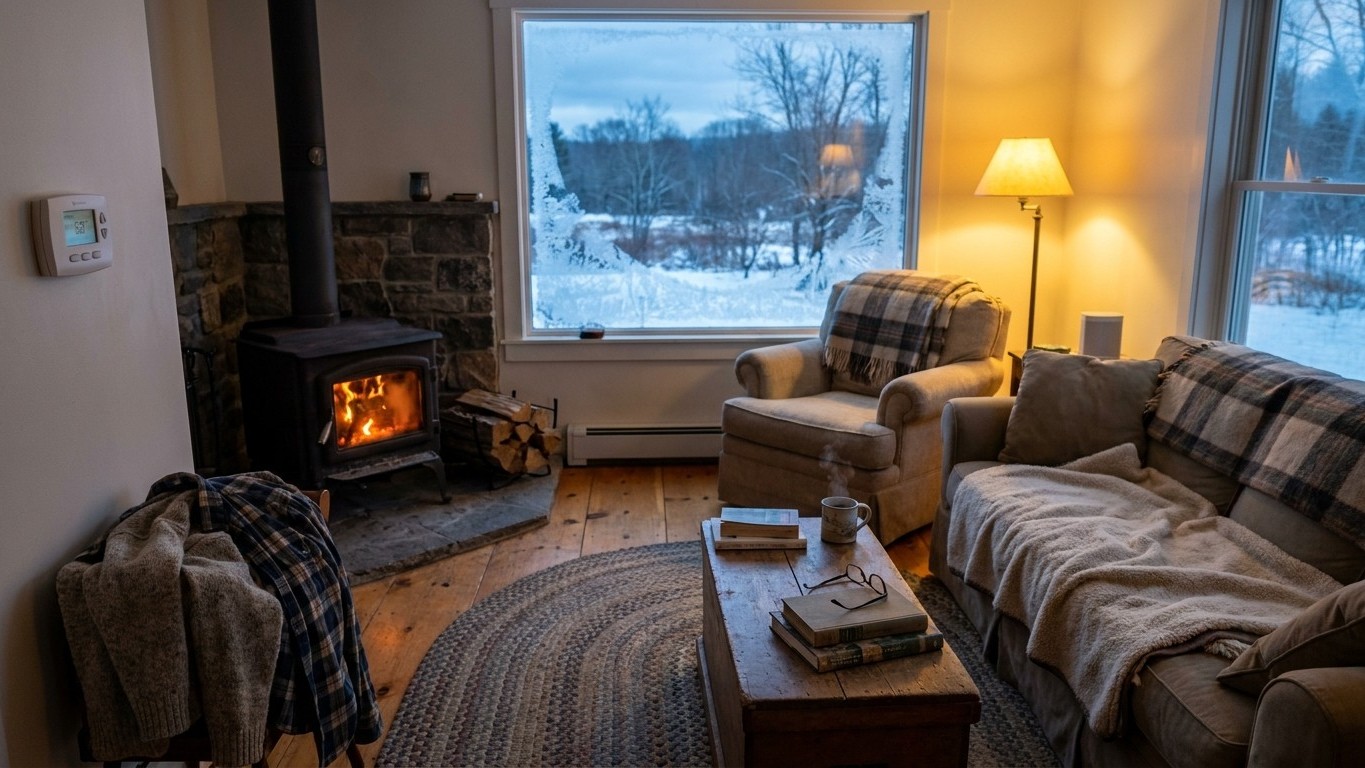

Rhode Island winters hover in a narrow, stubborn band: not brutal, but long enough to run a furnace or a woodstove for months on end. Here’s what that actually costs a household in effort, fuel, and timing.
How cold it gets, and for how long

The coldest month in Providence averages a daily low of 22.1°F, according to NOAA’s 1991-2020 Climate Normals. That’s the number that matters more than any record-cold headline, because it reflects what a house deals with night after night, not a single freak snap. A place that bottoms out at 22°F on an ordinary January night isn’t facing Arctic extremes, but it’s also not flirting with freezing for a few scattered weeks. It’s a sustained, mid-range cold that asks a heating system to work steadily from around November through March.
That distinction matters for anyone comparing notes with family in a different climate. A winter that dips to 22°F and holds there is a different animal than one that swings from 40°F to -10°F and back. The Rhode Island pattern is more marathon than sprint: no single night usually breaks the system, but the cumulative demand over four or five months adds up. Furnaces cycle more often than they run flat-out. Woodstoves need reloading on a schedule, not just during a cold snap, which raises the practical question of When Does the Heating Season Start in Rhode Island? and, just as important, When Can You Turn the Heat Off in Rhode Island?
Homes built or retrofitted with this climate in mind tend to prioritize consistent insulation and air-sealing over emergency-grade heat output. A boiler sized for occasional deep cold in a place like Minnesota would be overkill here; what Rhode Island homes actually need is efficient, steady output that doesn’t waste fuel keeping up with a mild-but-persistent chill. Understanding that 22.1°F baseline is the first step in sizing anything, whether it’s a furnace replacement or a season’s supply of firewood.
What a cord of wood is worth here
A cord of well-seasoned hardwood delivers about 20 million BTU, according to Michigan State University Extension. That’s a stack measuring 4 feet by 4 feet by 8 feet, or 128 cubic feet total, and getting that measurement right is the single most common place firewood buyers get shorted. A “cord” that’s stacked loose, or that’s really a face cord (a third of the depth), delivers a fraction of the heat while looking similar at a glance.
| Measurement | Value |
|---|---|
| Dimensions | 4 ft x 4 ft x 8 ft |
| Volume | 128 cubic feet |
| Heat output (seasoned hardwood) | about 20 million BTU |
MSU frames that 20 million BTU in terms a homeowner can actually use: one full cord of seasoned hardwood is roughly equivalent to 145 gallons of #2 fuel oil, or 215 gallons of LP gas. That’s a useful gut-check when weighing a season’s wood supply against other fuel options, though the comparison assumes the wood is properly dried, not fresh-cut.
A cord is a volume, not a weight, which is the whole trick of buying firewood intelligently. Dense species pack more mass into that same 128 cubic feet, so they burn longer and hotter than lighter woods filling the identical stack. Two cords that look the same in the yard can heat very differently depending on what’s actually in them. Given a Rhode Island heating season that runs several months on that 22.1°F baseline, a cord of dense, properly seasoned hardwood stretches further into the calendar than the same volume of a lighter species, an important detail when planning how much wood a season actually requires.
How long wood takes to dry in Rhode Island
Wood needs to reach 20 percent moisture or less before it burns efficiently. Green, freshly cut wood can sit above 60 percent moisture, according to MSU Extension, and that difference isn’t cosmetic. Every bit of that water has to boil off before the wood releases usable heat, which means green wood spends a good chunk of its energy just drying itself out mid-burn instead of warming the house.
Split and stacked properly, so air moves freely through the pile, green hardwood typically reaches that 20 percent threshold after one full summer of seasoning. That’s the standard timeline for most species in a New England climate: cut and split in spring, stack somewhere sunny and breezy, burn the following winter. Red oak is a notable exception. MSU points out that its cell structure slows moisture loss, so it needs more than one season to dry properly, an easy detail to overlook if someone assumes all hardwoods season on the same clock.
Burning wood before it’s ready doesn’t just mean a weaker fire. Unseasoned wood produces more smoke and deposits more creosote inside the chimney flue, which means more frequent sweeping and a higher fire risk over time. It’s not a dramatic hazard if caught early, but it’s the kind of maintenance shortcut that costs more in the long run than the patience of waiting out a proper seasoning period. Given that Rhode Island’s heating season stretches across several months of that 22.1°F cold, wood cut in a hurry in November and burned by December simply hasn’t had the summer air time it needs.
The practical takeaway: plan a summer ahead. Wood split and stacked by June has a real shot at being ready for the following winter’s heating season, assuming typical New England humidity and sun exposure. Wood acquired in October, whatever the seller claims about it being “seasoned,” deserves a second look before it goes in the stove.
Where to check before you buy
Rhode Island is a small state, but it still spans real differences in elevation, coastal exposure, and microclimate between the shoreline and the inland hills. The 22.1°F figure and the seasoning guidance above are anchored to the Providence reference station, and conditions elsewhere in the state can shift those numbers somewhat, especially near the coast where winter temperatures tend to moderate slightly compared to inland areas.
Before buying a season’s worth of firewood or committing to a particular heating setup, it’s worth checking with the University of Rhode Island Cooperative Extension for guidance specific to local conditions. Extension staff can speak to which hardwood species are actually available and well-suited to the region, and they track seasonal outdoor burning restrictions, which are set at the local level and can change from year to year depending on drought conditions, air quality concerns, or municipal ordinances.
That local layer matters because none of the statewide averages above override a town’s specific burn rules or a particular property’s exposure to wind and cold. The Extension office is the resource built to answer those narrower, more current questions, the kind that shift from one winter to the next in ways a fixed set of climate normals never will.
What each heat source costs to run in Rhode Island
At Rhode Island’s average residential prices, this is what one million Btu of heat delivered into the house costs with each system. It compares fuels on the same unit: it is not a yearly bill, and it leaves out the price of the equipment.
| System | Cost per million Btu delivered |
|---|---|
| Electric resistance (baseboard, 100% efficient) | $85.64 |
| Heat pump at 8.1 HSPF2 (seasonal COP about 2.4) | $36.07 |
| Natural gas furnace at 97% AFUE | $9.80 |
Cheapest to run in Rhode Island: natural gas furnace, $26.27 less per million Btu than the heat pump.
Prices: U.S. Energy Information Administration (EIA), average residential prices. Efficiencies: ENERGY STAR criteria. A heat pump’s figure is a seasonal average; in the coldest weather its efficiency drops.