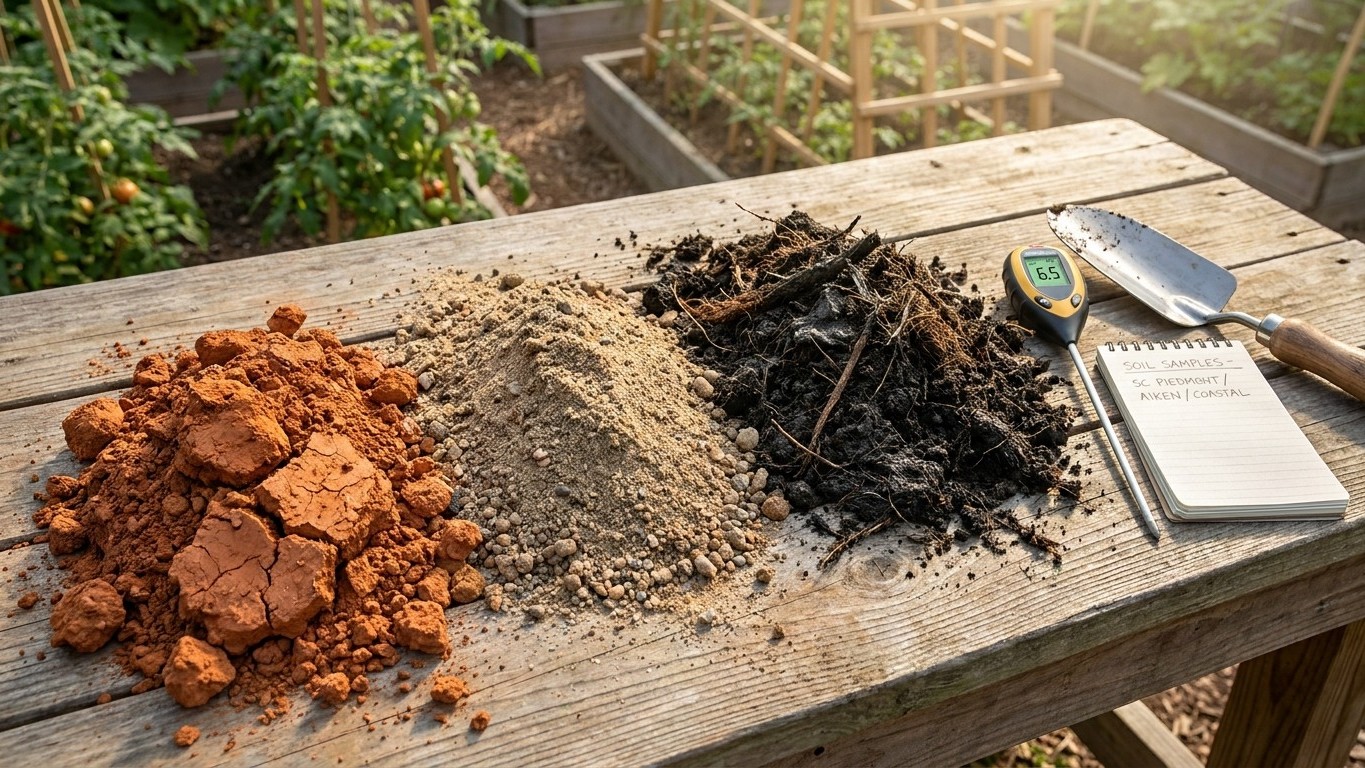

South Carolina’s official state soil is the Bohicket series, a heavy, poorly drained clay found in tidal marshes along the coast. It tells you almost nothing about the red clay hillside behind a Piedmont house or the sandy loam near Aiken, but it’s a useful starting point for understanding how this state’s ground behaves, and why a soil test matters more here than in most places.
What is under your garden

The USDA lists the Bohicket series as South Carolina’s representative state soil. It’s classified as an Entisol, which in plain terms means a very young soil with almost no profile development, layers haven’t had time to form the way they do in older, more developed ground. Bohicket forms in tidal marsh sediment, and it stays wet almost all the time. The USDA’s own component data puts the surface pH at about 7.3, near neutral, and the texture is heavy: 17 percent sand, 35 percent clay, and 48 percent silt. Organic matter runs about 15.0 percent, which is high for a mineral soil and reflects the marsh grass and detritus that build up in that environment. Drainage is rated very poorly drained, which fits a soil that sits at or below the tide line for much of the day.
| Reading | Value |
|---|---|
| Surface pH | about 7.3 |
| Sand | 17% |
| Silt | 48% |
| Clay | 35% |
| Organic matter | about 15.0% |
| Drainage class | very poorly drained |
Here’s the honest catch: Bohicket represents the state on paper, not the dirt under your tomatoes. It’s mapped along the coast, in salt marsh and tidal flats. If you garden in the Piedmont, you’re likely working red clay derived from old crystalline rock. If you’re in the Sandhills or coastal plain away from the marsh, you may be digging into deep sand. And if a builder graded your lot in the last twenty years, whatever soil you have now may be subsoil that got pushed around by a bulldozer, with none of the original structure left. None of that shows up in a state-level soil listing.
Reading your own dirt in five minutes
Grab a handful of moist soil from a few inches down and squeeze it into a ball, then push it out between your thumb and forefinger to form a ribbon. Sand won’t hold together at all. Loam forms a short ribbon, maybe an inch, before breaking. Heavy clay ribbons out two inches or more and feels slick, almost like modeling clay. That single test tells you more about your actual garden than any state average.
The second test takes overnight. Fill a clear jar about a third full of soil, top it with water, shake hard, and let it sit. Sand drops out within a minute or two, silt settles over the next few hours, and clay stays suspended, sometimes clouding the water for a full day before it finally layers out on top. The thickness of each band, measured against the total, gives you a rough percentage breakdown you can compare to any texture chart.
Testing before you amend
Guessing at pH or nutrients is how gardeners end up dumping lime on ground that’s already alkaline, or piling on nitrogen a soil doesn’t need. A lab test measures what your eyes can’t see: exact pH, phosphorus and potassium levels, and often organic matter percentage. Given that South Carolina’s representative soil sits near neutral at 7.3, you might expect similar readings nearby if you’re close to the coast, but expecting isn’t the same as knowing, and a few miles inland the number can swing in either direction depending on parent material and past land use.
Taking a sample correctly matters as much as sending it in. Do it this way:
- Pick the bed or area you actually plan to amend, and treat lawn, vegetable garden, and shrub beds as separate samples.
- Pull 8 to 10 small cores from scattered spots in that area, going down to about 6 inches, roughly where most roots feed.
- Mix the cores together in a clean bucket, breaking up clumps and removing rocks or roots.
- Let the mixed soil air-dry on newspaper for a day if it’s wet, since damp samples can skew lab results.
- Bag about a pint of the mixed, dried soil and label it with the location it came from.
- Drop it off or mail it to your local extension office along with the crop or plant you intend to grow there.
The report that comes back gives you a pH reading, nutrient levels, and usually a specific lime or fertilizer recommendation in pounds per thousand square feet, tailored to what you’re planting, not a generic number pulled from a state average.
Amending it
Correcting South Carolina ground starts with the pH question, and the state’s representative soil points toward neutral to slightly alkaline conditions at 7.3. That’s a different problem than the acidic clay found in much of the Piedmont, so the fix depends entirely on what your own test says.
If your soil tests acidic, below about 5.5
Lime is the tool here, not sulfur. Acidic ground locks up phosphorus so plants can’t use it, and it stresses brassicas like broccoli and cabbage, which prefer a pH closer to neutral. Applying lime raises pH slowly, over one or more full growing seasons, not weeks, because it has to react with soil moisture and work down through the root zone. Don’t expect a spring application to fix a bed by summer; think of it as a multi-season investment; your soil test will tell you how many pounds per square foot to apply based on how far off you are.
If your soil tests alkaline, above about 7.3
Never add lime to ground that’s already alkaline, it will only push the problem further in the wrong direction. Elemental sulfur, worked in gradually along with compost and other organic matter, is the slow but honest route to lowering pH over time. High pH also locks up iron, and that’s exactly what’s behind yellow leaves with dark green veins on plants like azaleas, blueberries, and camellias, all of which prefer acidic conditions. If you’re seeing that pattern, alkaline soil is almost always the reason.
If your soil is heavy clay
Work in organic matter, compost, aged leaves, well-rotted manure, every season, and keep doing it. Never dump sand into clay hoping to lighten it; the two combine into something closer to concrete than loam. And never work clay while it’s wet, since that compacts it into clods that can take a full season to break back down. Clay improvement is a multi-year project, not a one-time fix.
If your soil is sandy
Sand drains so fast that nutrients and water wash straight through before roots can use them. Organic matter helps it hold both, but you’ll also need to water more often, in shorter sessions, since sandy beds simply don’t store moisture the way clay does. Sandy ground actually responds faster to amendment than clay does, often showing improvement within a single season of consistent compost additions.
Drainage and compaction
The state’s representative soil carries a very poorly drained rating, meaning water sits at or near the surface for extended periods. That’s specific to marsh ground, but plenty of South Carolina gardeners deal with a version of the same problem: heavy clay subsoil, especially on graded or filled lots, that holds water long after a storm passes.
Test your own drainage with a simple percolation check: dig a hole about a foot deep and a foot wide, fill it completely with water, let it drain once, then fill it again and time how fast the second fill drops. Losing an inch an hour or faster is good drainage for most garden plants. Anything under half an inch an hour signals a slow-draining bed where roots are likely to sit wet and eventually rot.
Foot traffic and repeated tilling with heavy equipment compact soil over time, squeezing out the air pockets roots and soil organisms need. Double digging used to be the standard fix, but it’s fallen out of favor because it disturbs soil biology and structure that took years to build, and the compaction often returns within a season or two anyway. On genuinely slow-draining, compacted clay, building a raised bed with brought-in soil is usually the smarter move rather than fighting the native ground for three years straight.
- Slow-draining, compacted ground: build raised beds, add organic matter yearly, avoid walking on wet beds.
- Moderate drainage: amend with compost and mulch heavily to conserve moisture and structure.
- Fast-draining sandy ground: water more frequently in smaller amounts, mulch to slow evaporation.
- Plants that need consistently moist roots: reserve for the wettest, lowest-lying parts of the yard, or skip them if drainage is poor everywhere.
Local help
For an actual reading of your own dirt, contact Clemson Cooperative Extension, which runs the state’s soil testing lab. County extension agents review the results with you and can translate the numbers into specific amounts of lime, sulfur, or fertilizer for whatever you’re growing, rather than leaving you to guess from a statewide figure.
Common questions
Is South Carolina soil good for vegetable gardens?
It depends entirely on where you are and what’s under your specific plot. Coastal marsh ground like the Bohicket series is far too wet and salty for row crops, while inland clay and sandy loams can grow excellent vegetables once amended. A soil test is the only way to know what you’re starting with.
Why does my South Carolina clay turn rock-hard in summer?
Heavy clay shrinks as it dries, and without organic matter to hold structure, it can crack and harden noticeably. Regular compost additions and mulch help it retain moisture and stay workable through dry stretches.
Do I need to lime my South Carolina garden every year?
Not necessarily. Lime raises pH slowly and the effect lasts multiple seasons. Retest every two to three years rather than applying lime automatically each spring.
What does it mean if my soil test comes back near pH 7.3?
That’s close to the reading recorded for the state’s representative coastal soil, meaning your ground is roughly neutral. Most vegetables and lawn grasses grow well in that range without major correction.
Related guides
- North Carolina Soil: What You Are Digging Into, and How to Improve It
- Georgia Soil: What You Are Digging Into, and How to Improve It
- South Dakota Soil: What You Are Digging Into, and How to Improve It
- Arizona Soil: What You Are Digging Into, and How to Improve It
- Indiana Soil: What You Are Digging Into, and How to Improve It