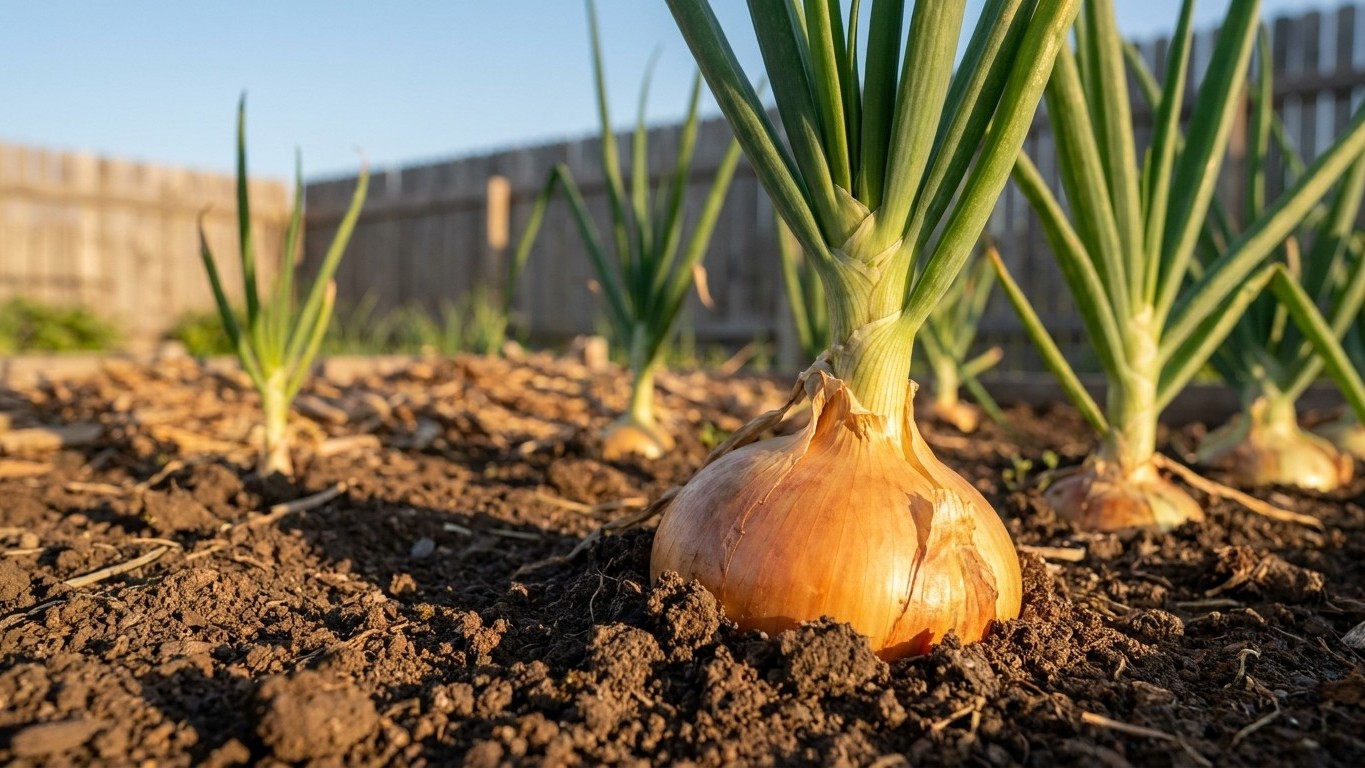

At 41.15 degrees north, the reference location for this page gets 14 hours and 58 minutes of daylight on the longest day of the year. That’s enough to trigger bulbing in long-day and intermediate-day onions, but nowhere close to what short-day varieties expect. If you’ve ever planted a sweet onion set from a big-box store here and watched it grow lush green tops with no bulb underneath, this is why.
How long your longest day is

Two numbers decide almost everything about growing onions here: 41.15 degrees north latitude, and 14 hours 58 minutes of daylight at the June solstice. Onions don’t bulb because of heat or fertilizer timing. They bulb because the plant is measuring how long the sun stays up, and once day length crosses a variety’s threshold, the plant switches from making leaves to making a bulb. Short-day types flip that switch around 12 hours of daylight. Intermediate-day types wait for something in the 12-to-14-hour range. Long-day types hold out for 14 to 16 hours before they’ll commit to bulbing at all.
At 14 hours 58 minutes, this location clears the bar for every intermediate-day onion and for most long-day onions. It’s a solid middle-latitude reading, not an extreme one. That single number is really the whole story for this page. Everything below, The Best Onion Varieties for Wyoming, the When to Plant Onions in Wyoming, the sweet-versus-keeping question, just fills in the detail around it.
Why your own spot might read differently
Wyoming stretches from roughly 41 degrees north at its southern border up to about 45 degrees north at the Montana line, so a gardener in Cheyenne or Torrington and a gardener up near Sheridan or Cody are not standing under the same sky. Move north and the longest day gets longer, sometimes by close to an hour compared to the reference figure used here. That extra daylight opens the door a little wider for long-day varieties bred for the northern edge of their range, and it pushes some borderline intermediate-day onions closer to the edge where they might struggle. If you garden near either end of the state, it’s worth checking a sunlight calculator for your own latitude rather than assuming the reference number applies exactly to your yard. The elevation swings across Wyoming (from around 3,100 feet to well over 6,000 feet in many gardening areas) don’t change day length at all, but they do change frost timing, which matters just as much as the numbers below.
Which varieties bulb in Wyoming
Given a latitude of 41.15 degrees north, most long-day and intermediate-day onions with published ranges that reach this far south have what they need to bulb properly. Nineteen documented varieties have a published latitude range that covers this location:
- Ailsa Craig, Barolo, Blush, Bridger, Frontier, New York Early, Patterson, Red Carpet, Red Long of Florence, Rossa di Milano, and Walla Walla Sweet (long-day)
- Cabernet, Calibra, Elsye, Expression, Monastrell, Red Long of Tropea, Scout, and Sierra Blanca (intermediate-day)
Three more sit close enough to a published boundary that they land in a blurred zone rather than a clear yes: Candy (intermediate-day, 33-40N), Safrane (long-day, 42-50N), and Talon (long-day, 42-50N). These are catalogue ranges, not hard lines, so treat all three as “may bulb here, worth trying on a small scale” rather than a guaranteed crop, since this location sits right at the edge of each one’s stated range.
The varieties that will not work here
This is the part that actually matters most, because it explains failures gardeners have already had without knowing why. Seven documented short-day varieties, bred for latitudes between 20 and 38 degrees north, are simply the wrong tool for this location: Gabriella, Madalyn, Red Rock, Red Sensation, Texas Grano 1015Y, Vidora, and White Castle. Planted here, a short-day onion senses the day length threshold it needs (around 12 hours) far too early in the season, while the plant is still small. It bulbs anyway, on schedule, and gives you a marble-sized onion instead of a full-sized one. That’s a variety mismatch, not something more compost would have fixed.
At the opposite extreme, two long-day varieties published for latitudes above this one, Powell (43-47N) and Redwing (43-65N), face the reverse problem. The day here never gets long enough, on average, to reach the threshold they’re bred for. These plants don’t just stay small. They keep producing leaves all summer, waiting for a day length that never arrives, and then rot in the ground as the season ends. No bulb forms at all. If you’re gardening in far northern Wyoming near 45 degrees, these two are worth a second look since the longer summer days up there change the math somewhat, but at the reference latitude they’re a poor bet.
When to plant onions in Wyoming
Because this location falls in the group where long-day and intermediate-day onions dominate, the planting calendar runs on a late-winter-to-spring schedule rather than the fall-planting approach used farther south, where mild winters let short-day onions overwinter in the ground. Here, the frost window is the frame everything else fits inside: the average last spring frost falls between May 7 and May 18, and the average first fall frost falls between September 24 and October 5, based on NOAA’s 1991-2020 climate normals. That’s a frost-free stretch of roughly 130 days at higher elevations, and those dates are averages built from a 30 to 70 percent freeze probability band, not a promise. Frost has shown up in surprise cold snaps outside that window, and at elevations above 6,000 feet it can appear in almost any month.
In practice, that means starting onion seed indoors 8 to 10 weeks before the early end of that spring frost window, so transplants go into the ground already several inches tall once the soil has warmed and frost risk has eased. Onion sets, the small dry bulbs sold for direct planting, can go in slightly earlier since they tolerate a light frost better than tender seedlings. Either way, treat mid-May as a rough target for having plants established, not a locked-in date, and keep row cover or another frost protection option on hand for a cold night that shows up ahead of schedule. Wyoming’s wide elevation range means a gardener at 6,500 feet should push their calendar later than one at 4,500 feet, even within the same county.
Sweet onions or onions that keep
The onions that grow well at this latitude lean toward the storage end of the spectrum rather than the sweet end, and that comes down to chemistry rather than luck. Pungency in an onion comes from volatile sulfur compounds, and University of Missouri Extension notes that those same compounds are what protect a bulb in storage. A sweet onion has fewer of them, which is exactly why it tastes milder raw and exactly why it breaks down faster in a bag or basket. As a rule, sweet onions do not store as well as the more pungent types.
Day length lines up with this trade-off almost perfectly. Short-day onions, grown in the South, tend to run sweeter and don’t keep past a few weeks. Long-day and intermediate-day onions, the types that actually bulb at this latitude, tend to carry more of those sulfur compounds and hold up in storage for months. That’s good news for a Wyoming pantry: onions from varieties like Patterson, Frontier, or Red Carpet, cured properly and kept cool and dry, can realistically still be usable in March. What you won’t get, at least not from a variety that also stores, is the mild, almost fruit-like sweetness of a Vidalia-style short-day onion. That flavor profile belongs to a latitude this location simply doesn’t share. Choose based on what you want more: onions to eat fresh within weeks, or onions that carry you through winter, because at this latitude you’re generally not getting both from the same bulb.