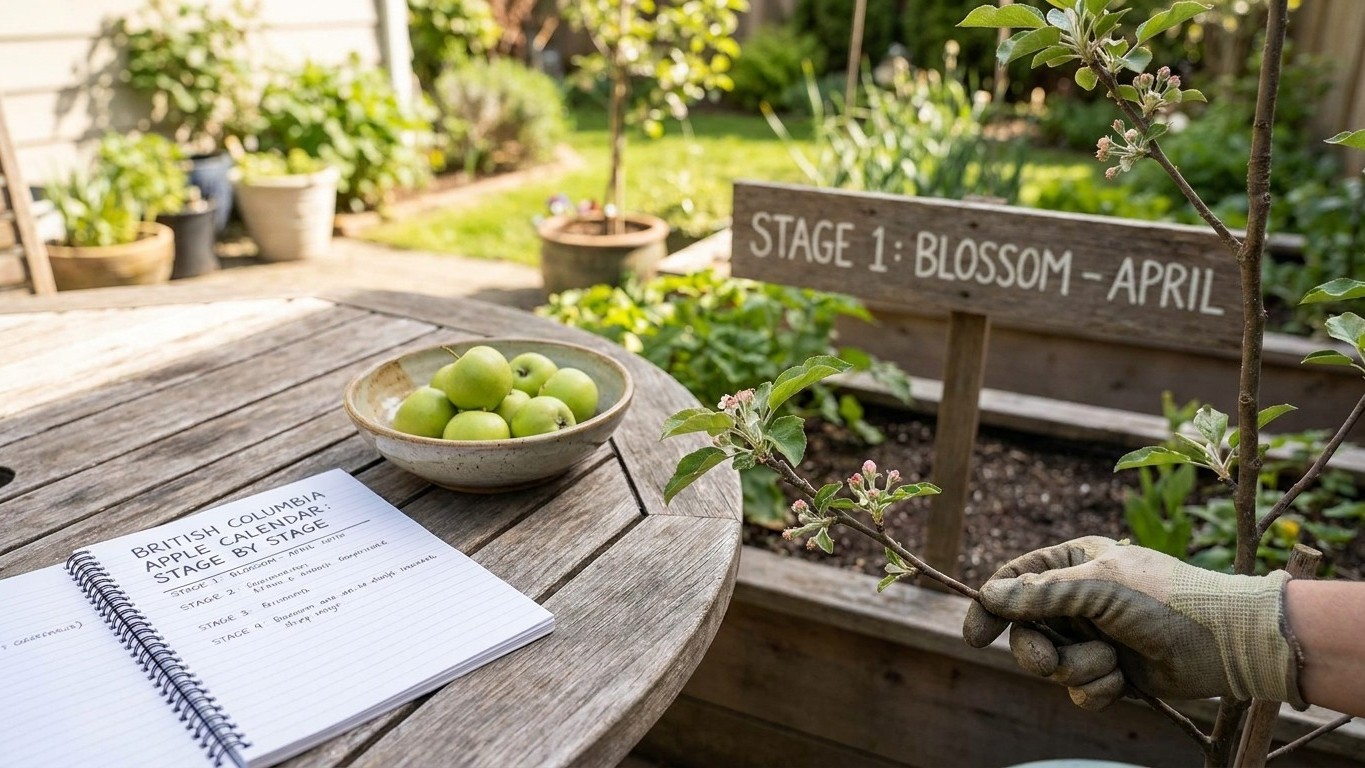

Apples in British Columbia are timed by bud stage, not by the calendar. Environment and Climate Change Canada’s 1981-2010 normals put the average last spring frost at Vancouver Int’l A at March 18 and the average first fall frost at November 10, which brackets a growing season of roughly eight months at that one coastal station. The one thing to do before anything else: walk out and check what stage your buds are actually at this week, because that stage, not the date on the wall, decides whether you spray, thin, or wait.
The short answer for British Columbia
At the Vancouver Int’l A reference station, ECCC’s 1981-2010 climate normals put the average last spring frost at March 18 and the average first fall frost at November 10. That gives a working frame for when bloom is at risk in spring and when late-season fruit is at risk in fall, but it is a mean date, not a guarantee: in roughly half of all years, frost at this station arrives later than March 18, so a tree in full bloom in mid-March is gambling on the better half of the odds.
What the answer depends on is where you actually are. Vancouver’s coastal air is moderated by the Strait of Georgia and by Pacific weather systems moving through, which is why its frost dates sit where they do. Move inland to a valley bottom, or up in elevation, and both the last spring frost and the first fall frost shift, usually later in spring and earlier in fall, which shortens the window on both ends. Nothing in the published ECCC normals covers those other stations directly, so treat the Vancouver dates as the coastal benchmark and adjust by what you see on your own trees, not by a number pulled from a different valley.
The other half of the answer is variety. An apple that blooms early meets more frost risk than one that blooms late, regardless of what the calendar says, and a full rundown of which cultivars fit which part of the province is worth reading before you plant: see The Best Apple Varieties for British Columbia for cultivar-level detail. This page is about the stages a tree already in the ground moves through each year, and about anchoring each stage against the Vancouver frost dates so you know which weeks carry real risk.
Working through it

An apple tree does not read a calendar. It moves through a fixed sequence of visible stages each year, and the pace of that sequence depends on temperature, which is exactly why frost dates matter more than months. Here is the sequence, anchored on the Vancouver Int’l A normals from ECCC.
Dormancy

From roughly November through February the tree is bare and inactive. This is the only safe window for structural pruning and for dormant oil sprays against overwintering pests, because cutting or spraying a tree that has already broken bud wastes chemical and invites disease into fresh wounds.
Green tip

Buds split and show a first sliver of green, typically while the ground is still cold. This is the last practical moment for a dormant oil application: once green tip has passed, the tender tissue underneath is exposed and oil at dormant-season rates can burn it.
Pink

The flower cluster becomes visible with pink at the tips before it opens. Fungicide programs against apple scab, where scab pressure is a known problem, typically start around here, because the wet spring weather that drives scab infection is already underway well before the flowers open.
Bloom

Full white blossom, usually falling somewhere inside the window either side of the March 18 mean last frost at Vancouver, is the single highest-risk stage of the whole year. An open flower is killed by a much lighter frost than a dormant bud tolerates, so a late frost landing on a tree already in bloom can wipe out the year’s crop even though the tree itself survives undamaged.
Petal fall

Petals drop and a tiny fruitlet appears at the base of each flower that was successfully pollinated. This is the point to judge pollination weather retrospectively: cold, wet, windless days during bloom mean fewer bees flying and a lighter fruit set at petal fall.
Fruit set

Fruitlets swell to marble size. Thinning, removing excess fruitlets by hand so the tree isn’t overloaded, is done here rather than later, because a tree carrying too many fruitlets past this point puts its stored energy into a heavy crop of small apples instead of a lighter crop of good-sized ones.
Harvest
Fruit reaches full size and the color and firmness that mark that cultivar’s ripeness. The stretch between petal fall and harvest has to fit inside the frost-free window bounded by the two ECCC means, and a late-maturing cultivar picked after the November 10 average first fall frost at Vancouver is exactly the kind of mismatch covered in the next section.
What changes across British Columbia
British Columbia is not one climate, and the Vancouver Int’l A figures describe the coast, not the whole province. The Okanagan Valley, where most of the province’s commercial apple acreage sits, runs a continental climate with colder winter nights and hotter summer days than the coast, and valley-bottom sites there are prone to cold air pooling on clear still nights, which is the classic setup for a late spring frost pocket right where the orchard floor sits lowest.
The Fraser Valley, inland of Vancouver but still coastal-influenced, tends to track closer to the Vancouver normals than the interior does, though local frost pockets still form in low, poorly drained fields where cold air has nowhere to drain away. Coastal Vancouver Island and the immediate Lower Mainland benefit from the moderating effect of surrounding water, the same effect that keeps Vancouver’s own coldest-month mean daily minimum at a mild 0.8 °C according to ECCC’s 1981-2010 normals, a figure that rules out true winter dieback risk for hardy apple wood at that station but says nothing about frost at bloom, which is a separate hazard entirely.
Higher-elevation districts and interior valleys such as parts of the Kootenays run behind the coast on both ends of the season: spring stages arrive later because the ground and air warm more slowly, and fall frost tends to arrive earlier because these areas lose the ocean’s heat-holding effect overnight. No ECCC figure in the normals used on this page covers those interior or upland stations directly, so a grower there should expect the whole stage sequence, dormancy through harvest, to run later than anything timed against the Vancouver dates, and should watch for the region’s own frost pattern rather than assume the coastal window applies.
The mistakes this climate punishes
The costliest mistake in this climate is planting an early-blooming cultivar and trusting the calendar instead of the frost record. Because the March 18 ECCC mean last frost at Vancouver is a midpoint, not a cutoff, a tree that blooms reliably by mid-March is exposed to frost in roughly half of all years at that station, and an early bloomer sited in an interior valley that runs behind the coast faces the same risk later in the season rather than avoiding it. This shows up as a bloom that looks perfect one week and a crop of brown, dead flower clusters the next, usually within days of a clear cold night.
The second mistake is applying dormant oil, or doing structural pruning cuts, after green tip has already opened. Oil at dormant-season concentration on exposed green tissue causes burn, and pruning cuts made once sap is moving bleed more and heal slower, inviting the fungal and bacterial problems that a clean winter cut avoids. This is a mistake of timing by the calendar instead of by the tree: a mild February can push green tip well ahead of where the calendar says it “should” be.
A third, less obvious mistake is feeding nitrogen too late in the season. Fertilizer applied in mid to late summer pushes soft new shoot growth right when the tree should be hardening off wood ahead of the November 10 ECCC mean first fall frost at Vancouver. That soft growth is the first tissue killed when the first real cold snap arrives, and the damage often isn’t visible until the following spring, when those shoot tips fail to leaf out.
- Early-blooming cultivar in a frost-prone valley bottom: crop loss shows at bloom, most years, not just the unlucky ones.
- Dormant oil or pruning after green tip: bud burn or slow-healing cuts, visible within days.
- Late nitrogen feeding: soft wood killed at first fall frost, damage visible the following spring.
Getting the cultivar right in the first place removes most of this risk before it starts, which is the argument for reading the variety-level detail before planting rather than after: see The Best Apple Varieties for British Columbia for cultivars matched to bloom timing and chill requirement, and Growing Apples in British Columbia for the planting and site groundwork this calendar assumes is already done.
Checking this against your county
The ECCC normals used throughout this page come from one station, Vancouver Int’l A, and describe the coast around Vancouver specifically. If you’re gardening in the Okanagan, the Kootenays, on Vancouver Island, or anywhere inland, your own frost dates and stage timing will differ from what’s written here, sometimes by weeks. For local guidance specific to your region, check the British Columbia Ministry of Agriculture and Food resources, which cover growing conditions and crop guidance province-wide rather than for a single coastal station.
Common questions
How do I know if my apple tree is at green tip or already past it?
Look closely at the buds rather than at the calendar. At green tip the brown scales have split and you can see a sliver of green leaf tissue still tightly rolled inside. If the leaf tissue has already unrolled and started to spread, you’re past green tip and dormant oil is no longer the right tool.
Will a late frost after bloom always kill the crop?
Not always, but it’s the highest-risk moment of the year. Open flowers are far more frost-sensitive than dormant buds, and because the ECCC mean last frost at Vancouver is a midpoint rather than a cutoff, frost lands after bloom in a meaningful share of years even at that coastal station, so a single frost event doesn’t necessarily mean total loss if only part of the bloom was open at the time.
Can I speed up bloom by feeding the tree in early spring?
Feeding won’t reliably move a tree’s stage forward, since bloom timing is driven mainly by accumulated temperature, not by nutrients. What early spring feeding can do, if it’s heavy on nitrogen, is push soft growth that’s more vulnerable to a late frost, which works against you rather than for you.
My tree bloomed weeks before my neighbor’s same variety. Why?
Site conditions move bloom timing more than most people expect. A tree against a south-facing wall, in a sheltered spot, or on a slope that sheds cold air will reach each stage days to a week or more ahead of the same cultivar in open, low, or shaded ground nearby, even within the same yard.