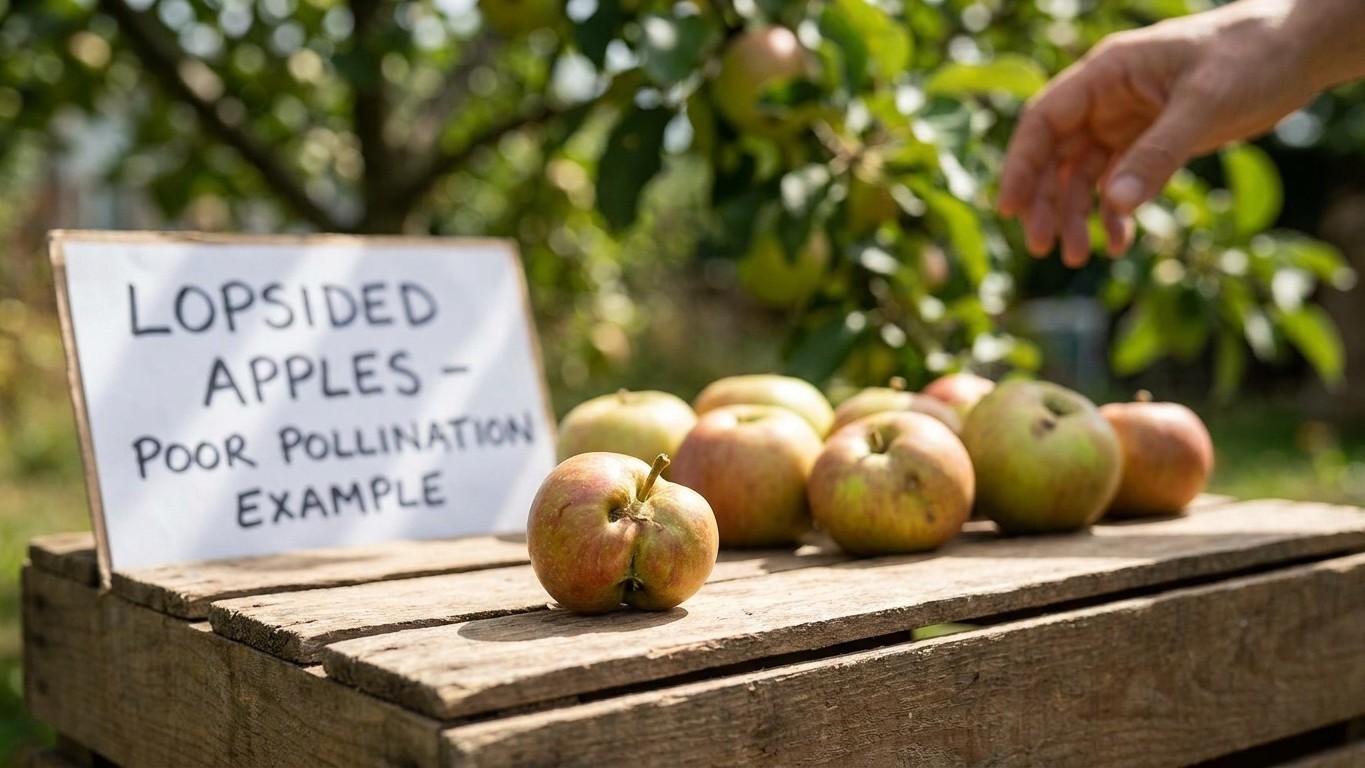

A lopsided apple is almost always a pollination problem, not a disease or a pest. Cut the fruit crosswise through the middle and count the seeds on the full side against the flat side. If the full side has more seeds, you have your answer.
What you are seeing

Look at the apple from the stem end. One shoulder bulges out round and full. The opposite shoulder is flatter, sometimes pinched in, and the whole fruit leans to one side when you set it down. Cut it in half through the core and the asymmetry usually continues inward: the core itself sits off-center, tilted toward the fuller side.
Seed count explains the shape
An apple has five carpels arranged around the core, and each one needs at least one fertilized seed inside it to push flesh outward evenly on that side. A carpel that never got pollen, or got it late, produces little or no seed, and the tissue around it simply grows less. The fruit is not damaged. It is just building itself around whatever seeds it actually has.
This is why a lopsided apple is completely edible and usually tastes no different from a well-formed one on the same branch. The flesh quality is not affected, only the shape. It does not mean the tree is sick, and it does not mean the orchard has a soil or watering problem. Some varieties, Golden Delicious among them, show a bit of natural asymmetry even in a good pollination year, so a mild lean to one side on an otherwise healthy-looking apple is not automatically a red flag. What should get your attention is a whole tree producing markedly lopsided fruit, or a pattern that repeats year after year on the same branches.
What it is not
Rule out the things that look similar before you settle on pollination as the cause. Cedar apple rust and other fungal infections cause distortion too, but they come with visible lesions, yellow-orange spotting on the leaves, or corky raised patches on the skin, not a smooth but uneven fruit shape. If the skin surface itself is broken, scabbed, or scarred, you are looking at a disease or an insect problem, not a seed-distribution issue.
Insect feeding, especially from plum curculio early in the season, leaves crescent-shaped scars and dimpled depressions with a distinct wound mark at the center of each scar. That is a puncture pattern, different from the smooth, gradual lean of a pollination-driven shape. Frost damage during bloom or shortly after tends to show as a ring of rough, corky russeting around the fruit rather than a one-sided bulge.
It also is not the same problem as a tree producing fruit that is uniformly small rather than uneven in shape. Undersized but symmetrical apples point toward crowding, water stress, or heavy crop load, which is a separate issue covered on Apples That Stay Small. A lopsided apple can be full-sized on its rounder half and still qualify as a pollination symptom, which is the detail that separates the two problems.
What actually causes it
Several things can leave a flower only partly fertilized, and they are worth telling apart because the fix is different for each.
Not enough pollen reaching the flower
If the tree has no compatible pollen source nearby, or the one it has bloomed too early or too late to overlap, most flowers get only a partial dose of pollen carried in by whatever bees happened to visit. The Clemson Cooperative Extension fact sheet HGIC 1350 groups common varieties by relative bloom timing: group A includes Anna and Dorsett Golden, group B includes Fuji, Gala, Ginger Gold, Granny Smith, Jerseymac, Mollie’s Delicious, Mutsu, Red Delicious, and Yates, and group C includes Arkansas Black, Golden Delicious, Jonagold, Ozark Gold, Priscilla, Rome Beauty, and Stayman. These groups are a relative order, not fixed calendar dates. They shift earlier or later depending on your climate, but a variety in group A will still tend to open before one in group C wherever you garden.
| Bloom group | Example varieties | Pollen note |
|---|---|---|
| A (earliest) | Anna, Dorsett Golden | Overlaps best with other group A or early group B bloom |
| B (mid) | Fuji, Gala, Ginger Gold, Granny Smith, Jerseymac, Mollie’s Delicious, Mutsu, Red Delicious, Yates | Mutsu has sterile pollen despite blooming in this window |
| C (latest) | Arkansas Black, Golden Delicious, Jonagold, Ozark Gold, Priscilla, Rome Beauty, Stayman | Jonagold and Stayman have sterile pollen |
Two varieties that cannot pollinate each other
Jonagold, Mutsu, Stayman, and Winesap all carry sterile pollen, according to HGIC 1350, the University of Georgia Extension Circular 740, and USU Extension. Each of these can accept pollen and set fruit normally, but none of them can be the pollen source for a neighboring tree. A garden holding only two of these four varieties, and nothing else, will bloom well and set little to no fruit at all, because neither tree can finish the other’s flowers. If you are still choosing what to plant, Growing Apples covers how to pick a second variety before you put a tree in the ground.
Weather during bloom matters just as much as variety pairing. Cold, wet, or windy conditions during the bloom stage keep bees from flying and can shorten the whole bloom window, so even a well-matched pair of trees can end up with a partial set in a bad spring. Your own extension service is the right place to check typical bloom-season weather patterns and frost risk for your area, since those figures shift from one county to the next.
What to do this season
There is not much you can do to reshape fruit that has already set. The seed count inside each apple was largely decided during the bloom and petal fall stages, weeks before the fruit reached any noticeable size, and no amount of feeding, watering, or pruning now will add seeds to a carpel that never got fertilized.
What you can do is manage the crop you have. During your normal thinning pass, prioritize keeping the well-formed, more symmetrical fruit and remove the most severely lopsided ones first, since they are usually the smallest contributors to total yield anyway. Some of the worst-affected fruit will drop on its own. A tree naturally sheds fruit with the weakest seed set during the June drop, and lopsided apples with low seed counts are exactly the kind of fruit that tends to go in that drop. If you are seeing a lot of small fruit falling around that stage, Why Small Apples Fall in June explains what is normal to lose and what is not.
If the lopsided fruit is otherwise sound, with no scarring or rot, there is no reason to remove it from the tree on cosmetic grounds alone. It will finish ripening on the same schedule as the rest of the crop and is fine to eat, can, or cook with. The one thing worth flagging for next year is whether the pattern was isolated to a few clusters, which is normal variation, or spread across the whole tree, which points toward the pollination problems above.
Stopping it happening again
The fix has to happen at the bloom stage next spring, which means the decisions get made well before that: what you plant, and where.
If your orchard currently relies on a single variety, or on two varieties that both carry sterile pollen, the single most effective change is adding a fertile-pollen variety that blooms in the same relative window. Checking HGIC 1350’s bloom groups against what you already have is the fastest way to find a match: a group B tree pairs well with another group B tree, and reasonably well with a group A or group C variety whose bloom overlaps at the edges. Avoid building an orchard out of only Jonagold, Mutsu, Stayman, and Winesap in any combination, since none of them can pollinate any of the others.
Encouraging pollinator activity during the bloom window helps close the gap in years when weather is against you. That means holding off on any insecticide application while the tree is in bloom, since the flowers are the thing you are trying to protect activity around, and keeping other early-blooming plants nearby to draw bees into the area in the first place. None of this replaces having a compatible second tree. It only makes better use of the pollen that tree is producing.
Common questions
Can I eat a lopsided apple?
Yes. The uneven shape comes from seed distribution, not rot or disease, and the flesh quality on a lopsided apple is normally the same as on a symmetrical one from the same tree.
Will thinning fix the shape of the apples still on the tree?
No. Thinning removes fruit, it does not add seeds to the fruit that remains, so the apples you keep will finish the season with whatever shape they already had by petal fall.
My tree has two apple varieties and I still got lopsided fruit. Why?
Check whether both varieties carry sterile pollen, since a pairing like Jonagold and Stayman looks like two varieties but functions like one for pollination purposes. Also check that their bloom windows actually overlap, since two compatible varieties that flower weeks apart will not help each other much.
Is a crabapple enough to fix pollination problems?
A flowering crabapple with fertile pollen and an overlapping bloom window can work as a pollen source, but not every ornamental crabapple blooms at a useful time or produces viable pollen. Confirm with your local extension service or a nursery catalogue before relying on one as your only pollenizer.