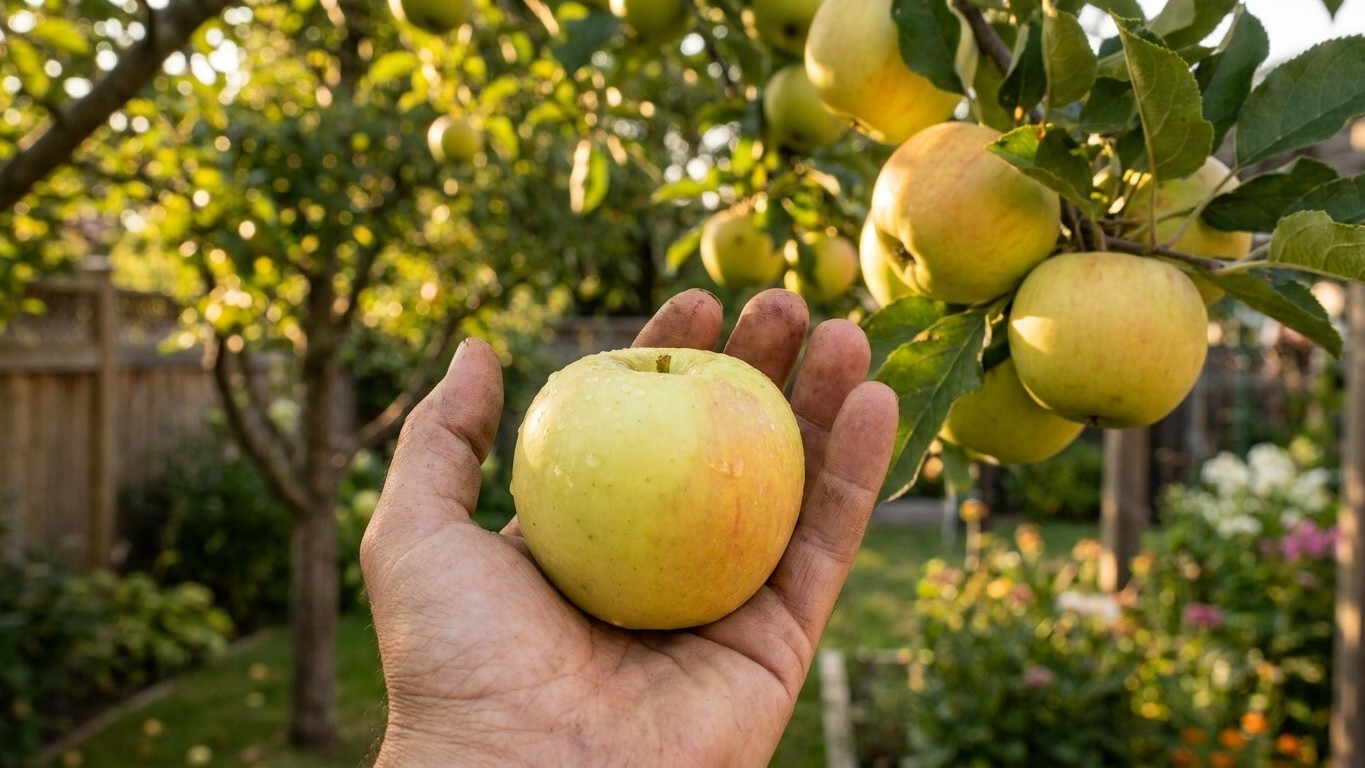

Sansa is a mid-to-late August dessert apple, hardy in USDA zones 5-7, with sweet, fragrant, honey-tinged flesh that’s better eaten fresh than baked into a pie. It blooms mid-season and carries a susceptibility to fire blight worth planning around before you plant it near other trees.
What Sansa actually is

According to USU Extension’s Apple Production for the Utah Home Garden, Sansa is defined by a handful of traits that matter more to a home grower than any marketing description ever could. Here’s what you’re actually getting:
- Ripening time: Mid to Late August
- Flavor: Sweet and fragrant with a hint of honey, crisp and juicy flesh
- Best use: An early dessert apple, eaten fresh out of hand
- Keeping ability: Short, as with most August apples
The flavor profile is the part growers tend to remember. Sweet and fragrant with a hint of honey isn’t a stretch of the imagination, it’s the recorded description, and it’s paired with crisp, juicy flesh that snaps rather than mushes when you bite in. That combination puts Sansa in the same conversation as other August apples grown for eating fresh rather than for storage or cooking.
Where Sansa loses points, at least for the baker, is acidity. The source notes that low acidity means it eats better than it cooks, and that’s a physical fact, not a taste preference. Pie apples need acid that survives an hour in a hot oven and flesh structure that holds together instead of collapsing into sauce. Sansa’s flesh is built for the hand, not the pan. If you’re planting for pies and applesauce, this isn’t your variety. If you’re planting to hand a kid an apple straight off the tree in the third week of August, it is.
Will it grow where you are
Hardiness zones
USU Extension lists Sansa as hardy in USDA zones 5 through 7. That’s a range, not a single number, and it matters because a lot of nursery tags round it down to “zone 5” or up to “zone 7” depending on which edge they want to advertise. In practice, the middle of that range, zone 6, is where Sansa is least likely to surprise you with winter dieback or a late frost catching mid-season bloom.
Winter chill
Hardiness zone only tells you whether the tree survives winter. It doesn’t tell you whether the tree will flower and fruit reliably, and that’s where winter chill comes in. Chill hours, the accumulated time a tree spends below about 45°F each winter, determine whether dormancy breaks cleanly in spring. Our source doesn’t publish a chill-hour figure for Sansa, so rather than guess at a number, it’s fairer to say plainly that the chill requirement isn’t documented in this source.
What the zone range does tell you is which end of the country this apple belongs to. Zones 5-7 cover most of the northern and mid-latitude United States, from interior New England and the upper Midwest down through the mid-Atlantic and into the cooler parts of the Southeast at higher elevation. It’s not a tree bred for mild-winter regions like coastal California or the Gulf Coast, where chill accumulation runs short most years. If you garden in one of those milder zones, Sansa is a riskier bet than it is in, say, Ohio or Utah, where the zone 5-7 band and typical chill accumulation line up comfortably.
What to plant beside it
This is usually the question that brought you here, and the honest answer is that a published pollination partner list for Sansa isn’t available in the source used for this page. That’s worth saying plainly rather than guessing at a name to fill the gap, because a wrong guess costs you a wasted planting season.
What can be said with confidence is the general rule that governs nearly every apple variety, Sansa included: nearly all varieties crop better with a compatible partner nearby. Apples are mostly self-unfruitful, meaning a lone tree either sets little fruit or none at all. A second variety, blooming at a compatible time and genetically distinct enough to cross-pollinate, is what actually gets bees moving pollen from flower to flower and fruit forming on the branch.
Sansa’s bloom season is listed as mid-season, which narrows the search considerably even without a named list. A workable pollinator needs to flower at the same time, mid-season varieties are the safest match, since early bloomers may finish flowering before Sansa opens and late bloomers may not have started. When you’re at the nursery, ask specifically for a mid-season apple variety known to be a strong, compatible pollen source, and confirm it isn’t a parent-and-seedling pairing; a variety can’t reliably pollinate its own direct offspring even if the bloom times line up, because the genetic overlap is too close for good cross-pollination.
A crabapple with a long, heavy mid-season bloom is often the simplest backup if you don’t want to commit a second full-size tree to the job. For the mechanics of matching bloom windows and reading pollination compatibility charts, see our guide to apple tree pollination.
Growing it well
Fire blight
USU Extension rates Sansa as susceptible to fire blight, a bacterial disease that moves fast in warm, wet spring weather and can kill blossoms, shoots, and eventually whole limbs if it isn’t caught early. In practice, susceptible means you’ll want to watch new growth closely during and just after bloom, looking for the telltale shepherd’s-crook curl at branch tips and blackened, water-soaked leaves that look scorched. It also means pruning tools need to be sanitized between cuts if you’re removing infected wood, and that planting Sansa next to another blight-prone variety compounds the risk rather than spreading it out.
Growth habit and thinning
The source doesn’t detail a specific growth habit for Sansa beyond its bloom timing and disease rating, so it’s worth applying general August-apple management here: mid-season bloomers that set a heavy crop typically benefit from hand-thinning fruit clusters down to one or two apples per cluster a few weeks after bloom. Thinning reduces limb stress, improves fruit size, and helps guard against the biennial bearing pattern, heavy crop one year, little to nothing the next, that afflicts many apple varieties when they’re left to overbear.
Without a published biennial-bearing rating for Sansa specifically, the safest approach is precautionary thinning every year rather than waiting to see if alternating crops become a problem. It costs you an afternoon each June and saves you a disappointing August three summers from now.
Picking it and keeping it
The harvest window for Sansa runs Mid to Late August, but a calendar date is a starting point, not a verdict. The tree, not the calendar, tells you when fruit is actually ready. Work through this sequence on a few apples before you pick the whole tree:
- Lift and twist a fruit gently in your palm. If it separates cleanly from the spur with a slight twist, it’s ready; if you have to tug or pull, give it more time.
- Cut one apple open and check the seeds. Ready fruit shows seeds that have turned brown to dark brown, not pale or greenish.
- Check the ground color, the background skin tone beneath any red blush. As Sansa nears ripeness, that background shifts from green toward a yellow-green or cream tone.
Storage
Like most apples that ripen in August, Sansa isn’t built for the long haul in storage. Early-season apples generally hold for a matter of weeks rather than months, even under good refrigeration, because their cell structure and lower acidity that make them so pleasant to eat fresh also make them break down faster in storage than a late-season, high-acid variety would. Refrigerate promptly after picking, keep the fruit away from ethylene-producing produce like bananas, and plan to eat your Sansa crop within the first few weeks rather than saving it for winter.
Common questions
When does Sansa apple ripen?
Mid to Late August, according to USU Extension, though the lift-and-twist test on individual fruit is a more reliable signal than the calendar date alone.
Is Sansa apple good for baking?
Not especially. It’s classed as an early dessert apple, and its low acidity means it eats better fresh than it cooks, since acid and firm flesh are what hold an apple together in a hot oven.
What zone does Sansa apple grow in?
USDA hardiness zones 5 through 7, per USU Extension. Winter chill requirements for the variety aren’t published in that source, so growers in milder zones should confirm local chill accumulation before planting.
Does Sansa apple need a pollinator?
Almost certainly, since nearly all apple varieties crop better with a compatible partner nearby. A specific named pollinator for Sansa isn’t published in the source used here, so look for another mid-season-blooming apple variety, matching Sansa’s own mid-season bloom.
Is Sansa apple susceptible to disease?
Yes, it’s rated susceptible to fire blight, which means watching new growth closely during bloom season and pruning out any infected wood promptly with sanitized tools.