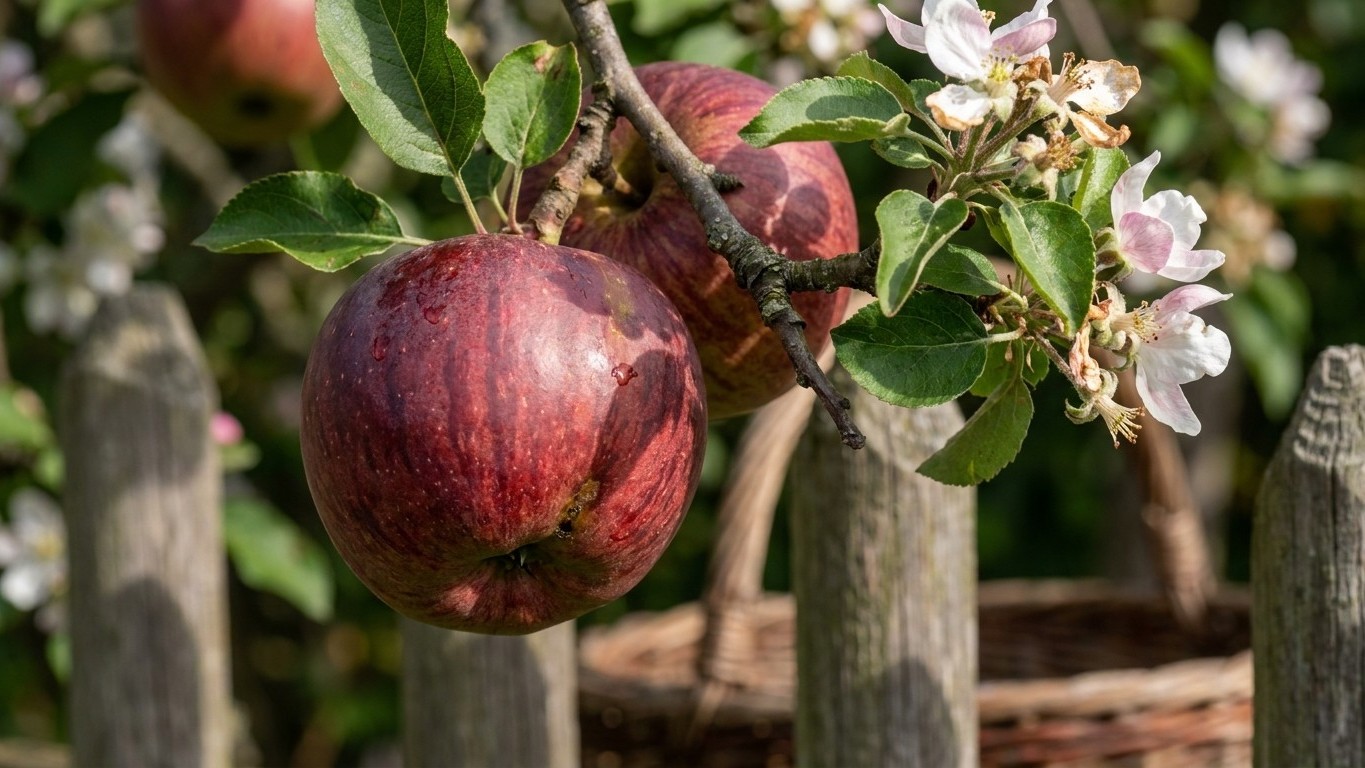

Stayman is a tart, all-purpose apple bred from Winesap stock, prized by home orchardists for its flavor and its cooking versatility. But it comes with a catch that trips up a lot of new growers: its pollen is sterile. Plant it alone, or pair it with the wrong neighbor, and you’ll get blossoms with no apples to show for them.
What Stayman actually is

- When it ripens: a fall-season apple, picked well after the early summer varieties are gone
- What it tastes like: tart, with real acidity that carries through cooking
- What it is good for: all-purpose use, fresh eating and cooking alike
- How Long It Keeps: covered in detail below, once it’s off the tree
Clemson Cooperative Extension’s variety table (HGIC 1350) lists Stayman’s eating quality as tart and its kitchen use as all-purpose, and that combination is the reason growers keep planting a variety that’s over a century old. A tart apple with all-purpose flexibility isn’t just a flavor note, it’s a physical property. The flesh holds its shape under heat instead of collapsing into mush, and the acidity that makes it bracing raw is the same acidity that balances sugar in a cooked pie or sauce. That’s a different animal from a soft, sweet dessert apple that turns to applesauce the moment it hits a hot oven, or from a pie-only apple too sharp to enjoy out of hand.
Growers who want one tree to do the work of two, a fresh-eating apple in September and a baking apple through the holidays, gravitate toward exactly this kind of dual-purpose fruit. Stayman doesn’t ask you to choose. Slice it into a lunchbox or into a pie crust and it performs both jobs without apology, which is a rarer trait among heirloom varieties than the marketing on nursery catalogs sometimes suggests.
Will it grow where you are
Hardiness
The sourced data used for this page doesn’t include a published USDA hardiness zone range for Stayman, so no zone figure is given here rather than guessing at one. What can be said with confidence is that Stayman is a variety with a long track record in regions with cold winters and a real dormant season, the kind of climate found through much of the mid-Atlantic and Appalachian growing belt. That regional pattern reflects decades of orchard practice rather than a lab-tested zone boundary, and it’s worth confirming local performance with a Cooperative Extension office before committing a planting site to it.
Winter chill
No chill-hour figure for Stayman appears in the sourced facts for this page, so none is stated here. Winter chill, the accumulated hours of cold a tree needs before it will break dormancy and bloom reliably, is the filter home growers in warm climates run into even when a variety’s cold-hardiness on paper looks fine. Varieties bred and grown for generations in colder eastern states, which is Stayman’s history, tend to belong at the higher-chill end of the spectrum rather than the low-chill end suited to mild-winter regions like the Gulf Coast or coastal California. A grower in a mild climate should treat that as a real question mark rather than an assumption, and check with a local extension office before planting.
What to plant beside it
This is where Stayman demands more attention than most varieties, because its pollen is sterile. According to Clemson HGIC 1350 and UGA Extension bulletin C740, Stayman can be pollinated by other apples, but its own pollen cannot fertilize any tree, including itself. That means a Stayman tree will never serve as the pollen source for a neighboring apple. It needs a partner to set fruit, and that partner needs a partner of its own, because Stayman can’t return the favor. A garden built around just two trees, Stayman and one pollinator, may bloom beautifully and still leave the grower short on fruit, because the pollinator itself may need a different variety to bear well. A third tree in the mix is the safer bet.
Stayman’s bloom group is C, according to the same Clemson and UGA sources, which places its flowering in the middle of the season relative to other apples, a useful marker since bloom groups describe relative order rather than fixed calendar dates. The following varieties are named in those sources as able to pollinate Stayman:
- Arkansas Black
- Golden Delicious
- Ozark Gold
- Priscilla
- Rome Beauty
One pairing to avoid despite matching bloom times: Jonagold flowers at the same time as Stayman, but Jonagold’s own pollen is also sterile, so the two together produce no fruit at all even though their blossoms overlap perfectly on the calendar. It’s a reminder that shared bloom timing is only half the equation. The other half is whether the pollen itself is viable and genetically compatible, and a parent variety generally cannot pollinate its own seedling either, which is why lineage matters as much as bloom date when choosing companions. For a fuller breakdown of how bloom groups and pollen compatibility interact across varieties, see this site’s apple pollination guide.
Growing it well
Fire blight
Stayman is rated susceptible to fire blight, a bacterial disease that spreads through blossoms and succulent new growth, especially during warm, wet spring weather. In practice, that rating means a grower should watch for blackened, wilted shoot tips that curl over into a shape often described as a shepherd’s crook, and should prune out infected wood promptly, cutting well below the visible damage and disinfecting tools between cuts. Resistance ratings in other varieties don’t mean immunity, and a susceptible rating like this one means the grower carries more responsibility for sanitation, especially in humid climates with wet springs where the bacteria spread fastest.
Growth habit and biennial bearing
Stayman is a vigorous grower, which is part of why it became a favorite in older home orchards where trees were expected to hold their own with minimal intervention. Like many heirloom varieties, it can lean toward biennial bearing, a heavy crop one year followed by a light one the next, if the fruit load isn’t managed. Thinning young apples early in the season, leaving one fruit per cluster rather than several, reduces the strain on the tree and helps even out production from year to year. Left unthinned, a Stayman tree may produce an impressive crop this season and then sulk through a nearly bare year that follows, a pattern growers of older varieties learn to head off rather than tolerate.
Picking it and keeping it
Because ripening dates shift with climate and season, the surer method is to read the fruit itself rather than a calendar. Three checks, done in order, tell a grower when Stayman is ready to come off the tree:
- Lift and twist a fruit gently upward. A ripe apple separates from the spur with little resistance; one that clings and resists needs more time.
- Cut one apple open and check the seeds. Pale or green seeds mean the fruit is still immature; brown seeds are the surer sign of ripeness.
- Check the ground color, the background color beneath any red blush. As the apple ripens, that background shifts away from hard green toward a softer yellow-green.
Storage
No specific storage duration for Stayman appears in the sourced facts for this page, so none is stated here as a firm figure. In general, apples of this type keep longest in cold, humid conditions, ideally near freezing with high humidity, conditions closer to a refrigerator’s crisper drawer or a root cellar than a kitchen counter. Fruit left at room temperature ripens and softens far faster than refrigerated fruit, so growers looking to stretch a harvest into winter should move apples to cold storage soon after picking rather than letting them sit in a bowl.
Common questions
Can a Stayman tree pollinate itself?
No. Its pollen is sterile, so a lone Stayman tree, or an orchard of nothing but Stayman trees, will bloom but set little to no fruit without a compatible partner variety nearby.
Does planting Jonagold next to Stayman solve the pollination problem?
No. Jonagold blooms at the same time as Stayman, but Jonagold’s pollen is also sterile, so the pair together still won’t produce fruit. A third, pollen-fertile variety is needed.
What’s the best pollinator to plant with Stayman?
Arkansas Black, Golden Delicious, Ozark Gold, Priscilla, and Rome Beauty are all named as compatible pollinators in Clemson and UGA Extension sources, and any of these can supply the pollen Stayman needs.
Is Stayman a good baking apple?
Yes. It’s rated all-purpose, and its firm, tart flesh holds its shape under heat while its acidity balances added sugar, which is exactly what a pie or baked dish needs.
Is Stayman resistant to fire blight?
No, it’s rated susceptible. Growers in humid, wet-spring climates should prune out any blackened shoot tips promptly and keep tools sanitized between cuts to limit spread.