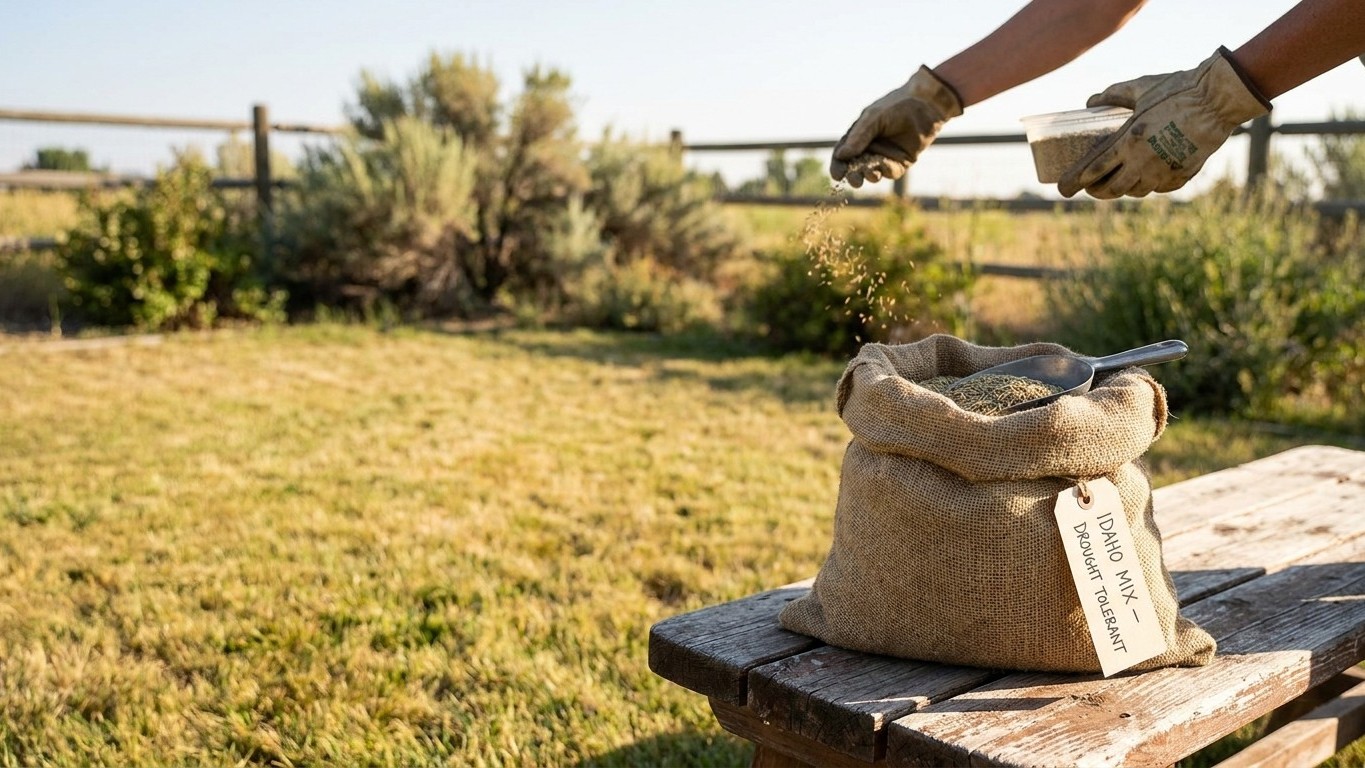

There is no single best grass seed for an Idaho lawn, because Boise and most of the state sit in what turf scientists call a transition zone, where cool-season grasses and warm-season grasses each carry a real cost. Tall fescue, Kentucky bluegrass and perennial ryegrass stay green through Idaho’s cold winters but need irrigation to survive July heat, while zoysiagrass and bermudagrass shrug off summer drought but turn brown from fall through spring. Decide first how much brown turf you can tolerate in winter, and whether you have irrigation to spare in summer, before you pick a species.
The short answer for Idaho
Using Clemson Cooperative Extension’s turf classification framework (HGIC 1214), The Homestead Post places Boise’s climate in the transition zone: warm enough in summer to stress cool-season turf, cold enough in winter to kill warm-season turf back to brown dormancy. That single fact is why no seed catalog can hand you one winning species for the whole state. The choice is a trade-off, not a verdict.
If you want green grass in January, you plant a cool-season species: tall fescue, Kentucky bluegrass or perennial ryegrass, all named by Clemson HGIC 1214 and by Penn State Extension as workable cool-season choices for a transition climate. The price is a lawn that goes drought-stressed and semi-dormant in the hottest weeks of summer unless you water it. If you want a lawn that shrugs off heat and needs less water once established, you plant a warm-season species: zoysiagrass or bermudagrass, also listed in HGIC 1214. The price there is a lawn that is straw-brown, not dead, from the first hard freeze until well into spring green-up.
Which price you’d rather pay depends on three things: how much you’re willing to irrigate in July, how much a brown lawn bothers you from fall to spring, and how high up you garden. A lot with reliable sprinklers and a gardener who minds a brown yard all winter does better with bermudagrass or zoysiagrass. A lot that gets watered by hand, or a gardener who wants green from March through November even if it costs more water, does better with tall fescue. Neither is objectively correct here, and any page that tells you otherwise is skipping the actual Idaho climate.
Working through the year

Ranking the realistic species
Tall fescue is the steadiest performer in a transition-zone lawn because its deep root system tolerates both Idaho’s cold winters and a fair amount of summer drought stress without dying outright, only browning temporarily. Kentucky bluegrass makes a denser, finer-textured lawn but needs more water and more nitrogen to hold that density through summer, and it’s slower to recover from foot traffic damage. Perennial ryegrass germinates fastest of the three and is often mixed in for quick cover or used to overseed a thin fescue lawn, but it has less heat tolerance on its own and thins out faster in a hot, dry August.
On the warm-season side, bermudagrass grows the most aggressively and tolerates the most heat and drought of any grass on this list, but it goes brown earliest in fall and stays brown longest in spring, and its stolons will invade flower beds if left unedged. Zoysiagrass makes a denser, more shade-tolerant lawn than bermudagrass and stays contained better at the edges, but it is notoriously slow to fill in from seed or plugs, often taking a full season or two before it looks like a finished lawn.
| Grass | Season | Drought tolerance | Winter color | Maintenance calendar |
|---|---|---|---|---|
| Tall Fescue | Cool | Moderate | Stays green | Clemson HGIC 1219 |
| Kentucky Bluegrass | Cool | Low | Stays green | Penn State Extension |
| Perennial Ryegrass | Cool | Low | Stays green | Penn State Extension |
| Zoysiagrass | Warm | High | Brown, dormant | Clemson HGIC 1217 |
| Bermudagrass | Warm | Very high | Brown, dormant | Clemson HGIC 1216 |
Timing matters more than which species you pick. NOAA’s 1991-2020 climate normals put Boise’s first fall freeze between October 7 and October 21, at station USW00024131. Cool-season seeding wants to happen roughly six weeks before that freeze window, so seed and roots have time to establish before real cold sets in, which puts Boise’s seeding window in late August to early September. That’s arithmetic from the freeze range, not a fixed date, and it shifts earlier the higher and colder your ground runs. Clemson’s Tall Fescue Maintenance Calendar (HGIC 1219) lays out the mowing height, nitrogen and overseeding sequence for fescue lawns, and Clemson’s Bermudagrass (HGIC 1216) and Zoysiagrass (HGIC 1217) calendars do the same for warm-season lawns, but all three are written against South Carolina’s growing season. Use them for the order of tasks and how each relates to green-up or dormancy, then translate the actual months against Boise’s own frost dates, or check The Idaho Lawn Care Calendar, Month by Month for a version already set to local timing.
What changes across Idaho
Elevation is the biggest variable
Boise sits low in the Treasure Valley, and NOAA’s frost data for that station is the mildest reading you’ll find anywhere in the state. Most of Idaho sits considerably higher, and elevation is the single biggest reason a lawn plan that works in Boise fails elsewhere. The Panhandle around Coeur d’Alene, the mountain valleys around Sun Valley and Stanley, and most of eastern Idaho’s higher benches all run colder and shorter-season than the Treasure Valley floor, which pushes any cool-season seeding window earlier in the fall and makes a warm-season lawn a riskier bet the higher you go.
That risk isn’t abstract. Bermudagrass and zoysiagrass both need a long enough warm season to build the root reserves that get them through winter dormancy, and a shorter, cooler season anywhere above the valley floor means less time to build those reserves before the first freeze arrives. In practice that makes warm-season turf a Treasure Valley and lower Snake River plain proposition more than a statewide one. Tall fescue, Kentucky bluegrass and perennial ryegrass are the more forgiving choice at elevation precisely because their whole growing strategy is built around surviving cold, not avoiding it.
None of this is a fixed rule you can apply by county line. Local terrain, slope, and how much cold air pools in a given yard on a still night all shift things further, sometimes by a lot on the same street. The frost figures in this article describe the Boise station specifically. If you garden anywhere else in Idaho, treat them as a starting reference point, not your own number.
The mistakes this climate punishes
Feeding a warm-season lawn nitrogen late in the fall is one of the most common errors here, because it pushes soft new growth right as the plant should be shutting down for dormancy, and that new growth is what a hard freeze kills outright. The damage doesn’t show immediately. It shows the following spring, as thin, slow-to-green patches where the lawn should have come back strong.
Seeding tall fescue, Kentucky bluegrass or perennial ryegrass in late spring instead of late summer is the reverse mistake, and it’s just as common with a new homeowner eager to seed as soon as the ground thaws. Seedlings that germinate in May are hitting their most fragile root stage right as Idaho’s summer heat arrives, and most of that seeding fails by midsummer, showing up as bare, weedy patches by July rather than a filled-in lawn.
Mowing cool-season turf too short during a summer heat spell is the third repeat offender. Scalping a fescue or bluegrass lawn down close to the soil in July removes the leaf tissue the plant needs to shade its own root zone, and the damage shows within a couple of weeks as browning and thinning that a taller cut would have prevented. Cutting a bermudagrass or zoysiagrass lawn that short in summer is fine, because those species are bred to run low and dense, but the same mower setting on a cool-season lawn is a mistake that costs the lawn its whole summer.
A fourth mistake worth naming: overwatering a bermudagrass or zoysiagrass lawn in early fall trying to keep it green past its natural season. Extra moisture on cooling nights favors fungal disease rather than color, and the damage shows as large, irregular brown patches distinct from the lawn’s normal, even dormancy. Brown from a hard freeze recovers in spring. Brown from a fall fungal outbreak often doesn’t come back the same in that spot.
Checking this against your county
Idaho runs from low, warm valley floors to high mountain benches, and no single article can give you a frost date or seeding window for every one of them. The Idaho Lawn Care hub on this site works through the state-level basics, but for a number specific to your own address, the University of Idaho Extension is the right first call. Its county offices track local frost data and can tell you where your ground actually sits relative to the Boise figures used here.
You can find your nearest office and current publications through University of Idaho Extension. Bring your elevation and your nearest town when you call. It’s the fastest way to find out whether your yard runs closer to Boise’s numbers or well outside them.
Common questions
Can I mix cool-season and warm-season grass seed in the same Idaho lawn?
You can, but it rarely looks good, because the two groups want opposite mowing heights, opposite watering schedules, and go dormant at opposite times of year. Most lawns that try this end up patchy, with one grass dominating and the other struggling in the same soil.
Will bermudagrass actually survive an Idaho winter?
In the lower Treasure Valley around Boise, established bermudagrass generally comes back from winter dormancy, though it will be the last thing green in spring. At higher elevation or in colder pockets of the state, the growing season may not be long enough for it to build the root reserves it needs, and winterkill becomes a real risk.
How long does zoysiagrass take to fill in from seed?
Longer than most people expect, often a full season or more, because zoysiagrass spreads slowly compared to bermudagrass or the cool-season species. Many growers start it from plugs or sod instead of seed specifically to shortcut that slow fill-in period.
Do I need to overseed perennial ryegrass every year?
Often, yes, if you’re using it as the main lawn rather than as a nurse grass mixed with tall fescue. Perennial ryegrass germinates fast and looks great quickly, but it doesn’t persist as reliably through Idaho’s summer heat as tall fescue does, so a lawn seeded to ryegrass alone tends to thin out faster year over year.