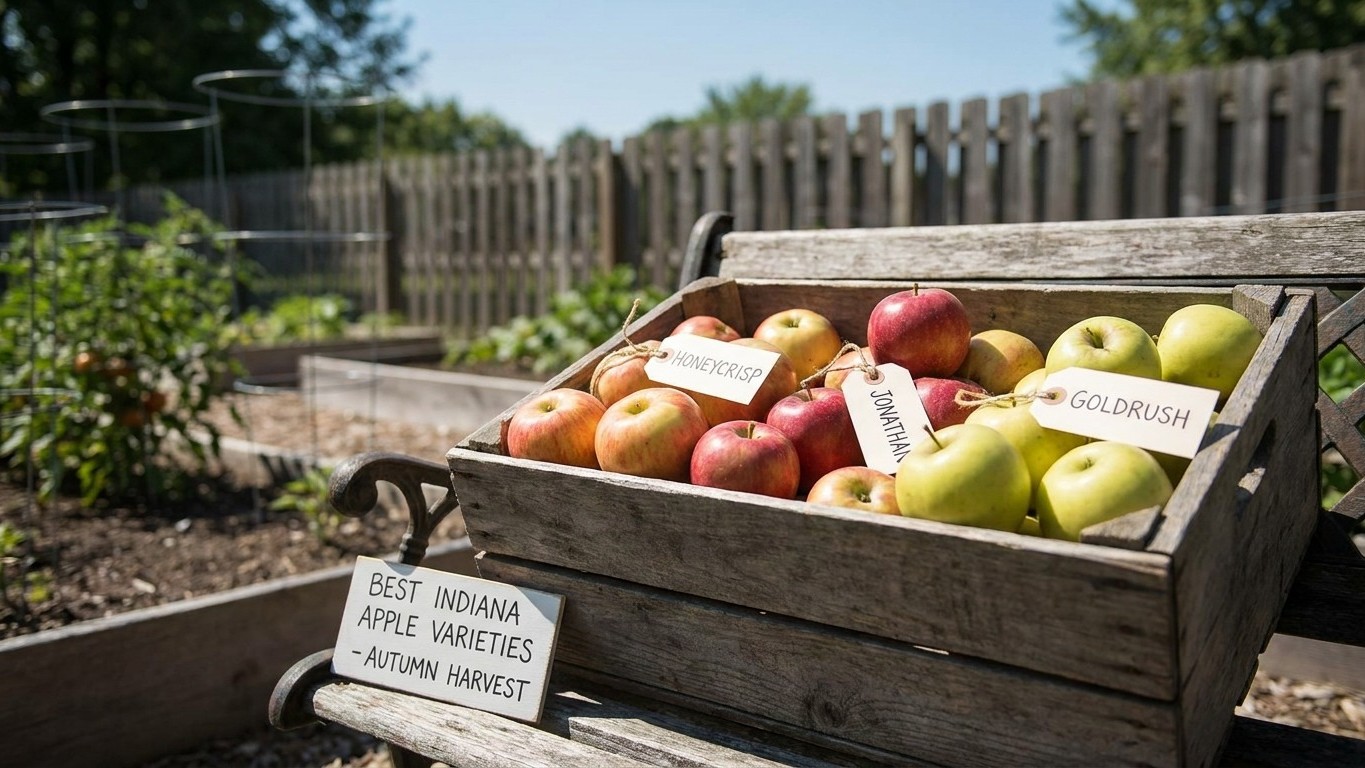

Indiana has no single “best” apple variety, because the deciding factor isn’t a name on a tag, it’s whether a tree’s bloom date clears the region’s frost window. At Indianapolis, NOAA’s 1991-2020 Climate Normals put the last spring freeze at April 9 to April 21 and winter cold rarely gets severe enough to kill a tree outright. Before ordering anything, check Purdue Extension’s current county-level variety trial data rather than a catalog description alone.
The short answer for Indiana
Indiana doesn’t hand you one “best” apple — it hands you a frost window, and the only variety that works is the one whose bloom date falls outside it. Around Indianapolis, that last freeze typically lands between April 9 and April 21, and a tree in bloom on the wrong side of that date loses its crop no matter how disease-resistant or well-rated it is. So before you pick a name off a nursery tag, find out when your own ground usually clears its last freeze and hold every variety up against that date first.
Hardiness versus bloom timing
Winter survival is almost never the limiting factor here. NOAA’s normals put Indianapolis’ coldest month mean daily minimum at 20.5°F, which is well within the range nearly every commercially grown apple cultivar and its rootstock tolerate without wood damage. That number is an average, not a record low, so it tells you what the tree lives through in a typical January, not what it might face in an outlier cold snap. Because hardiness is rarely the bottleneck, the real screens are bloom timing against the frost window, the tree’s chill requirement (whether the winter delivers enough sustained cold for even bud break), and local disease pressure, since apple scab, fire blight, and cedar-apple rust are all common in Indiana’s humid growing season. Purdue Extension also notes there is roughly a 10% chance of a freeze after the printed spring date, so even a tree that blooms at the safe end of the window isn’t fully out of danger.
Working through it

Rather than ranking specific cultivars, which shift year to year as new disease-resistant releases come through university trials, it helps to sort the realistic choices into three bloom-timing categories and weigh what each one costs you.
| Bloom timing category | Frost exposure (Indianapolis normals) | What it costs you |
|---|---|---|
| Early-blooming dessert types | Blossoms can open before NOAA’s April 9-21 freeze window has fully closed | A longer ripening season, but a late freeze inside that window can cost the whole crop in the years it happens |
| Midseason types | Bloom typically follows the close of the freeze window | The safest default for most home orchards, with no major trade-off attached |
| Late-blooming types | Bloom clears frost risk with margin to spare | Less time between bloom and the October 21-30 fall freeze to finish ripening a long-season fruit |
Rootstock and chill requirement
The rootstock underneath the named variety matters almost as much as the variety itself. A dwarfing rootstock brings a tree into bearing faster and keeps it small enough for a backyard, but its roots sit shallower and take more damage on an exposed, wind-scoured site than a standard or semi-dwarf rootstock would. A tree also needs enough accumulated winter cold to break dormancy evenly across all its buds. In a mild winter that falls short of a cultivar’s chill requirement, bloom can come out staggered and uneven rather than in one clean flush, which complicates both pollination and spray timing. None of that shows up on a nursery tag, which is why cross-checking a shortlist against Purdue’s own trial notes before you order is worth the ten minutes it takes. If you haven’t settled on a planting site, rootstock, and spacing yet, that groundwork is covered in Growing Apples in Indiana.
What changes across Indiana
NOAA’s frost figures are measured at Indianapolis, and the rest of the state runs earlier or later by a fortnight or more, according to NOAA’s own caution on the data. Three features move that window in predictable directions.
The Lake Michigan shoreline
The northwest counties along Lake Michigan sit close enough to the water that the lake moderates temperature swings in both directions. It slows spring warming, which delays bud break and bloom, and it also tends to hold off the first hard freeze in fall. A tree that would bloom into frost risk further south can bloom later and safer near the shoreline, at the cost of a shorter overall season.
Southern Indiana and the hill country
The Ohio River valley in the south runs milder in winter and earlier in spring than the Indianapolis reference point, which pushes bloom earlier into whatever frost risk remains. At the same time, the hilly terrain of south-central Indiana creates cold air drainage: cold air rolls downhill overnight and pools in low ground, so an orchard planted in a valley bottom can see a harder, more damaging frost than a site just a few hundred feet upslope, even on the same night and in the same county. Site selection inside a single property can matter as much as which region of the state you’re in. For how these regional shifts move each stage of the tree’s calendar, see The Indiana Apple Calendar, Stage by Stage.
The mistakes this climate punishes
Most losses trace back to a handful of repeat mistakes, and each one shows up at a specific point in the season rather than as a vague bad year.
Frost timing mistakes
- Planting an early bloomer on an exposed site — blossoms open during the tail of NOAA’s April 9-21 freeze window, and a freeze that lands late in that range, which happens in roughly one year in ten per Purdue’s caution, kills that year’s crop even though the tree itself survives.
- Trusting the county average frost date on a low-lying site — cold air drainage in valley bottoms produces a harder local freeze than the regional normal predicts, so a bloom date that would be safe on a ridge isn’t safe in the hollow below it.
- Assuming a mild winter is only good news — a winter that falls short of a cultivar’s chill requirement produces staggered, uneven bloom the following spring, which weakens pollination and makes spray timing harder to get right.
Disease and care mistakes
Feeding or pruning late in the growing season pushes soft new growth right into the run-up to the first fall freeze, October 21 to October 30 at Indianapolis, and that late-season growth is what takes the worst damage when the freeze finally arrives. Skipping a spray program because a variety is billed as “disease-resistant” is another common one: resistance ratings for apple scab, fire blight, and cedar-apple rust are usually partial, and Indiana’s humid summers give all three plenty of opportunity, so even a resistant tree benefits from basic sanitation and a watchful eye on fallen leaves and cankers.
Checking this against your county
Everything above is anchored on the Indianapolis station, and NOAA’s own data flags that the rest of the state can run a fortnight or more ahead or behind it. Before you commit to a variety and a rootstock, Purdue Extension is the right place to check county-level trial results, current spray guides, and disease pressure updates for the season. Their county offices also track which cultivars have actually performed well in university trial blocks around the state, which is more useful than any generic ranking.
Common questions
What’s the best apple variety for Indiana backyards?
There isn’t one statewide answer. The deciding factors are bloom timing against your local frost window, the disease pressure your site sees, and whether the winter delivers enough chill for your cultivar, so check Purdue Extension’s county trial results before ordering.
Can I grow apples without spraying at all?
You can, and the tree will likely survive, but fruit quality usually drops fast in Indiana’s humid summers as scab, fire blight, and cedar-apple rust take hold. Even disease-resistant cultivars generally do better with basic sanitation, orchard airflow, and a minimal spray schedule than with none at all.
Do I need a second apple tree nearby to get fruit?
Most apple cultivars need cross-pollination from a different variety that blooms at roughly the same time, rather than self-pollinating reliably on their own. A neighbor’s tree or a crabapple within bee-flying distance can substitute for a second tree on your own property, as long as its bloom window overlaps yours.
How do I tell if a spring frost damaged my apple blossoms?
Check the center of a few open blossoms the morning after a hard freeze during bloom. A blackened or mushy pistil at the center means that flower won’t set fruit, even if the petals around it still look undamaged.