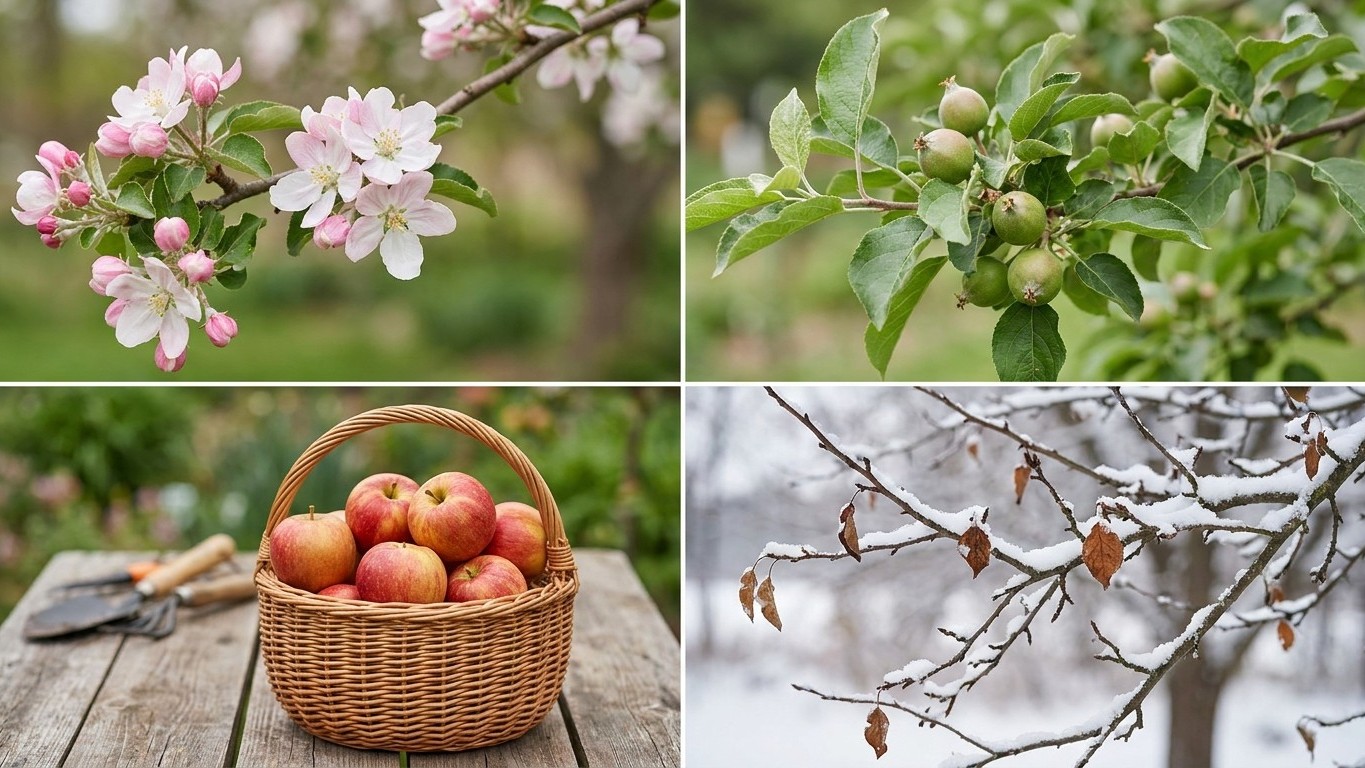

Michigan’s apple bloom hinges on frost, not on a fixed date. MSU Extension puts the last spring frost around April 30 in the Detroit area, with early to mid May typical across most of the Lower Peninsula, and the first fall frost between October 6 and October 21 in zone 6a country. Before you plan a spray, a thinning, or a pick date, check where your own tree’s buds actually sit against those frost windows for your county, not against a generic month on the wall.
The short answer for Michigan
Pink bud is the moment a Michigan apple tree stops running on the calendar and starts running on frost risk — that swollen pink cluster, days before it opens, is what a hard overnight cold snap can wipe out before the season even gets going. It doesn’t happen on the same day twice: an early cultivar hits pink well before a late one, and a low valley spot lags or races ahead of a slope three miles off. So the one thing to do right now is walk your rows and check bud stage against your own county’s last-frost window, not the date on the wall.
That answer depends on two things that have nothing to do with the calendar: the variety’s bloom timing and the site’s own microclimate. An early-blooming cultivar such as Zestar! opens flowers well ahead of a late bloomer like Fuji, and a site low in a valley or far from Lake Michigan’s moderating water sees frost linger longer into spring than a slope or a lakeshore orchard a few miles away.
The other filter, separate from cold survival, is winter chill. NOAA’s 1991-2020 climate normals put the coldest month’s average daily minimum at 19.1°F near Detroit, a level most named apple cultivars and their common rootstocks handle without injury. That figure rules out a warm-climate stone fruit long before it says anything about which apple to plant. Cold hardiness answers whether the wood survives January. Chill hours answer whether the buds break evenly and bloom on schedule, and keeping the two questions separate matters when picking a tree, a choice the The Best Apple Varieties for Michigan page runs through by name.
Working through it

This calendar assumes you have already sorted site, rootstock and variety, the decisions covered in Growing Apples in Michigan. What follows is what to do once the tree is in the ground and the stages start moving, each one anchored to the tree’s own growth rather than to a date on paper.
Dormancy

From leaf drop into late winter, the tree is bare and biologically shut down. This is when to prune, since cuts made now heal before sap starts moving, and when to apply dormant oil to smother overwintering mite and scale eggs before green tip. NOAA’s 1991-2020 normals put the coldest month’s mean minimum near Detroit at 19.1°F, a level most bearing apple wood tolerates without dieback, though young whips and marginal rootstocks are worth wrapping in a hard winter.
Green tip

Buds swell and split to show a sliver of green leaf tissue, usually as the ground thaws and daytime temperatures climb through the 40s and 50s. This is the first fungicide timing for apple scab in a wet spring, since the fungus needs exposed green tissue to infect. Green tip itself tolerates a light frost with little damage, but it marks the start of the tree’s vulnerable stretch.
Pink

The unopened flower buds swell into visible clusters of pink before they crack open. This stage is noticeably more frost-tender than green tip, and it typically falls in the weeks bracketing MSU Extension’s last spring frost dates, around April 30 near Detroit and running into early or mid May across most of the Lower Peninsula. Growers watch the overnight forecast closely here, since a hard frost at pink can still cost blossoms that haven’t opened yet.
Bloom

Open white to pale pink flowers make bloom the single most frost-sensitive stage of the season, and it is also the stage that decides the crop, since pollinators need open flowers to work. Bloom timing varies by cultivar by as much as two weeks, which is why matching a variety’s bloom window to a site’s frost risk matters more than picking a variety on flavor alone.
Petal fall

Petals brown and drop, and the tiny green fruitlet at the center of each spent flower becomes visible. Frost risk drops sharply here, since the truly tender flower tissue is gone, and this is when to start thinking about thinning, since the tree will set more fruit than it can properly size.
Fruit set

Fruitlets swell from pea-size toward a small marble over the following weeks, and this is the window for thinning to one apple per cluster, spaced along the branch, so the remaining fruit sizes properly and next year’s bloom isn’t starved of stored energy.
Harvest
Timing runs off the variety’s days to maturity from bloom, not a fixed date, and it needs to land before a hard freeze. MSU Extension’s Michigan Garden Calendar puts the first fall frost for zone 6a country between October 6 and October 21. A late-season cultivar picked in a warm October near Detroit has more room than the same variety in a county whose frost lands at the early end of that window.
What changes across Michigan
The apple calendar shifts noticeably between the Lake Michigan shoreline, the interior Lower Peninsula, and the state’s northern reaches, and no single set of frost dates covers all of them. The lakeshore counties, historically known as Michigan’s fruit belt, sit downwind of open water that stays cold into spring and warm into fall, which slows bud break in April and delays the first hard freeze in October compared with interior sites at the same latitude. That buffering is exactly why the region became commercial orchard country in the first place.
Move inland and the frost calendar MSU Extension publishes for the Lower Peninsula already shows a spread: around April 30 near Detroit against early to mid May for most of the rest of the peninsula, a two-week range within a single peninsula before the Upper Peninsula or the far north are even considered. A county at the early end of that window carries less margin for an early-blooming variety than one at the late end.
Low ground matters as much as latitude. A site at the bottom of a valley or a frost pocket, where cold air pools overnight, sees frost settle in and linger long after a slope fifty feet higher has cleared, regardless of which county it sits in. An orchard planted on a gentle slope with open air drainage below it consistently loses fewer blossoms than one planted in the low, flat ground beside it, even when both report the same nearest-town frost date.
No single figure in this piece describes every one of those sites. The Detroit-area numbers from NOAA and MSU Extension are a reference point, not a promise, and a grower an hour north or west of that reference station should expect the real dates to differ, sometimes by more than a week in either direction.
The mistakes this climate punishes
Four mistakes show up in Michigan orchards more than any others, and each one is a mismatch between the tree’s biology and a stage this climate handles roughly, not gently.
- Planting an early-blooming variety where frost lingers late. A cultivar that opens bloom in the first wave is exposed on exactly the nights MSU Extension’s frost data still calls live, from around April 30 near Detroit through early to mid May farther out in the Lower Peninsula. The damage shows as a light crop or no crop the following August, with no other symptom to explain it.
- Assuming a mild winter guarantees an easy spring. A variety bred for a longer, colder chill period can break dormancy unevenly after an unusually mild winter, opening some buds weeks ahead of others on the same tree. The result is a stretched-out, patchy bloom that pollinators and growers both struggle with, visible at green tip and pink as buds sitting at different stages on the same branch.
- Feeding nitrogen too late in the season. A late summer fertilizer application pushes soft new shoot growth that has no time to harden off before the first fall frost, which MSU Extension’s Michigan Garden Calendar places between October 6 and October 21 for zone 6a country. That new growth blackens and dies back at the first freeze, and the tree spends the following spring healing wounds instead of setting fruit.
- Leaving fruit on the tree past its harvest window waiting for more color. Apples held on the tree into the first hard frost can suffer internal breakdown even when the skin looks fine, and the risk is highest for late-season varieties in counties where the fall frost date lands at the early end of the zone 6a range rather than the late end.
Each of these shows at a different point in the season, which is part of why they get missed. The bloom mismatch is obvious by August, the late-nitrogen dieback doesn’t show until the following spring’s pruning, and the chill problem only becomes visible once you have several seasons of the same variety to compare bloom timing against.
Checking this against your county
Every date in this piece is anchored to Detroit-area data from NOAA and MSU Extension, and Michigan’s geography is varied enough that a county three hours away can run a week or two ahead or behind. Before locking in a spray schedule or a harvest date, check your own county’s current bud stage and frost record with MSU Extension, reachable through the state extension service, and treat that local read as the deciding figure once bloom is close. County offices also track which pests and diseases are active locally that season, information no statewide calendar can predict a year ahead.
Common questions
Can I grow apples if I’m north of Michigan’s fruit belt, like in the U.P.?
Apples grow well north of the traditional fruit belt, since cold hardiness in named cultivars and standard rootstocks generally exceeds what even a hard Michigan winter delivers. The bigger issue that far north is a shorter growing season pushing bloom and harvest later, which favors early and mid-season varieties over long-season ones, and no source in this piece documents specific U.P. frost dates, so check with your county’s MSU Extension office directly.
What temperature kills apple blossoms in bloom?
Open blossoms are the most cold-sensitive stage of the whole season, and the damage depends on how far below freezing it gets and how long the cold lasts, not on one fixed number. The exact threshold also shifts by cultivar and by how far the flower has opened, which is why growers treat any frost warning during bloom as a real threat rather than checking it against a specific degree.
How do I find my apple variety’s chill hour requirement?
Chill hour requirement is a published trait of the named cultivar, listed on the nursery tag or catalog page alongside days to maturity and disease resistance, the same in every state. It’s worth checking before you plant rather than after a mild winter produces a patchy, uneven bloom.
Do I need two apple trees to get fruit, or does one work?
Most apple varieties need a different variety blooming at the same time nearby for pollination, since a single tree of one cultivar rarely sets a full crop on its own. A neighbor’s tree or a crabapple within bee range can sometimes do the job, but planting two compatible varieties on your own site is the more reliable route.