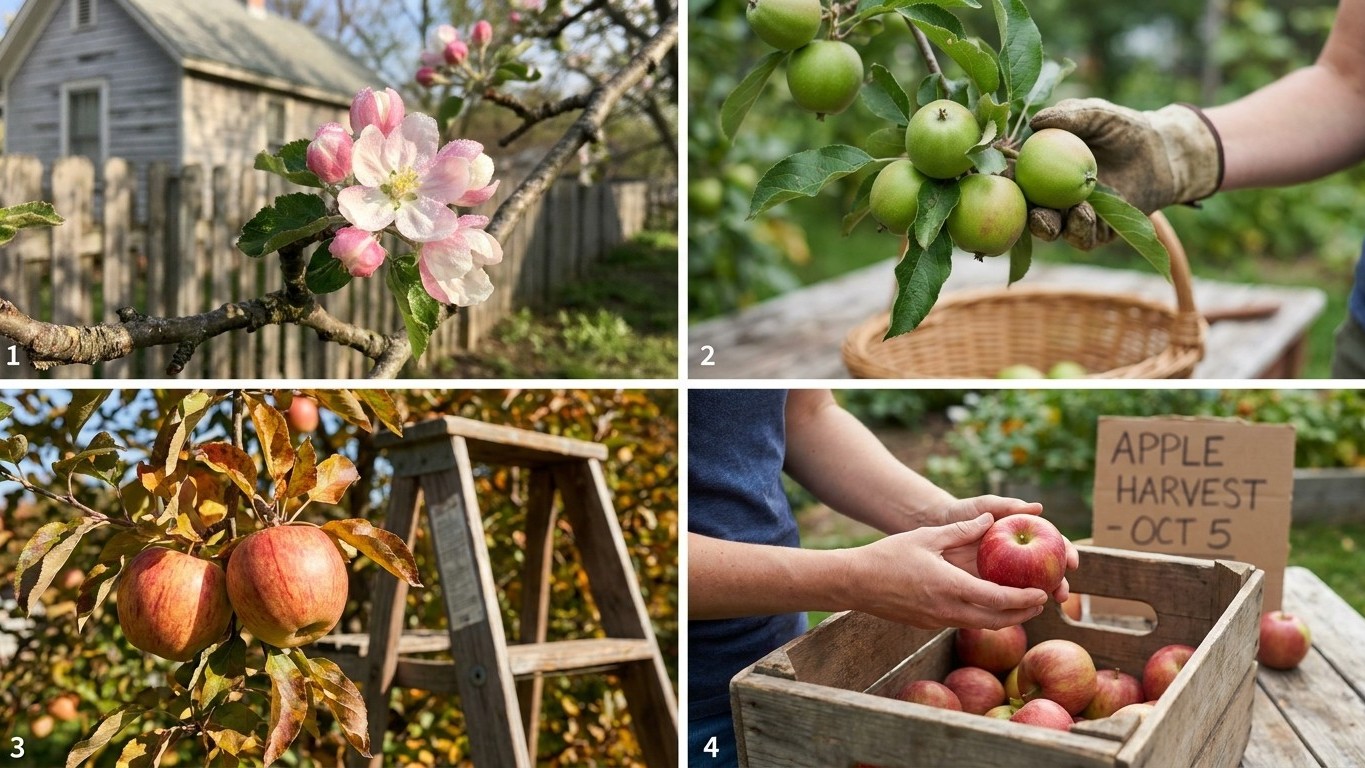

Minnesota’s apple calendar runs off frost, not the date on a wall calendar. NOAA’s 1991-2020 climate normals put the last spring freeze at the Minneapolis reference station between April 17 and April 30, and the first fall freeze between October 11 and October 23, and every stage from dormancy to harvest sits somewhere inside that window. Check your tree’s buds against the stages below rather than a date on paper, and hold off on any spring spray or pruning cut until the stage on the branch matches the one you’re planning for.
The short answer for Minnesota
What season is your tree actually in right now — and does that match what you’re about to do to it? In Minnesota, the safe answer is never the date, it’s the bud in front of you: dormant, green tip, pink, bloom, petal fall, fruit set, or harvest, each with its own freeze risk and its own list of jobs that are safe to do. Walk out to the tree and check the buds against those stages before you make a single spring cut or spray.
What actually decides the calendar in any given year is the tree’s stage, not the date on the page. A cool April can push green tip and pink back a week or two while the frost-risk window itself stays fixed, so a grower who prunes or sprays “on schedule” instead of on stage ends up out of step with the tree. The stage is the clock: read the buds, not the month.
Before any of that matters, the tree has to survive a Minnesota winter in the first place. NOAA’s 1991-2020 normals put the mean minimum temperature of the coldest month at Minneapolis at 7.5°F, an average rather than a record low, and it is the figure that rules out anything but a genuinely cold-hardy tree and rootstock. Site, cultivar, and how exposed a planting is to wind all shift the calendar further, which is why the stage-by-stage approach below matters more than a printed date.
If you haven’t yet worked through planting and site choice, Growing Apples in Minnesota covers that ground. An established tree changes on the branch from here.
Working through it

Every stage below is anchored to NOAA’s 1991-2020 climate normals for Minneapolis: a last spring freeze of April 17 to April 30 and a first fall freeze of October 11 to October 23. Northern Minnesota runs two to three weeks tighter at both ends of that window, per the same NOAA normals record, so shift the whole sequence earlier in fall and later in spring the farther north you garden.
Dormancy

The tree sits leafless from the first hard fall freeze through the last stretch of winter. This is when to do structural pruning, since cuts made now heal before sap starts moving and there’s no foliage hiding the branch structure. Dormant oil sprays for scale and mite eggs also go on now, on a day above freezing with no rain expected for 24 hours.
Green tip

Tiny green leaf tips push through the bud scales as soil and air warm past the point where the tree resumes growth. It shows well ahead of the close of the last-freeze window, so a hard frost after green tip is still a real risk. This is the last realistic point for a delayed dormant spray against early-season pests.
Pink

Flower buds swell and show color before they open, a stage named for the rose-pink of the still-closed cluster. It usually falls close to the front edge of the April 17 to April 30 freeze window, which makes it the single riskiest stage of the year: an open pink bud can be killed by a freeze that a fully dormant bud would shrug off.
Bloom

White, five-petaled flowers open across the tree, and this is when pollinators do the work that decides the size of the crop. Bloom typically lands inside or just after the tail end of the spring freeze window, so a late frost inside that April range can still cut bloom short even in a year that otherwise looks safe.
Petal fall

Petals brown and drop within a week or two of bloom, leaving a small green fruitlet at the base of each flower that survived pollination and frost. This is the point to apply the first thinning if the set looks heavy, since apples thinned early size up better than apples thinned in midsummer.
Fruit set

Fruitlets that made it through petal fall swell from pea size toward their eventual shape over the following weeks, and this is when a light second thinning pass corrects anything the first pass missed. It’s also the stage most exposed to a return of cold snapping shoots that grew soft during an unusually warm stretch, though a hard freeze this late is rare inside the Minneapolis normals.
Harvest
Fruit reaches full size and color from late summer into fall, with the exact date set by cultivar rather than the calendar. Because NOAA’s normals put the Minneapolis area’s first fall freeze between October 11 and October 23, any variety that ripens later than that window needs to pick or protect ahead of the first hard frost. The Best Apple Varieties for Minnesota lists ripening windows by cultivar so you can check a specific tree against this date.
What changes across Minnesota
The two NOAA windows above are measured at Minneapolis, in the mildest part of the state, and every other region moves the calendar in one direction or another. NOAA’s 1991-2020 normals record shows that stations across northern Minnesota run two to three weeks tighter at both ends than the Minneapolis reference, meaning a shorter frost-free season on both the spring and fall side.
The Arrowhead region along Lake Superior’s North Shore is the exception inside that pattern, not an extension of it. A large body of water like Lake Superior holds heat into fall and releases it slowly, which tends to delay both the first hard freeze near the immediate shoreline and the spring warm-up that starts green tip and pink, compared with inland sites at the same latitude. Move a few miles back from the shore and that buffering effect fades quickly.
The Red River Valley in the northwest and the open plains around International Falls sit at the far end of the tightening NOAA describes: flat, treeless terrain with nothing to hold warm air in place lets cold settle in early and linger. Elevation compounds the effect inland, too. The Iron Range’s higher ground, away from any lake, cools faster after sunset than the valleys below it, and even within the milder south a low spot along a river bluff or the bottom of a sloped yard can trap cold air on a still night and see frost days or weeks ahead of a site fifty feet higher up the same slope.
None of this changes which stage matters, only when each stage lands on the calendar for a given site. A grower on a frost-prone low spot in the Minneapolis metro area may see pink and bloom behave more like the northern normals than the southern ones NOAA records for the reference station.
The mistakes this climate punishes
Minnesota’s compressed season does not forgive timing mistakes the way a longer season might, because there’s no slack at either end to make up for a bad call. A gardener working from a generic national calendar rather than this territory’s own frost data is the one most likely to lose a crop to a mistake that would be harmless somewhere with a longer, milder spring and fall.
- Buying a cultivar on bloom date alone, without checking it against Minnesota’s own frost window.
- Trusting a single mild winter as proof that a marginally hardy tree is safe.
- Feeding nitrogen into midsummer, which leaves soft new growth unhardened by fall.
- Pruning after green tip instead of during true winter dormancy.
The first mistake shows in April: a cultivar that blooms early somewhere with a milder spring can bloom straight into Minnesota’s own frost window, which NOAA’s 1991-2020 normals put at April 17 to April 30 for the Minneapolis area. Check bloom timing against that window using The Best Apple Varieties for Minnesota before ordering a tree, not after it flowers into a frost.
The second shows only in a hard winter, sometimes years after planting: NOAA’s normals put the mean minimum of the coldest month at Minneapolis at 7.5°F as a thirty-year average, which means plenty of individual winters run colder than that figure. A tree chosen on one lucky season’s evidence can die back the next time the cold matches or beats the average.
The third and fourth show at the same point, over winter: soft shoot growth from late feeding, and a fresh pruning wound made after green tip, both fail to harden or heal before the season’s first hard freeze arrives, which NOAA’s normals put at October 11 to October 23 for the Minneapolis reference station. Structural pruning belongs in dormancy, before any green shows, and nitrogen feeding belongs earlier in the season, not after.
Checking this against your county
Before you commit a spray date, a pruning day, or a harvest window to memory, check it against your own county.
UMN Extension publishes county-level growing information. Search for your county’s horticulture office there before you plant a first tree or move a pruning date off the dormancy stage described above.
Common questions
Why did my tree bloom and then lose all its flowers to frost?
Bloom often lands right at the tail end of the spring freeze window that NOAA’s normals set at April 17 to April 30 for the Minneapolis area, and an open flower is far more frost-tender than a dormant bud. A cultivar with an earlier bloom habit, or a site in a low spot that runs colder than the surrounding area, makes this more likely in any given year.
Can I even grow apples up near International Falls?
Yes, with a cultivar hardy enough for the tighter frost window that runs through far northern Minnesota, which NOAA’s normals show running two to three weeks shorter at both ends than the Minneapolis reference. Check with UMN Extension for what’s actually documented as reliable that far north before you commit to a specific tree.
How do I tell green tip apart from pink on my own tree?
Green tip is leaf tissue, a sliver of green pushing out of a brown bud scale. Pink is a flower bud, swollen and colored but still closed, and it comes later, closer to the risky part of the spring frost window.
Should I prune in fall instead of waiting for spring?
No. A cut made while the tree is still active in fall doesn’t heal before winter and is more likely to die back at the wound. Wait for true dormancy, after leaf drop and before any green shows the following spring.