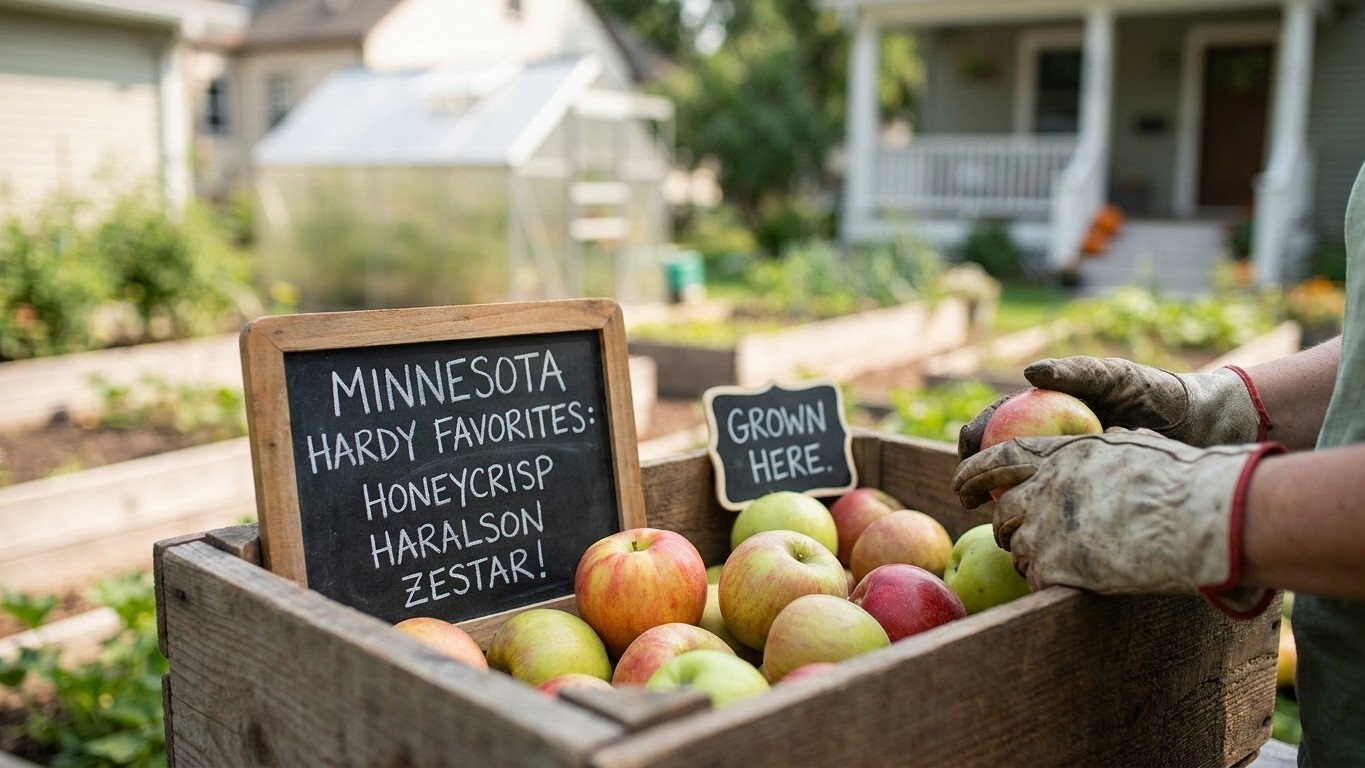

Seven and a half degrees is the average daily low Minneapolis records in its coldest month, and that’s the mild end of what Minnesota trees have to survive. Layer on a last spring freeze that can land as late as April 30 and a first fall freeze that can arrive by October 11, and you’ve got the real question: not which apple is “best,” but which apple’s wood, bloom time, and ripening window actually fit your particular address, elevation, and cold pockets.
The short answer for Minnesota
The apple that does best on your lot is the one whose wood survives your site’s winter cold and whose blossoms open clear of the local frost window, not whatever variety a big-box garden center happens to stock. NOAA’s 1991-2020 climate normals, measured at the Minneapolis reference station, put the coldest month’s average daily minimum at 7.5°F. That is a normal, not a record low, so treat it as a baseline rather than the worst your trees will ever see.
The same NOAA dataset puts the Minneapolis last spring freeze between April 17 and April 30. A tree that flowers inside that window, or just ahead of it in a warm spring, is gambling its whole crop on a freeze that has a real chance of showing up. The first fall freeze at the same station runs October 11 to October 23, which sets the outer edge of how long a late-ripening apple has to finish and how much time the tree has to shut down new growth before winter.
What the right answer depends on is your specific address, not the state as a whole. Minneapolis sits on the mild end of Minnesota’s frost calendar. A site north of the metro, at higher elevation, or in a valley that pools cold air will need a hardier tree and a later bloomer than a sheltered city lot in St. Paul. If you haven’t yet sited and planted a tree, it’s worth settling that groundwork first, covered in Growing Apples in Minnesota, before you go shopping for a variety name.
Working through it

Two separate filters decide whether an apple tree belongs on your property, and growers who skip one of them usually find out the hard way.
Cold hardiness versus winter chill
Cold hardiness is whether the wood itself survives the winter low. Winter chill is whether the tree has banked enough accumulated cold to break dormancy evenly and flower on schedule. In a state where winter is long and reliably cold, chill is rarely the limiting factor. The risk runs the other way: a tree bred for a milder region may not have the wood hardiness to get through a Minnesota winter at all, no matter how well it flowers once it does.
A nursery tag that lists a hardiness rating is telling you the coldest winter the wood is rated to take. Compare that rating against the 7.5°F average minimum NOAA records for Minneapolis, and remember that’s the mild end of the state’s range. Away from the Twin Cities, the same tree needs a deeper margin of cold tolerance to be worth planting at all.
Matching ripening class to the frost window
Once hardiness is settled, the second filter is timing: does the tree bloom late enough to dodge the spring frost window, and does it ripen with enough of the season left before the fall freeze arrives. Apples fall into rough ripening classes, and each one carries a different trade-off against Minneapolis’s NOAA-measured frost dates.
| Ripening class | Bloom timing risk | Fit against the Oct 11-23 fall frost | Storage life |
|---|---|---|---|
| Early-season | Can bloom close to the April 17-30 window in a warm spring | Ripens well ahead of frost, little pressure | Short, best eaten within a few weeks |
| Midseason | Usually blooms after the frost window has closed | Comfortable margin before the first freeze | Weeks to a couple of months in cold storage |
| Late-season | Low risk, blooms well clear of frost | Ripens close to the fall frost window, tight in a short-season site | Several months in proper cold storage |
A late-season keeper is the one most likely to get caught by an early fall freeze in a short-season part of the state, so match that class to a site where the growing season reliably runs long, not to a north-facing slope or a low pocket that cools first. For the stage-by-stage detail on what a tree is doing at bloom, petal fall and fruit set, see The Minnesota Apple Calendar, Stage by Stage.
What changes across Minnesota
Minneapolis is the reference point for the NOAA figures above, and it sits on the mild southern edge of the state’s frost calendar. The same NOAA dataset shows northern Minnesota running its frost window two to three weeks tighter at both ends, meaning a later last spring freeze and an earlier first fall freeze than the metro sees. A tree that comfortably outruns frost in Minneapolis can run out of season two to three weeks earlier along the Iron Range or the far north.
Lake Superior’s North Shore behaves differently again. A large body of water moderates temperature swings nearby, holding cold back in spring and holding warmth later into fall right along the shoreline, even while the interior a few miles inland runs a wider swing in both directions. That moderation can push a marginal variety’s odds in a good direction close to the lake, but it does not extend far from the shore.
The Red River Valley in the northwest is open, flat, and exposed. With little to block wind or slow radiational cooling on a clear night, low spots there can drop several degrees colder than the surrounding land, creating frost pockets that hit blossoms even when the regional forecast looks fine. Southeastern Minnesota’s bluff country along the Mississippi runs generally milder than the northwest, but the valleys that give the region its scenery also trap cold air at night, so a site at the bottom of a bluff can frost before a site partway up the slope.
The mistakes this climate punishes
Most of the failures aren’t about picking a bad variety. They’re about matching a reasonable variety to the wrong site or the wrong calendar.
- Choosing a tree rated for a warmer hardiness zone than Minneapolis’s own 7.5°F NOAA average, let alone a colder site further from the Twin Cities.
- Planting an early bloomer on a low or north-facing site where a warm early spell pulls the blossoms open before the April 17-30 frost window has closed.
- Feeding or heavily watering a young tree into midsummer so it pushes soft new growth that hasn’t hardened by the time the October 11-23 fall freeze arrives.
- Siting a late-keeper variety in a short-season pocket that cools first, leaving fruit unfinished when frost comes early.
- Assuming a mild winter means chill was the problem when a tree fails to fruit. In Minnesota, a failure to flower is far more often winter injury to the wood than a chill shortfall.
The site matters as much as the tree. A hardy, well-timed variety planted at the bottom of a frost pocket will still lose its blossoms some years, and no amount of variety selection fixes a poor planting spot.
Checking this against your county
Your county can run colder, warmer, or on a different frost schedule depending on how far you are from the Twin Cities and what local terrain does to that number. The University of Minnesota Extension, the state’s land-grant extension service, publishes county-level guidance and can point you to a fruit specialist or master gardener volunteer who knows your specific frost pattern and soil.
Before you commit to a tree, it’s worth a call or a look at their published material to confirm your county’s frost dates line up with the Minneapolis figures used here, and to check whether your site sits in one of the colder or warmer pockets described above.
Common questions
Do I need two apple trees to get fruit?
Most apple varieties need a different variety blooming nearby at the same time to set fruit, since a single tree usually can’t pollinate itself. A neighbor’s tree or a nearby crabapple can sometimes do the job if it blooms at the right time, so check what’s already growing near your lot before assuming you need a second tree of your own.
What happens if a late frost hits my apple blossoms?
A hard freeze during bloom can kill the open flowers outright, which means no fruit forms from that flush even though the tree itself usually survives fine. Flowers that were still tight buds when the frost hit often come through undamaged and open a few days later, so a single freeze doesn’t always wipe out the whole crop.
How long before a new apple tree produces fruit?
Most apple trees on standard or semi-dwarf rootstock take three to five years before their first real crop, and a full-size seedling tree can take longer still. Dwarfing rootstock tends to bear sooner, often within two to three years, but it also needs staking and doesn’t reach the same cold hardiness as a full-size rootstock in a hard winter.
Can I grow apples on a small city lot?
Yes, a dwarf or semi-dwarf tree on a hardy rootstock fits a small lot fine, and many varieties are grafted specifically for that purpose. The trade-off is that smaller rootstocks generally have less cold hardiness and a shorter working lifespan than a full-size tree, so a small-lot tree in a colder pocket of the state needs an especially hardy rootstock to hold up over the years.