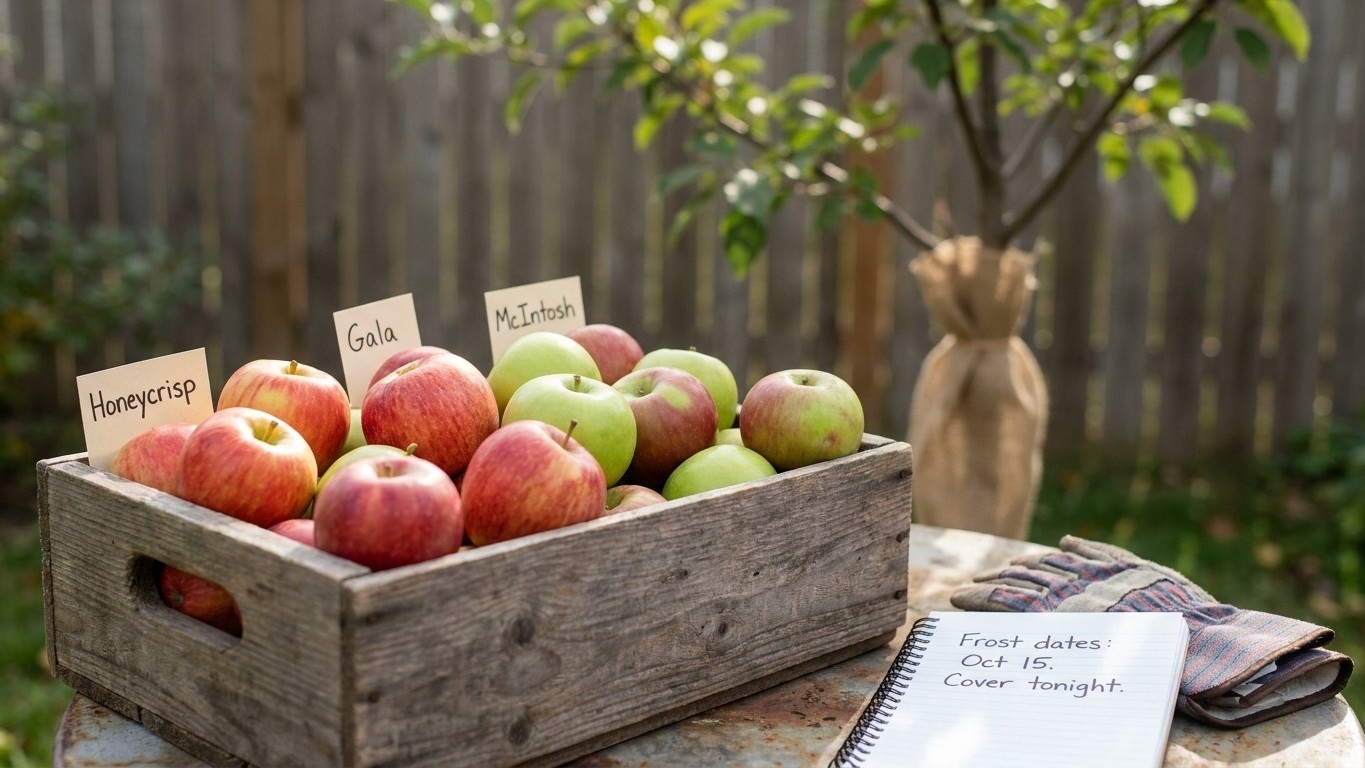

Michigan’s apple answer isn’t one zone number, it’s yours. Zone 6b hugs the southern border near Detroit while the northern Lower Peninsula and the U.P. drop to 4a, and the tree that thrives on one side of that line can die in a cold pocket on the other. So before you order a variety, walk your own ground: is it a hollow where frost settles, a slope, or close enough to Lake Michigan or Lake Huron to run milder than the map suggests? Match what you find there to the tree’s printed hardiness rating, not to the state average.
Can you grow apples in Michigan
Zone range across the state
The range matters more than any single number on a map. Southern Michigan, including the area around Detroit, sits near the mild end at zone 6b, with winters comparable to much of the Ohio Valley. Move north toward the northern Lower Peninsula and across the Upper Peninsula, and the zone drops toward 4a, close to the cold limit for most commercial apple cultivars. A tree rated for zone 5 planted in a 4a pocket may survive most winters but get killed back in a hard one. Match the variety’s printed zone rating to your own site rather than to the state average, and lean toward the cold end of any variety’s stated range if you’re unsure which side of the line you’re on.
Where winters run coldest, apple growing is still realistic. It just means leaning on the hardiest cultivars, several of them bred specifically by northern land-grant breeding programs for climates at least as harsh as Michigan’s, a starting point for choosing which ones is The Best Apple Varieties for Michigan, and choosing the planting site with care, while timing each task around The Michigan Apple Calendar, Stage by Stage. A south-facing slope with open air drainage runs several degrees milder on a clear, still night than a low spot at the bottom of the same hill, because cold air is heavier than warm air and settles into hollows.
Site and soil
Soil matters as much as zone, and it’s the more common reason a Michigan apple tree fails. Apples want deep, well-drained ground and at least six hours of direct sun. Heavy clay that holds standing water through a wet spring rots young roots long before winter cold becomes a factor, so a raised planting mound or a bit of tile drainage does more for a struggling tree than any amount of variety selection.
The Great Lakes themselves change the picture along the coast. Shoreline counties near Lake Michigan and Lake Huron run milder in winter and later into spring than inland sites at the same latitude, because the lake water holds its Temperature and slows both the freeze and the thaw. A backyard a few miles inland can sit a full zone colder than a lakefront orchard on the same county map, so treat the state-level zone figure as a starting point and adjust for your own elevation, tree cover, and distance from open water.
The Best Apple Varieties for Michigan

Hardiness versus winter chill
Hardiness tells you whether the tree survives the winter. Winter chill is a separate question: it tells you whether the tree flowers properly the following spring, and it’s the filter most casual advice skips entirely. Every apple variety has a chill requirement, a rough count of hours spent in cold-but-not-frozen temperatures needed to break dormancy cleanly. Michigan sits at the high-chill end of the range that catalogs describe. A low-chill selection bred for a mild southern winter, of the kind sold for Deep South orchards, is the wrong choice here: it satisfies its chill requirement early in a Michigan winter and then sits exposed to breaking dormancy during any prolonged warm spell, which puts flowers at risk from a later frost. A high-chill northern selection planted in a warm southern state has the opposite problem: it never accumulates enough cold hours and comes into a thin, ragged bloom instead. In Michigan, the safer default is a variety bred for or well proven in northern climates.
Varieties by hardiness and bloom
Several widely sold cultivars carry a published hardiness range that covers Michigan’s zone 4a to 6b span. ‘Haralson’ and ‘Zestar!’ were both bred at the University of Minnesota for winters colder than Michigan’s on average, the same breeding tradition behind several of the varieties recommended for growing apples in Minnesota. ‘Liberty’ was bred at Cornell and carries useful resistance to apple scab, a fungal disease that thrives in Michigan’s humid summers. ‘Honeycrisp’, ‘Cortland’, ‘McIntosh’, and ‘Empire’ all carry catalog hardiness ratings that reach into zone 4, and ‘Northern Spy’ blooms noticeably later than most of the others, which matters for frost timing.
| Variety | Catalog hardiness zone | Bloom timing | Pollen |
|---|---|---|---|
| Honeycrisp | 3-8 | Mid-season | Fertile |
| Liberty | 4-8 | Mid-season | Fertile |
| Haralson | 3-7 | Mid to late | Fertile |
| Zestar! | 3-7 | Early to mid | Fertile |
| Northern Spy | 4-7 | Late | Fertile |
| Jonagold | 5-8 | Mid-season | Sterile (triploid) |
Treat the table above as catalog information to cross against your own site’s zone and chill exposure, not as a local endorsement. Contact your county extension office for a variety list specific to your part of the state.
Planting a pair that works here
Apples need two trees of different varieties blooming at overlapping times, with at least one of them producing fertile pollen, or you get a healthy tree and no fruit. This is where the catalog table above earns its keep: match bloom timing columns, not just names you recognize at the garden center.
‘Honeycrisp’ paired with ‘Liberty’ works in most Michigan sites, since both bloom mid-season and both carry fertile pollen. ‘Zestar!’ paired with ‘Cortland’ is another workable combination for a slightly earlier bloom window. Watch for triploid varieties such as ‘Jonagold’, ‘Mutsu’, and ‘Winesap’: their pollen is sterile, so they need a nearby diploid variety to pollinate them, and that diploid variety needs a third tree of its own if it isn’t self-fertile either. A single ‘Jonagold’ tree next to a single crabapple will not always cover the gap.
Bloom overlap is a window measured in days, not a guaranteed match every single spring. A cool, slow spring stretches bloom out and improves the odds that two varieties overlap even if their catalog bloom times differ slightly. A fast, warm spring compresses bloom into a shorter window and makes exact timing matter more, which is one more reason to pick a pair with bloom times that are close on paper rather than merely adjacent.
The frost that costs a crop here

Why pink bud is the danger point
MSU Extension puts the average last spring frost around April 30 in the Detroit area, with the date running early to mid May across most of the rest of the Lower Peninsula. That’s a wide window, and it’s measured from Detroit specifically, so a site further north or further from Lake Michigan’s moderating effect should expect the later end of it or beyond.
The real damage doesn’t come from a frost hitting a dormant tree. It comes from a frost landing after the flower buds have opened to the pink stage, the point just before bloom when the petals show color but haven’t fully unfurled. A frost at pink or during bloom kills the flowers, not the tree. The tree leafs out fine that summer and looks completely healthy. The crop, however, is gone for the year, because a killed flower cannot set fruit no matter how good the rest of the season turns out.
What you can do about it
Site selection is the first line of defense: a tree on a slope with air drainage sees a milder frost than the same tree in a low hollow, for the same reason cold settles into valleys overnight. Delaying bud break with a thick mulch on the north side of a young tree can push bloom back by a few days in some years, though it’s a minor edge rather than real protection. The more dependable answer, especially where frost tends to come late, is choosing a late-blooming variety such as ‘Northern Spy’ so that bloom itself lands after the frost risk has mostly passed rather than sitting inside the danger window.
Frost risk at the far cold end of the spectrum looks nothing like Michigan’s. In the Yukon, the frost-free season is short enough that apple growing itself sits at the edge of what’s practical; see growing apples in Yukon for how growers there push bloom timing and site selection much further than anything needed in the Lower Peninsula.
The apple year in Michigan
Dormancy through bloom
Dormancy runs through winter while the tree carries no active growth, and this is the safe window for pruning and for planting bare-root trees, since the tree isn’t pushing new tissue that a hard freeze could damage. Green tip follows as the first sign of leaf growth breaks the bud scales, usually well before the last frost date, and it’s the point to start watching the forecast rather than the calendar. Pink comes next, the stage described above where flower buds show color and frost sensitivity peaks. Bloom itself typically falls somewhere inside or just after MSU Extension’s last-frost window for the Detroit area and the broader Lower Peninsula, though the exact date shifts with how warm or cool the spring runs.
Petal fall through harvest
Petal fall marks the end of bloom, when spent petals drop and the tiny fruit begins to swell behind them. Fruit set follows over the next few weeks, and this is when thinning pays off: removing excess young fruit now, leaving one apple every six to eight inches along a branch, produces larger, better-colored fruit at harvest than a branch left to carry everything it set. Harvest timing depends entirely on the variety, since early cultivars color up in late summer while late-keeping types hang on the tree well into fall, but the whole harvest window needs to close before the season’s first hard freeze. MSU Extension puts the first fall frost between October 6 and October 21 in zone 6a, so a late-hanging variety in a colder inland zone should be picked on the earlier side of that range rather than the later one.
Local help
MSU Extension is the right first call for anything specific to your county, from a locally tested variety list to current spray timing for apple scab and codling moth. Reach the outreach directory at MSU Extension’s outreach page and ask for the office covering your county, since advice calibrated to Detroit’s climate won’t always fit a site in the Upper Peninsula or along the Lake Michigan shore.
Common questions
Can I grow apples in Zone 4a Michigan?
Yes, provided you choose a variety with a catalog hardiness rating that reaches zone 4 or colder, such as ‘Haralson’ or ‘Zestar!’. A variety only rated to zone 5 is a gamble in a true 4a site once you hit a genuinely hard winter.
Why did my apple tree bloom but not set fruit?
The most common reason is a missing pollinator. Apples need a second variety blooming at the same time with fertile pollen, and triploid varieties like ‘Jonagold’ or ‘Mutsu’ can’t pollinate themselves or each other. A late frost during bloom is the second most common cause, and it kills the flowers while leaving the tree looking perfectly healthy.
Do I need to spray my apple tree in Michigan?
Most backyard trees need at least some disease management, since Michigan’s humid summers favor apple scab and cedar-apple rust. Choosing a scab-resistant variety such as ‘Liberty’ reduces the need considerably. Contact MSU Extension for current spray timing rather than guessing at it, since timing depends on the specific pest or disease pressure in a given year.
How many years until a newly planted apple tree bears fruit?
This depends on rootstock rather than variety alone. A tree on dwarfing rootstock generally bears sooner than one on standard seedling rootstock, though the exact timeline varies enough by nursery stock and site that it’s worth asking the nursery directly what rootstock a given tree is grafted onto.
Is it too late to plant if I missed spring planting?
Bare-root trees are best planted in early spring while still dormant, but container-grown trees can go in through much of the growing season as long as they get consistent water afterward. Fall planting is also an option in many parts of the state, giving roots a head start before the following spring, provided the tree has time to establish before the ground freezes hard.