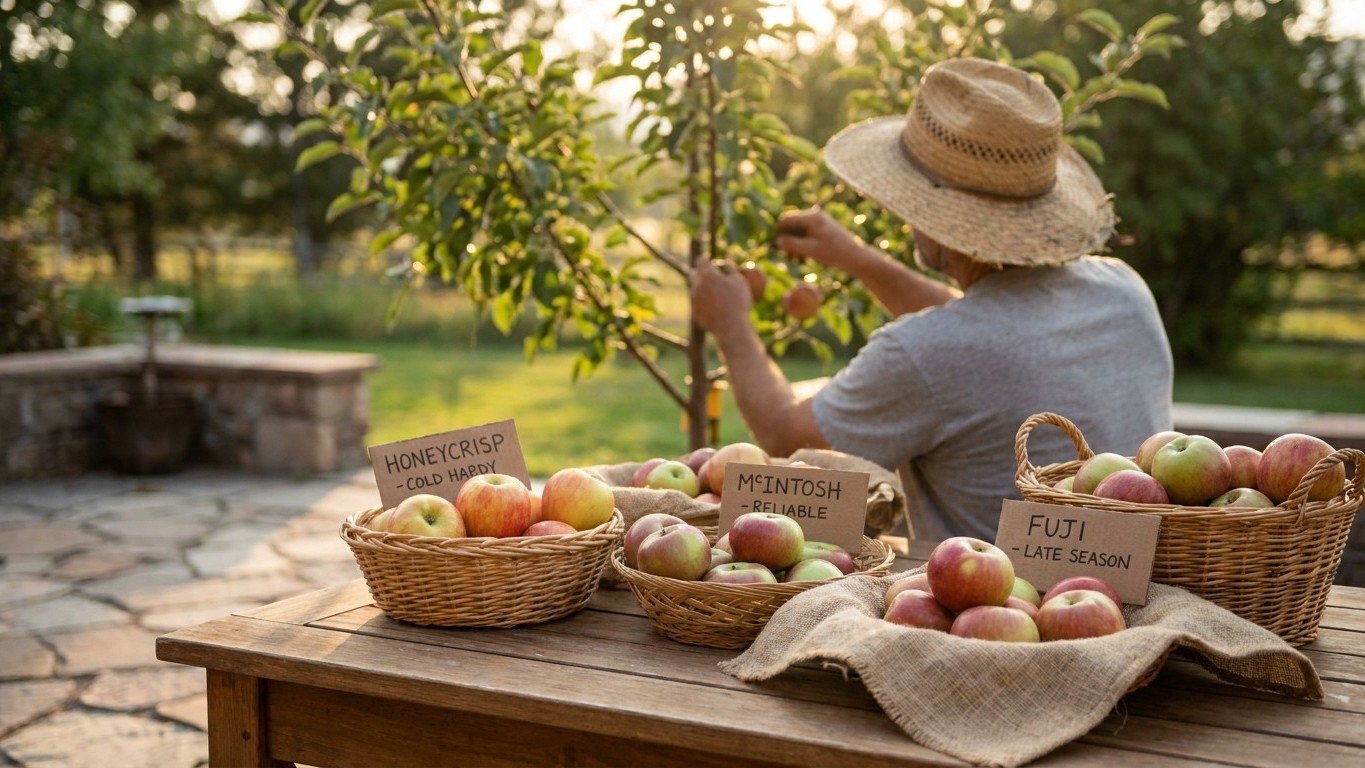

Montana doesn’t have one best apple — it has a hardiest one for wherever you’re standing, because a variety that shrugs off winter in one valley can freeze out in the next. Near Billings, the average low on an ordinary cold night in the dead of winter is 17.8°F, and that single number already eliminates a long list of trees before bloom timing or chill even enters the conversation. So before you order anything from a nursery catalog, find your own valley’s typical winter low and check the rootstock against it, not the variety name on the tag.
The short answer for Montana
There isn’t a single best apple variety for the whole state, because Montana’s winters vary from merely cold to genuinely brutal depending on where you stand. What decides whether a tree survives at all is winter hardiness, and near Billings, NOAA’s 1991-2020 climate normals put the coldest month’s average daily minimum at 17.8°F. That is not a record low. It is the typical low on an ordinary cold night, and it already knocks out any apple variety bred for milder climates further south or west.
What the frost dates add
The second filter is bloom timing against frost. NOAA’s 1991-2020 normals put the last spring freeze at Billings, using the 32°F threshold, in the window of April 29 to May 10, and the first fall freeze between October 1 and October 14. A variety that blooms before that spring window closes risks losing its blossoms to a late freeze, and one that still hangs unripe fruit after the fall window opens risks losing it to an early one. Both dates come from a relatively mild valley by Montana standards, and mountain valleys elsewhere in the state can see frost in almost any month of the year.
Winter chill, the accumulated cold hours that break dormancy evenly, rounds out the picture, though it is rarely the limiting factor here. Montana winters run long and cold enough that most apple varieties accumulate all the chill they need well before spring arrives.
The practical answer, then, is to choose a rootstock and scion combination documented as hardy through winters at least as cold as your own valley, with a bloom date that falls safely inside your local frost-free window, and to confirm both against your own site rather than a statewide average. The sections below work through what that means stage by stage and where it shifts across the state.
Working through it

Ranking apple choices for this climate starts with hardiness, moves to chill, and finishes with bloom timing. Get the order wrong and a tree that would have handled a Montana winter fine instead gets caught out by a frost it never needed to face.
Hardiness first
An apple tree survives a Montana winter through its rootstock as much as through its scion. Standard and semi-dwarfing rootstocks generally carry more cold-hardy root systems than the fully dwarfing types bred for milder commercial orchards, and a root system that dies below ground kills the tree regardless of how hardy the top growth is rated. Check the rootstock, not just the variety name, before you buy: a cold-hardy apple grafted onto a tender dwarfing rootstock is only as hardy as its roots.
Chill second
Chill mainly matters if you’re considering a variety bred for a mild-winter region, where too few accumulated cold hours cause patchy, delayed bloom. That’s not a Montana problem in most years. The state’s long winters supply plenty of chill; the risk here runs the other way, toward cold that’s too severe rather than too scarce.
Bloom timing third
This is where the site-specific frost dates matter most. A variety that blooms early is racing the tail end of the frost window described above, while a late-blooming variety trades some of that spring risk for a shorter window before fall frost catches up with the fruit still on the tree. Check The Montana Apple Calendar, Stage by Stage for how to read your own trees’ bud stage against the season rather than the date on a calendar.
| Bloom timing | Frost risk at bloom | Harvest timing |
|---|---|---|
| Early-blooming | Highest, especially in a spring that runs behind the Billings normal | Earliest, most margin before fall frost |
| Mid-season | Moderate, blooms nearer the middle of the freeze-probability window | Mid-season, moderate margin |
| Late-blooming | Lowest, blooms after most spring frost risk has passed | Latest, least margin before the first fall freeze |
Every choice costs the same trade-off restated in different terms: a variety that dodges spring frost by blooming late is also the one most likely to still be ripening when the first fall freeze arrives, and one that ripens early enough to beat that fall freeze is also the one most exposed to a late spring frost. No cultivar escapes the trade entirely. There’s only the one that matches your site’s actual frost record, which is why Growing Apples in Montana is worth reading in full before you plant a tree that stays in the ground for decades.
What changes across Montana
Billings, the reference station behind the frost dates above, sits in one of the milder valleys in the state, and that matters more than its position on a map suggests. The Yellowstone Valley around Billings benefits from lower elevation and open exposure that lets cold air drain away rather than pool, which is part of why its frost-free window runs as long as NOAA’s normals show.
Elevation and cold air drainage
Higher mountain valleys don’t get that same benefit. Cold air is heavier than warm air and settles into low ground overnight, so narrow valleys ringed by mountains, the kind found through much of western Montana, tend to hold onto frost later into spring and pick it back up earlier in fall than an open valley like the one around Billings. A valley bottom is almost always colder at dawn than a slope just a few hundred feet above it, which is why an orchard planted partway up a hillside can outperform one on the valley floor a short distance below it, frost-wise.
Water and local moderation
Large water bodies work the other direction. A lake of sufficient size holds summer heat into fall and releases it slowly, which moderates temperature swings on the immediate shoreline compared with dry ground a few miles inland. The effect fades quickly with distance from the shore, so it’s a narrow-band advantage, not a regional one.
None of this changes the two filters described above. It changes where each one binds. A grower in a cold mountain valley is fighting the hardiness filter hardest, since winter lows there run colder than the Billings normal. A grower in a moderated pocket near open water or on a favorable slope is fighting the bloom-timing filter instead, because the frost-free window there likely runs longer than the Billings figures suggest, though exactly how much longer isn’t something a single Billings weather station can tell you. That’s a question for your own site’s history, which is where a local extension office earns its keep.
The mistakes this climate punishes
Planting an early-blooming variety in a valley where the last frost normally lingers into the window NOAA records for Billings, April 29 to May 10, or later in a colder valley, is the most common way to lose an entire crop to a single cold night. The damage shows at bloom or just after: blackened blossom centers, and no fruit set on the wood that flowered too soon. It doesn’t kill the tree, but it empties the harvest for that year.
Timing mistakes
Feeding a tree late in the season is a related mistake, and it shows up months after the fertilizer goes down. Nitrogen applied in mid to late summer pushes soft new growth that hasn’t hardened off by the time the first fall freeze arrives, in the October 1 to October 14 window NOAA records for Billings and often earlier in colder valleys. That soft growth is the first tissue to die back, and repeated winters of it weaken a tree’s overall cold tolerance even where the older wood survives fine.
Hardiness assumptions
Assuming a nursery tag’s hardiness rating settles the question is the next mistake. A hardiness rating usually describes the scion, not the rootstock it’s grafted onto, and a tender rootstock under a hardy top can still be lost at the roots in a cold winter with thin or absent snow cover, even while the branches above ground look fine until the following spring exposes the problem.
A fourth mistake is ignoring where cold air actually sits on your own property. A tree planted in the lowest corner of a yard or field, where cold air drains and pools overnight, will see a harder frost than one planted on higher ground fifty feet away, and a bloom-timing choice that would have worked fine on the slope can still fail in the hollow.
Checking this against your county
Every figure above comes from one weather station near Billings, and Montana State University Extension is the right place to check how much your own county differs from it. The Montana State University Extension maintains county offices across the state, and county agents typically know which local orchards have apple trees that have already survived a run of hard winters in your specific valley, which is a better guide than any statewide figure.
If you garden or orchard outside the Billings area, treat every date and temperature in this piece as a starting comparison point rather than your local answer, and ask your county office for its own frost record and any variety notes it keeps for growers nearby.
Common questions
Can you even grow apples in Montana?
Yes, apples are grown successfully across much of Montana, including in valleys considerably colder than the Billings reference station used in this piece. The limiting step is matching a tree’s rootstock hardiness and bloom timing to your own valley’s winter lows and frost dates, not the state line.
Do I need more than one apple tree to get fruit?
Most apple varieties need a second, different variety blooming at the same time nearby to set fruit, since a single tree usually can’t pollinate itself. Check that any two trees you plant have overlapping bloom windows, which matters even more in a climate where a cold spring can compress or shift that window from one year to the next.
What’s the difference between hardiness and chill hours?
Hardiness is whether the tree’s wood and roots survive the winter’s cold. Chill is whether it accumulated enough cold hours to break dormancy evenly and bloom on schedule. In most of Montana, winters are long enough that chill is rarely the problem, and hardiness is the filter that actually rules varieties out.
When is the safest time to plant a new apple tree?
Plant once the ground is workable and the risk of a hard freeze has dropped, which in the Billings area falls after NOAA’s last spring freeze window of April 29 to May 10, and later in colder valleys. The tree itself is less time-sensitive than its first bloom will be, so lean toward the later end of that window rather than the earlier one.