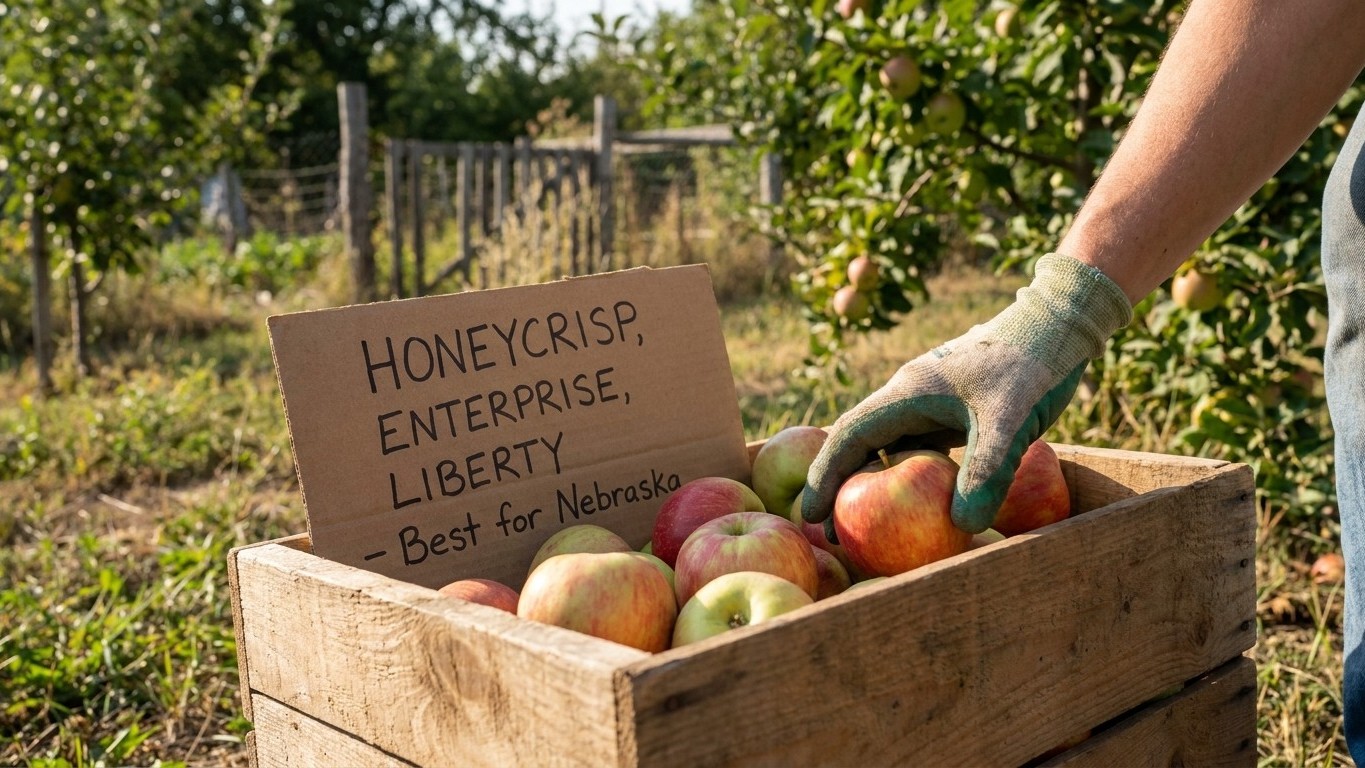

Is there a single best apple for Nebraska? No — what matters is whether the tree can survive your coldest winter night and whether it blooms after your last frost, not the name on the tag. Nebraska winters can drop the coldest month’s average low to 13.6°F, and Omaha’s last spring freeze can land anywhere from April 12 to April 23, sometimes later in a rural yard than that. So before picking a variety, find your own county’s last frost date and match it against that tree’s bloom timing — that comparison decides more than any catalogue name ever will.
The short answer for Nebraska
Apples do fine across most of Nebraska, provided the rootstock is rated for real winter cold and the tree’s bloom lands solidly inside the local frost-free window rather than at its edge. NOAA’s NCEI 1991-2020 normals put Omaha’s last spring freeze (32°F, in the 30-70% probability band) at April 12 to April 23, and the first fall freeze at October 15 to October 26. Those are airport-station figures, and NOAA’s own data shows suburban and rural gardens typically see frost later in spring and earlier in fall than that station, sometimes by one to two weeks.
That gap is the whole answer. A tree that opens its blossoms while frost risk is still high can survive the winter perfectly and still lose the entire year’s crop in one bad night, because open flowers and young fruit set are far more frost-sensitive than dormant wood. So “best for Nebraska” really means two things at once: a rootstock rated for cold at least as severe as the Omaha coldest-month minimum, and a bloom period that clears the local frost window with margin to spare.
The answer also depends on where in the state you garden. Eastern Nebraska, where Omaha sits, has a longer and comparatively milder frost-free season than land farther west and at higher elevation. Anyone setting up a new planting should start with Growing Apples in Nebraska, since site selection and rootstock choice are decided before a single variety name gets picked, not after.
Working through it

Cold hardiness: the first filter
Cold hardiness is a survival question, not a fruiting question. It asks whether the trunk, roots, and dormant buds can take the coldest night of a typical winter without dying back. NOAA’s 1991-2020 normals put that coldest-month minimum at 13.6°F at the Omaha station, and named apple cultivars sold through northern nurseries generally publish a hardiness rating alongside their fruit description, the same way a tomato packet lists its days to maturity. Rootstock matters as much as the top variety here: a standard or semi-dwarfing rootstock generally tolerates a harder freeze than a fully dwarfing one, though it also takes longer to reach a manageable size and to bear its first crop. That trade-off, hardier and slower against smaller and quicker, is the first decision a Nebraska grower makes, and it has nothing to do with which variety name ends up on the tag.
Winter chill: the second filter
Winter chill is a different question entirely. It asks whether the buds get enough accumulated cold to break dormancy cleanly and bloom on schedule, rather than blooming late, unevenly, or not at all. In a climate as cold as Nebraska’s, running short on chill is rarely the risk, unlike in the Deep South, where growers sometimes choose low-chill cultivars for exactly that reason. Here the two filters point in the same direction: winters cold enough to demand a hardy rootstock also supply chill in abundance, so the practical risk shifts almost entirely onto cold hardiness and bloom timing rather than chill accumulation.
What every choice costs
Every apple cultivar’s published bloom period and hardiness rating are catalogue facts, printed the same way in every state, the same as a tomato’s days-to-maturity figure. What changes is how those catalogue numbers land against Omaha’s frost window. A cultivar that blooms early trades a longer growing season and earlier harvest for a real chance of losing blossom to a late freeze in a cold spring. A cultivar that blooms later trades that risk away but gives up some of the season on the harvest end, which matters more in years when the first fall freeze arrives on the early side of NOAA’s October 15 to October 26 window. This page does not carry a sourced, named list of apple cultivars for this territory, so the specific names worth planting in your county are a question for Growing Apples in Nebraska and for UNL Extension directly, both of which can match rootstock and bloom timing to your actual address rather than to a statewide average.
What changes across Nebraska
The figures above come from the Omaha reference station, on the eastern edge of the state near the Missouri River, and they do not describe the whole territory. Western Nebraska, including the Panhandle around Scottsbluff, sits at a much higher elevation than Omaha, and higher elevation generally means a shorter frost-free season and colder winter nights than the eastern river valley enjoys. No NOAA normals for a Panhandle station are cited in this piece, so treat that as a general pattern to confirm locally, not a number to plant against.
The Sandhills, in north-central Nebraska, sit even farther from the moderating effect of the Missouri River and are known for sandy, fast-draining soil that also drains heat quickly on a clear night, which tends to sharpen frost risk at ground level in low spots. A gently sloping site that lets cold air drain away downhill will almost always run warmer on a frost night than a low pocket at the base of the same slope, even a few hundred feet away and at the same elevation.
None of this changes the two filters themselves, cold hardiness and bloom timing against frost still decide the outcome everywhere in the state. It changes how much margin you need to build in. A garden west of Omaha, or one sitting in a low frost pocket anywhere in the state, should treat NOAA’s Omaha frost dates as an optimistic starting point and lean toward the later end of any bloom range, not the earlier one, when weighing a variety’s published bloom timing.
The mistakes this climate punishes
Nebraska’s winters are forgiving of caution and unforgiving of a bad bet on timing. The mistakes below show up in specific, predictable ways.
- Planting an early-blooming cultivar on a low or exposed site. The failure shows up in a cold spring when NOAA’s April 12 to April 23 Omaha frost window runs late, or later still in a garden that trails the airport station: open blossom takes a hard hit and the harvest drops sharply even though the tree itself leafs out fine.
- Choosing rootstock rated for a milder climate than the coldest-month minimum actually seen here. This shows up as trunk splitting or dieback after a genuinely cold winter, not every year, which is exactly why it gets overlooked until the one season it matters.
- Feeding nitrogen late into summer. Late feeding keeps a tree pushing soft new growth right up to the first fall freeze, and that new growth is the part most likely to be damaged when temperatures drop, especially if the freeze lands on the early side of the October 15 to October 26 Omaha window.
- Planting in a frost pocket instead of on a slope. Cold air is heavier than warm air and settles in low ground on a clear, still night, so the exact same variety planted fifty feet uphill can escape a freeze that wipes out blossom in the low spot.
- Assuming chill hours are the risk, and picking a low-chill variety to compensate. In a climate this cold, chill is almost never the limiting factor, so a variety chosen to solve a chill problem that doesn’t exist here often turns out to bloom too early for local frost timing instead.
Each of these mistakes is invisible in a mild year and expensive in a hard one, which is exactly why they keep getting repeated. The tree that survived three easy winters in a row tells you nothing about how it handles the fourth.
Checking this against your county
Every figure above comes from the Omaha airport station in NOAA’s 1991-2020 climate normals, and a garden in another county, at a different elevation, or in a low-lying site can run a week or two ahead or behind that window in either direction. Before you commit to a rootstock or a bloom timeline, confirm your own frost dates and get a locally matched cultivar recommendation from the University of Nebraska-Lincoln Extension, which can weigh your specific county rather than a statewide average.
UNL Extension is also the right first call if you are trying to decide between a dwarf and a standard tree for a given site, since that decision depends on soil, exposure, and available space as much as it depends on climate, and none of that shows up in a set of NOAA frost tables alone.
Common questions
Can apples even survive Nebraska winters?
Yes, standard orchard rootstock and most northern dessert cultivars are rated to handle winters colder than the 13.6°F coldest-month minimum NOAA’s 1991-2020 normals record at the Omaha station. The bigger risk in most years is a late spring freeze hitting open blossom, not the tree failing to survive winter itself.
Do I need two apple trees for pollination?
Most apple cultivars need a different variety blooming at the same time nearby to set fruit reliably, since a single tree of most cultivars will not pollinate itself. Check the specific cultivar’s pollination requirement before planting just one tree and expecting a full crop.
What happens if frost hits my tree while it’s already blooming?
The outcome depends on how far the flowers had opened and how hard the freeze was, a light frost on partly open buds often does less damage than a hard freeze on fully open blossom. Losses can range from a thinner crop to none at all that year, even though the tree itself typically leafs out and grows normally afterward.
Is it too late to plant an apple tree if I missed the spring window?
Bare-root and container trees are usually planted while dormant or in early spring, so missing that window in a given year generally means waiting for the next dormant season rather than planting into an already active tree. Ask a local nursery or UNL Extension what stock and timing they actually have on hand before assuming the year is lost.