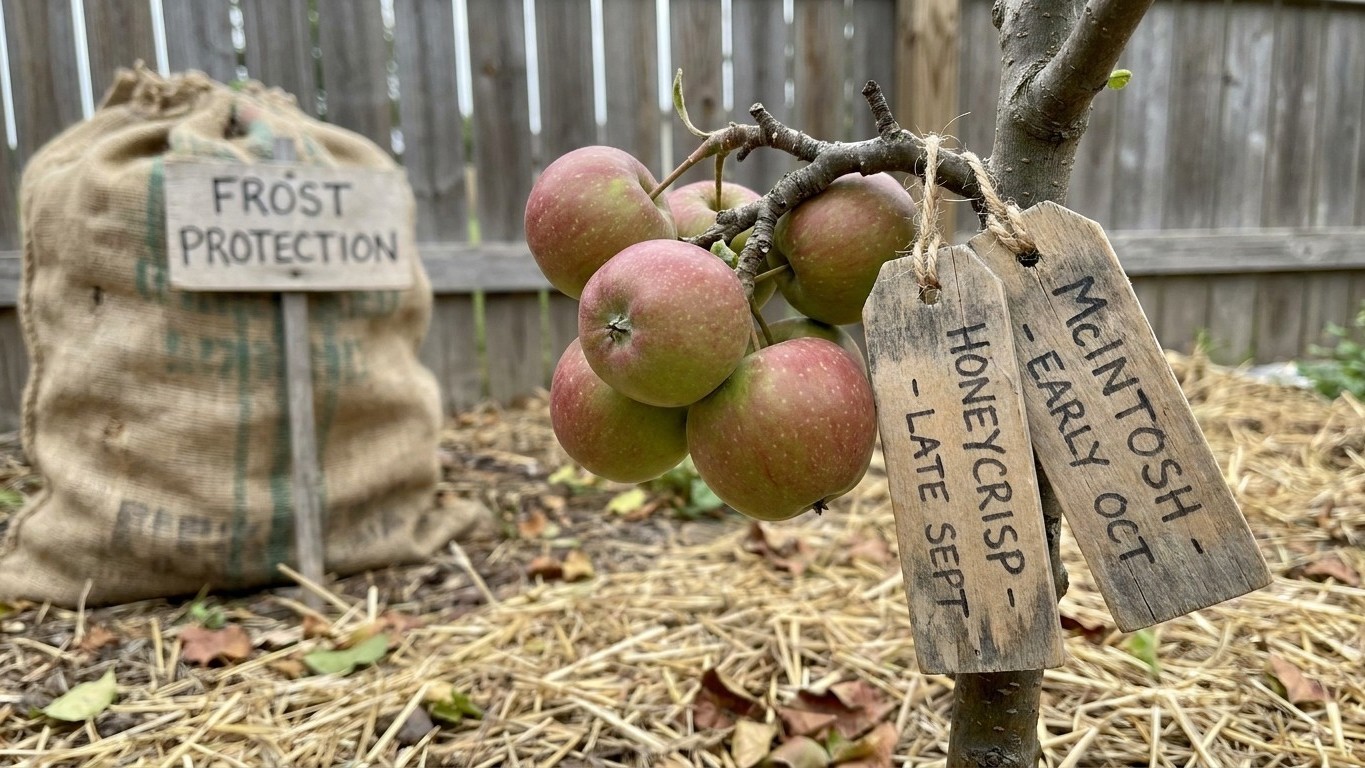

Yes, apples grow reliably across most of Nebraska, though conditions shift sharply between the Panhandle and the Missouri River valley. USDA’s Plant Hardiness Zone Map, built from 1991-2020 normals, places the state between zones 4a and 5b, and NOAA’s 1991-2020 climate normals put Omaha’s coldest-month average minimum at 13.6°F. Check your own county’s zone on the USDA map before ordering a tree, since a cultivar rated for zone 5 can struggle two hours west in a zone 4a county.
Can you grow apples in Nebraska
Apples are one of the more forgiving tree fruits for Nebraska’s climate, and growers have raised them from the Missouri River bluffs to the High Plains for generations. The real question is not whether apples survive here, but which cultivar matches your specific county’s winter.
USDA’s Plant Hardiness Zone Map, drawn from 1991-2020 normals, splits the state between zone 4a in the north and west and zone 5b in the southeast river valleys. That is a wide spread for one state. A tree bred for zone 5 can lose wood or die outright in a zone 4a winter, so matching a cultivar’s published hardiness rating to your own county’s zone, not the state average, is the first decision to get right.
NOAA’s 1991-2020 climate normals, measured at Omaha’s reference weather station, put the coldest month’s average daily minimum at 13.6°F. That figure describes an average night in the coldest month near Omaha, not a record low, and it sits well within the range mature apple trees handle without injury. Further north and west, in the Panhandle and Sandhills, winters run colder and the frost-free season shorter, a version of the same gradient North Dakota growers deal with on a larger scale (see Growing Apples in North Dakota for how that colder end plays out).
Southeast Nebraska, roughly along the Missouri River near Omaha, gets the mildest and longest season in the state and supports the broadest range of cultivars. West and north of there, stick to cultivars rated for zone 4 and plan for a shorter window between the last spring freeze and the first fall frost. See The Best Apple Varieties for Nebraska for cultivar picks suited to each of these zones, and check The Nebraska Apple Calendar, Stage by Stage to see how bloom and harvest timing shifts across these same zones.
Site placement matters more in a state with Nebraska’s swings than in a milder climate. Plant on a gentle slope rather than in a low spot, since cold air pools in hollows and collects the frost that damages blossoms in spring. A site with good air drainage and full sun will outperform a higher-rated cultivar stuck in a frost pocket.
Which varieties suit this climate

No single Nebraska source ranks apple cultivars for the whole state, so the varieties below are chosen on two catalogue-level facts that hold true wherever you plant: published hardiness rating and winter chill requirement.
Winter chill is the filter most guides skip. Hardiness tells you whether the wood survives the cold. Chill tells you whether the tree flowers properly the following spring, and it runs on hours of cold accumulated over the whole dormant season, not on the coldest single night. Nebraska’s long winters put the state at the high end of the chill scale, the opposite problem from a mild-winter state like Delaware, where growers pick low-chill cultivars bred for the Mid-Atlantic (see Growing Apples in Delaware). A high-chill northern cultivar gets all the cold hours it needs here and blooms on schedule. The risk runs the other way: a low-chill cultivar bred for a mild state can break dormancy too early during a warm spell and get caught by a spring freeze.
Honeycrisp

Honeycrisp is rated hardy to USDA zone 3, which covers Nebraska’s 4a-5b range with margin to spare, and its chill requirement is easily met by the state’s winters. Fruit ripens in early to mid fall, with the exact date shifting a week or two with the season.
Haralson

Haralson was bred in Minnesota for this kind of winter and carries a zone 3 rating. It blooms and ripens later than many cultivars, which happens to work in Nebraska’s favor against spring frost, a point covered in the next section.
Zestar!

Zestar! is also rated to zone 3 and ripens earlier than Honeycrisp or Haralson, giving a harvest option ahead of the main fall rush.
Liberty

Liberty is rated to zone 4 and bred for resistance to apple scab, a useful trait in Nebraska’s humid summers.
| Variety | USDA hardiness rating | Relative bloom timing | Notable trait |
|---|---|---|---|
| Honeycrisp | Zone 3 | Mid | Widely grown fresh-eating apple |
| Haralson | Zone 3 | Late | Bred in Minnesota for cold winters |
| Zestar! | Zone 3 | Early | Ripens ahead of the main fall harvest |
| Liberty | Zone 4 | Mid | Bred for scab resistance |
Planting a pair that works here
Apples are not reliably self-fertile, so plan on two trees from the start, and choose two that bloom at the same time. At least one of the pair must be a normal diploid variety with fertile pollen, since a handful of well-known cultivars, including Jonagold, Baldwin and Winesap, produce sterile pollen and cannot pollinate anything, even themselves.
- Jonagold, sterile pollen, needs two other varieties nearby
- Baldwin, sterile pollen, same problem
- Winesap, sterile pollen, same problem
Planting two of these sterile-pollen varieties next to each other, with no third pollen source nearby, is a common beginner mistake. It produces plenty of blossom and almost no fruit.
Among the cultivars suited to Nebraska’s zone 4a-5b range, Honeycrisp and Haralson bloom close enough together to work as a pair in most seasons, and both carry fertile pollen. Zestar! blooms slightly earlier and pairs better with Honeycrisp than with the later Haralson. Liberty overlaps closely enough with all three to serve as a third tree if space allows, and its scab resistance is a useful backstop if a susceptible variety is also in the yard.
A flowering crabapple planted nearby, chosen for a bloom period that overlaps your main varieties, is a reliable backup pollen source and takes far less space than a second full-size apple tree. Check with a local nursery on that specific crabapple’s bloom timing before relying on it as your only pollinator.
The frost that costs a crop here

The frost that actually costs a Nebraska apple crop most years is not a hard winter freeze. It’s an ordinary spring frost landing after the buds have already opened. NOAA’s 1991-2020 climate normals put the last spring freeze at Omaha’s reference weather station in the window of April 12 to April 23, with the exact date moving within that band year to year. Suburban and rural sites away from that airport station often see their last frost run one to two weeks later, so treat this window as a starting point for the Omaha area and check your own county’s typical date before assuming your trees are past risk.
A frost that arrives once the buds have opened to pink or into bloom kills the flowers, not the tree. Wood and leaf buds survive a freeze that open blossoms cannot. A tree can look completely healthy in May while carrying no fruit at all that year, because the flowers that would have set apples were killed weeks earlier at the pink or bloom stage.
There is not much a home orchard can do to warm a whole tree overnight, but a few things reduce the damage on a young planting. Covering a small tree with a frost blanket or old sheet on a night frost is forecast after bud break can hold a few degrees. Stringing incandescent lights under the cover adds a little more warmth. Watering the orchard floor the evening before a frost, so the soil releases heat overnight, helps marginally on a larger planting. None of these fully protects a mature, full-size tree, which is why variety choice matters more than any single frost-night trick.
The more durable protection is choosing a variety that blooms later in the window, after the sharpest frost risk near Omaha’s April 12 to April 23 range has mostly passed. Among the cultivars suited to this climate, Haralson blooms later than Honeycrisp or Zestar!, giving it a real, if partial, edge in a year when frost lands late. No variety blooms so late that the risk disappears, but a later window narrows the odds of getting caught.
The apple year in Nebraska
Timing an orchard by the calendar month is unreliable in a state with Nebraska’s year-to-year swings. Read the tree by its stage instead, and anchor each stage against the Omaha reference frost dates above, shifting later if you garden outside the river valley.
Stage by stage
| Stage | Typical timing near Omaha | What to do |
|---|---|---|
| Dormancy | Late fall through winter | Prune while wood is dormant and buds are tight |
| Green tip | Weeks before the April 12-23 last-frost window (NOAA, Omaha) | Watch for warm spells pushing buds ahead of schedule; hold off on nitrogen |
| Pink | Inside or just before that same window | Frost sensitivity begins here; watch the forecast closely |
| Bloom | Within or just after the window | Let pollinators work; avoid spraying insecticide during open bloom |
| Petal fall / fruit set | Days after bloom, once frost risk usually eases | Thin excess fruit if the set is heavy |
| Harvest | Variety-dependent, generally before the October 15-26 first-frost window (NOAA, Omaha) | Pick before a hard freeze damages fruit left on the tree |
Late-ripening cultivars like Haralson can still be on the tree when the first fall frost risk begins in mid to late October near Omaha, so pick before a hard freeze if a cold night is forecast, since frozen fruit turns mealy quickly even when the tree itself takes no harm.
Local help
UNL Extension keeps county-specific spray schedules, pest alerts and variety trial notes that a general guide cannot cover, and it is the right first call before you plant. Reach your local office through the University of Nebraska-Lincoln Extension site for a current variety list and a spray calendar timed to your county rather than the Omaha reference station used throughout this article. A call to your county office before ordering trees is worth more than any general guide, since they track which pests and diseases are active in your area this season.
Common questions
What if I only have room for one apple tree?
A single tree usually will not set much fruit on its own. A nearby flowering crabapple, or a neighbor’s apple tree within normal bee foraging range, can supply pollen, and a dwarf rootstock lets you fit two small trees where one standard tree would have gone.
My tree bloomed heavily but set almost no fruit. What happened?
The two most common causes are a late frost that killed the open blossoms without leaving any visible sign, or a pollination mismatch, such as a sterile-pollen variety with no fertile partner nearby. A young tree under four or five years old can also bloom before it is mature enough to hold fruit.
Can I grow apples in pots or a small yard in Nebraska?
Dwarf and semi-dwarf rootstocks make container growing possible, but roots in a pot freeze harder than roots in open ground, since the container walls offer far less insulation than surrounding soil. A potted tree needs its container moved to an unheated garage or wrapped and insulated for winter, even if the same variety would be fine planted in the yard.
How long before a new apple tree bears fruit?
Dwarf trees typically start bearing in two to three years, and standard-size trees can take five to eight. Rootstock, not the fruiting variety grafted onto it, is usually what decides the wait.
Is Nebraska too cold for peaches even though apples do fine?
Peaches generally need milder winters than apples and struggle in the state’s colder zone 4a counties, while apples tolerate that same cold without much trouble. If you are set on stone fruit, ask your county extension office which peach or cherry cultivars, if any, hold up in your specific area before planting.