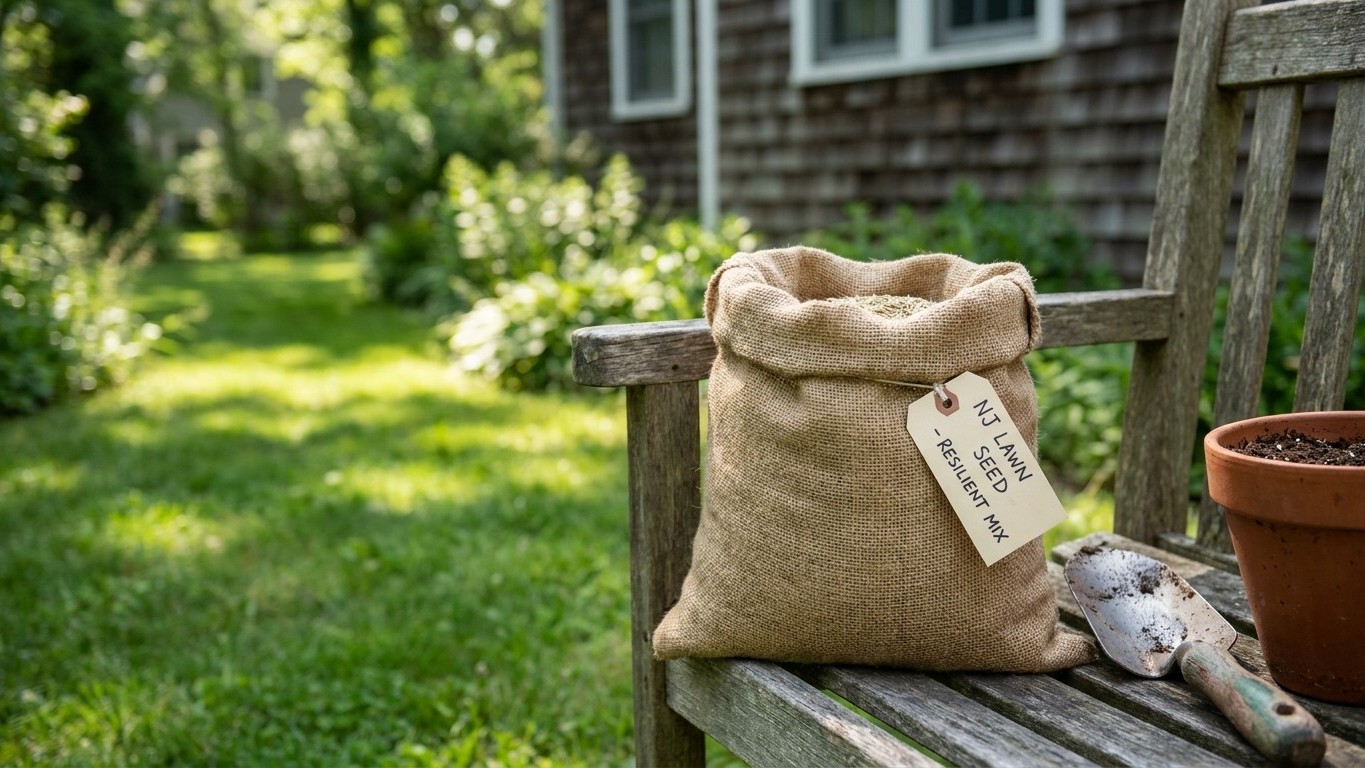

New Jersey falls in the transition zone, a classification The Homestead Post assigns using Clemson Cooperative Extension’s HGIC 1214 season tolerances, which means the state gets too much summer heat for cool-season grass to stay perfect year-round and too much winter cold for warm-season grass to do the same. There is no single best grass for New Jersey: a tall fescue lawn looks tired in a dry July, and a zoysiagrass lawn sits brown from the first fall frost until spring. Decide which season you’re willing to lose before you buy seed.
The short answer for New Jersey
New Jersey sits in the transition zone, which is the reason no single grass seed works here for all twelve months. Pick tall fescue and your lawn coasts through fall, winter, and spring, then looks rough for a stretch of July; pick zoysiagrass or bermudagrass and you get a thick, tough summer lawn that goes brown from the first frost until late spring. Neither is broken — that’s just the trade New Jersey’s climate forces on you. Decide which season you can stand to watch your lawn struggle through, then buy seed matched to that choice.
Which species actually grow here
Clemson’s HGIC 1214, together with Penn State Extension’s cool-season species guidance, points to five species that belong in this climate: tall fescue, Kentucky bluegrass, and perennial ryegrass on the cool-season side, zoysiagrass and bermudagrass on the warm-season side. Tall fescue is the most common cool-season choice for New Jersey home lawns because its deep root system handles the summer stretch better than bluegrass grown alone, though most bagged mixes blend it with a smaller share of bluegrass or ryegrass for faster germination and self-repair. Zoysiagrass and bermudagrass are the realistic warm-season options, and both spread by stolon and rhizome rather than staying in the bunch-type habit tall fescue keeps.
What the right answer depends on is what you’re willing to give up. A cool-season lawn stays green through fall, winter, and spring, then goes tan and drought-stressed for stretches of a hot, dry summer. A warm-season lawn is thick and durable in July heat, then goes dormant and brown from the first hard fall frost until it greens back up in late spring. Neither browning means the grass is dead. It means the season doesn’t suit it, and it recovers on its own calendar.
Working through the year

Start with the basics covered in New Jersey Lawn Care before layering species-specific timing on top, since mowing height and soil prep matter regardless of which grass you’re running. Cool-season and warm-season species are worked in opposite halves of the year, so the first thing to know is which one you have before you follow any date below.
If you have a cool-season lawn
Clemson Cooperative Extension’s HGIC 1219 (Tall Fescue Maintenance Calendar) sets the working calendar for tall fescue, and the same rough shape applies to Kentucky bluegrass and perennial ryegrass mixed into it: growth picks up in spring, slows through summer heat, and picks up again in fall, which is also the best window for overseeding and the season’s heaviest nitrogen feeding. Fall seeding beats spring seeding for cool-season grass in New Jersey, because a seedling gets a whole cool, moist fall to root before summer heat arrives, instead of racing to establish before it hits. Near Newark, NOAA’s 1991-2020 climate normals put the first fall freeze between November 4 and November 16, and HGIC 1219 lays out mowing height, nitrogen rate in pounds per 1,000 square feet, and irrigation guidance week by week counting back from that fall window. Check that calendar directly for the actual rate figures rather than guessing, since an overshot nitrogen rate in a transition-zone summer stresses the lawn further instead of helping it.
If you have a warm-season lawn
Warm-season grass runs on the opposite clock. Clemson’s HGIC 1217 (Zoysiagrass Maintenance Calendar) and HGIC 1216 (Bermudagrass Maintenance Calendar) both start the working season at spring green-up, carry the heaviest feeding and mowing through summer, and taper off well before the first fall freeze so the grass can harden off before dormancy. Between the first fall freeze near Newark and spring green-up, a warm-season lawn needs no mowing, no fertilizer, and very little water. That long dormant stretch, not any defect in the grass, is the real cost of choosing bermudagrass or zoysiagrass this far north.
| Grass | Season type | Established from | Growth pattern |
|---|---|---|---|
| Tall Fescue | Cool-season | Seed | Bunch-type, deep roots |
| Kentucky Bluegrass | Cool-season | Seed or sod | Spreads by rhizome, self-repairs |
| Perennial Ryegrass | Cool-season | Seed | Bunch-type, fast germination |
| Zoysiagrass | Warm-season | Sod, plugs, or sprigs | Spreads by stolon and rhizome, dense |
| Bermudagrass | Warm-season | Seed, sod, or sprigs | Spreads aggressively by stolon and rhizome |
Aeration timing follows the same split: fall for cool-season lawns, alongside overseeding, and late spring for warm-season lawns, once green-up is underway and the grass can recover quickly from the holes. Pre-emergent herbicide for crabgrass goes down before either grass breaks dormancy, and HGIC 1219, HGIC 1216, and HGIC 1217 each time that to soil temperature rather than a fixed date. Match the calendar to the grass you actually have, since running a bermudagrass schedule on a fescue lawn, or the reverse, is one of the fastest ways to damage either one. The New Jersey Lawn Care Calendar, Month by Month lines up both Clemson calendars against the reference-city frost window so you can see what to do in the month you’re actually in.
What changes across New Jersey
Every figure above is measured at or near Newark, and Newark is not the whole state. New Jersey’s frost timing shifts with elevation and coastline, and both matter for choosing and scheduling grass.
The northwest highlands
Ground in the Kittatinny Ridge and Highlands region of northwestern New Jersey sits well above Newark’s elevation, and higher ground cools faster on a still night. Gardeners there should treat the Newark frost window as a floor, not a target, and plan fall overseeding or warm-season dormancy prep a week or two earlier than the November 4 to November 16 range NOAA’s normals show for the reference city.
The coast and the south
Along the immediate Jersey Shore and down to the Cape May peninsula, the Atlantic Ocean holds heat late into fall, so frost typically arrives later than the Newark date suggests. That extra margin helps warm-season turf harden off properly before its first freeze. Further inland in South Jersey, the sandy soils common through the Pine Barrens drain faster than the clay-heavier soils farther north, which shows up as drought stress on cool-season lawns sooner in a dry July even at the same air temperature.
None of this changes which five species belong in a New Jersey lawn. It changes how much margin to build into the calendar: earlier fall work on higher ground, a later frost expectation right on the coast, and closer attention to irrigation wherever the soil is sandy.
The mistakes this climate punishes
A transition zone forgives less than either a pure cool-season or pure warm-season climate, because both grass types are only partly suited to it. These are the errors that show up fastest here.
Cool-season mistakes
- Seeding tall fescue, bluegrass, or ryegrass in late spring instead of fall, so seedlings hit summer heat before rooting deep enough to survive it. The failure shows as bare, tan patches by midsummer, right when it’s too hot to reseed and fix it.
- Scalping a cool-season lawn during a hot, dry stretch removes the leaf area it needs to shade its own root zone. The damage shows within one or two weeks as faster browning than a neighboring lawn cut higher.
- Skipping the fall nitrogen application that HGIC 1219 calls for and feeding heavily in spring instead. Spring nitrogen pushes soft top growth right before summer stress arrives, which works against the lawn rather than for it.
Warm-season mistakes
- Fertilizing zoysiagrass or bermudagrass in early fall as growth is already slowing toward dormancy. The new growth that nitrogen pushes doesn’t have time to harden off before the first freeze near Newark, and it shows as blackened, mushy blades right after that freeze instead of a clean, even dormancy.
- Mowing or fertilizing warm-season grass too early in spring, before the soil has actually warmed and the lawn has greened up on its own. Fertilizer applied to a still-dormant lawn mostly feeds weeds instead of grass.
- Judging a warm-season lawn dead over winter and tearing it out. Brown from the first fall freeze through spring green-up is the normal dormant color for zoysiagrass and bermudagrass in New Jersey, not a sign of disease or death.
Checking this against your county
Every figure on this page comes from the Newark weather station and from Clemson Cooperative Extension calendars written by species, not from a New Jersey-specific source. Before buying seed or applying the first bag of fertilizer, check your county’s actual timing against Rutgers New Jersey Agricultural Experiment Station, the state’s land-grant extension service, which can tell you how far your county’s frost dates and soil conditions run from the Newark figures used here. Local confirmation matters more the farther you live from Newark, whether that’s the colder northwestern highlands or the milder immediate coast.
Common questions
Is Kentucky bluegrass better than tall fescue for a New Jersey lawn?
Not automatically. Bluegrass spreads by rhizome and self-repairs bare spots, but it generally wants more water and fussier soil than tall fescue’s deep root system needs. Most New Jersey lawns use a fescue-heavy blend with a smaller share of bluegrass for repair, rather than a pure stand of either.
Can I grow zoysiagrass from seed here instead of sodding it?
You can, but seed-grown zoysiagrass establishes very slowly compared with sod or plugs. In a transition zone, where the warm season is already shorter than it is farther south, that slow start is a bigger handicap, so sod or plugs are the more practical route for most New Jersey yards.
When should I stop mowing in the fall?
Keep mowing a cool-season lawn as long as it’s actively growing, which usually runs up to around the first fall freeze near Newark, sometime in the November 4 to November 16 range NOAA’s 1991-2020 normals show. Stop mowing a warm-season lawn once it goes dormant around the same window, and don’t be tempted to mow it again until it greens up in spring.
What if my county’s frost dates don’t match Newark’s?
Use your own county’s numbers instead of the Newark figures on this page. Suburban and rural gardens often see the first fall freeze earlier and the last spring freeze later than an airport weather station shows, sometimes by a week or two, and Rutgers NJAES is the place to check what your specific county typically sees.