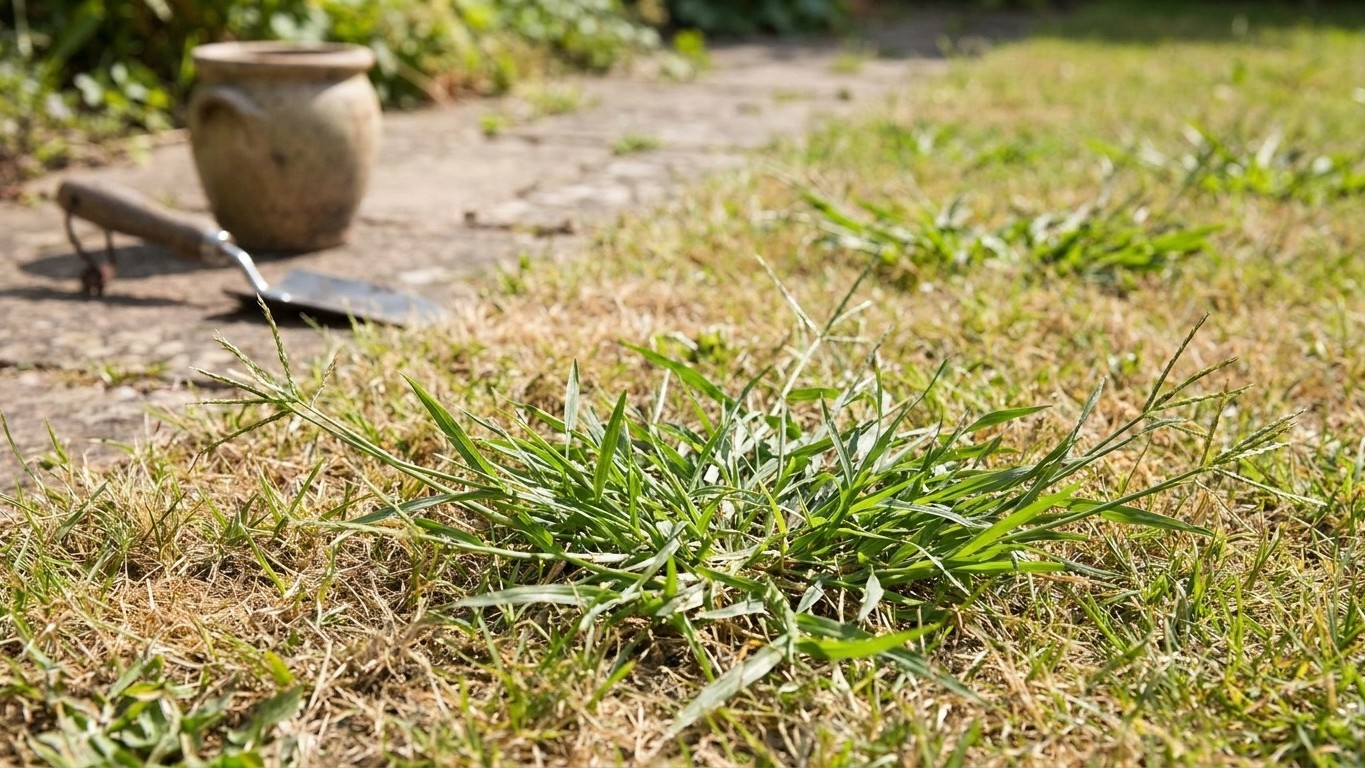

That patch of pale, wide-bladed grass sprawling out from the driveway edge or the sidewalk crack — that’s crabgrass, and the only question that matters is whether you’re early enough to stop it. Pre-emergent works before the seed sprouts and does nothing after, so timing beats every other decision you’ll make about it. Before you buy a bag, walk outside and look at your forsythia: if it’s blooming, soil temperature has already crossed the line crabgrass needs.
How to be sure that is what you have

Crabgrass (Digitaria species) is a warm-season annual grass, not a broadleaf weed, and that distinction is why it survives most broadleaf weed killers untouched. The two species most likely to turn up in a home lawn are large crabgrass (Digitaria sanguinalis) and smooth crabgrass (Digitaria ischaemum). Both grow low and wide, radiating out from a central crown in a shape often compared to a starfish or a spider.
Leaf, root, and season
The blades are coarse and flat, wider than the fine or medium-textured grasses in a typical lawn, and colored a lighter, almost yellow-green that stands out against darker turf even before the plant flowers. Large crabgrass carries visible hair along the leaf sheath and blade edges, while smooth crabgrass is nearly hairless, which is the fastest way to tell the two apart in hand. Where a stem touches bare soil it roots at that node and sends up a new fan of leaves, so a single plant can sprawl across a foot or more of open ground by midsummer.
Crabgrass shows up first in the thin, sunny margins of a lawn: along driveway edges, around manhole covers, in the last few feet of turf next to a sidewalk, in wheel ruts. By late summer it throws up seed heads shaped like a claw or a spread hand, several finger-like spikes radiating from one point at the top of the stem. By fall the whole plant turns a purplish red before frost kills it outright, leaving a bare patch exactly where it stood.
What it gets mistaken for
Two lookalikes cause most of the confusion. Quackgrass is a perennial with underground rhizomes, so pulling the top growth leaves a network of roots that regrows within weeks, something crabgrass never does. Goosegrass, sometimes called silver crabgrass, has a flattened, whitish stem base where it meets the soil and typically germinates two to three weeks after crabgrass does, so a plant showing up early in the season with a silver-white crown is more likely goosegrass than crabgrass.
Why it is in your lawn
Crabgrass seed needs bare soil and direct sun to germinate, so its presence is less a verdict on your lawn and more a map of where the turf already failed. Any spot mowed too short, worn thin by foot traffic, or shaded out and then exposed again is an invitation, and the seed bank in most lawns is large enough that a single opening is all it needs.
What thins the turf first
Mowing height is the biggest lever most homeowners control without realizing it. Cool-season lawns cut below the ranges Clemson Cooperative Extension’s HGIC 1214 lists, tall fescue below 2.5 to 3.5 inches, Kentucky bluegrass below 2 to 3 inches, let more light reach the soil surface between blades, and that light is the trigger crabgrass seed is waiting for. The same is true on the warm-season side: bermudagrass and zoysiagrass are commonly mowed at the low end of their 0.75 to 1.5 inch and 0.75 to 2 inch ranges, and a lawn kept there with no other density behind it opens the same door.
Compacted soil compounds the problem. Foot traffic along a regular path, parked vehicles on a lawn edge, or heavy clay that was never aerated all thin the grass stand and firm the surface enough that water runs off instead of soaking in, weakening the desirable turf while crabgrass, which tolerates poor soil far better than most lawn grasses, keeps germinating in the gaps. Drought stress does the same job from the other direction: a cool-season lawn that thins in a dry stretch opens exactly the kind of bare, sunlit soil crabgrass needs.
The window that decides everything
Pre-emergent herbicide is the strongest chemical option against crabgrass, and it only works before germination. Put it down too early and it breaks down before the seed sprouts. Put it down too late and you’ve missed the plant entirely. There is no middle correction once the window closes.
The trigger, not the date
Clemson Cooperative Extension’s tall fescue maintenance calendar, HGIC 1219, times that application to a plant event rather than a date: forsythia and flowering dogwood bloom. Both shrubs respond to the same soil-warming trend that triggers crabgrass germination, so when forsythia’s yellow flowers are opening and dogwood is starting to bloom, soil temperature has reached the range crabgrass seed needs. Watching your own forsythia is a more reliable signal than any date printed on a bag of pre-emergent, because soil warms at a different pace every spring.
That bloom trigger does not arrive on the same week nationwide. It moves north over several weeks as spring advances, so a lawn in the Deep South reaches forsythia bloom well before one in the upper Midwest, and the gap between the two can run past a month. Rather than borrow a date from a general article, check the maintenance calendar for your own grass species, since the same bloom-cue timing applies to warm-season lawns covered in Clemson’s centipedegrass (HGIC 1215), bermudagrass (HGIC 1216), zoysiagrass (HGIC 1217), and St. Augustinegrass (HGIC 1218) calendars.
If you miss it
Once the window closes, a post-emergent product is the only option left, and it works best on crabgrass that is still young, ideally before it has more than two or three tillers. This is also the moment to be sure of what you’re fighting: crabgrass germinates as spring soil warms, while chickweed does the opposite, thriving in the cool, wet weeks of fall and winter and dying back right as the soil crabgrass needs starts to warm. Treating one on the other’s calendar wastes the application.
Getting rid of it
Pulling it by hand
Hand-pulling works on crabgrass in a way it doesn’t on many perennial weeds, because the plant has a fibrous root system with no rhizomes or stolons underground. A crabgrass plant does not regrow from a root fragment left in the soil, so if you get the crown out, that plant is finished. The catch is timing: pull it before the seed heads form, since a mature plant can have already dropped viable seed into the soil around it by the time you notice the clump.
Pulling is realistic for a handful of plants along a walkway or garden bed border. It is not practical for a lawn with crabgrass scattered across hundreds of square feet, and broadleaf weeds like dandelions that show up in the same thin patches need a different herbicide entirely, since dandelion is a broadleaf perennial and crabgrass is a grass, so one product rarely handles both.
Chemical control
Pre-emergent products sold to home gardeners generally contain one of three active ingredients: dithiopyr, prodiamine, or pendimethalin. All three form a chemical barrier in the top layer of soil that stops germinating seedlings before they emerge, and none of them will do anything for a crabgrass plant that has already come up.
Post-emergent control relies on different actives, most commonly quinclorac or fenoxaprop-P-ethyl, and these work only while the plant is young. Once crabgrass is mature and setting seed in summer heat, post-emergent control becomes unreliable no matter which product you choose. Quinclorac in particular can injure centipedegrass and St. Augustinegrass, so a warm-season lawn needs the label checked against the turf species, not just against the weed.
Several herbicide actives used against crabgrass are restricted or unavailable in some states, so check your state’s list of registered products, available through your state department of agriculture or your extension office, before buying anything. A product legal in one state can be off the shelf in the next.
Keeping it out
Thick, dense turf is the only control that lasts beyond one season, because it shades the soil surface enough that crabgrass seed never gets the light and warmth it needs to germinate. Everything else, pre-emergent included, is a stopgap that has to be repeated every year the turf stays thin.
Mow high, not low
Raising the mowing height is the single fastest change most lawns can make, and it costs nothing but a different setting on the mower deck. Clemson Cooperative Extension’s HGIC 1205 mowing guide and the species profiles in HGIC 1214 give the ranges most lawn grasses tolerate:
| Grass | Season | Mowing height | Shade tolerance |
|---|---|---|---|
| Tall Fescue | Cool-season | 2.5-3.5 in | Good |
| Kentucky Bluegrass | Cool-season | 2-3 in | Fair |
| Fine Fescue | Cool-season | 2.5-3.5 in | Excellent |
| Perennial Ryegrass | Cool-season | 2-3 in | Fair |
| Zoysiagrass | Warm-season | 0.75-2 in | Excellent |
| St. Augustinegrass | Warm-season | 2.5-4 in | Excellent |
| Centipedegrass | Warm-season | 1.5-2 in | Fair |
| Bermudagrass | Warm-season | 0.75-1.5 in | Very poor |
Cutting at the top of a grass’s tolerated range, rather than the bottom, keeps more leaf surface working and more shade on the soil. A lawn mowed at the low end of its range all season is functionally thinner than the same grass cut higher, even if the count of plants underneath is identical.
Feed and overseed on schedule
Fertilizing at the timing Clemson Cooperative Extension’s HGIC 1201 recommends for your specific grass species keeps the stand dense enough to close gaps before crabgrass seed gets a foothold. Feeding a cool-season lawn at the wrong time of year, pushing growth in the heat of summer instead of the cool seasons it actually grows in, weakens it instead of thickening it. Overseeding thin cool-season areas, and repairing bare warm-season patches with sod, plugs, or sprigs during their active growing season, closes the exact gaps crabgrass is waiting for. A lawn that never shows bare soil in spring never gives crabgrass an opening, which is the same logic behind managing every entry on the broader list of lawn weeds that exploit thin turf.
Common questions
Will mowing at the right height kill crabgrass that’s already growing?
No. A taller cut slows seed production and shades out new germination, but it will not remove crabgrass already established. Existing plants need to be pulled while young or treated with a post-emergent product.
Can I use one product on crabgrass and dandelions at the same time?
Usually not. Crabgrass is a grass and most pre-emergent and post-emergent crabgrass products are built around active ingredients that target grassy weeds, while dandelion is a broadleaf perennial that needs a broadleaf herbicide. Read the label for both weeds named specifically before assuming one product covers both.
My crabgrass turned reddish-purple and looks dead. Is it dormant or actually dead?
It’s dead. Crabgrass is a true annual, so the purplish-red color that appears before frost is the plant dying, not going dormant, and it will not green back up in spring. That’s different from a perennial lawn grass going brown in drought or cold, which usually recovers on its own.
Why does crabgrass keep coming back in the exact same spot every year?
Because the seed bank in that patch of soil can persist for several years, and if the underlying condition, thin turf, compaction, or a mowing height that’s too low, was never fixed, new seeds germinate there every spring regardless of how many mature plants you removed the year before. Fixing the turf density is what actually breaks the cycle.