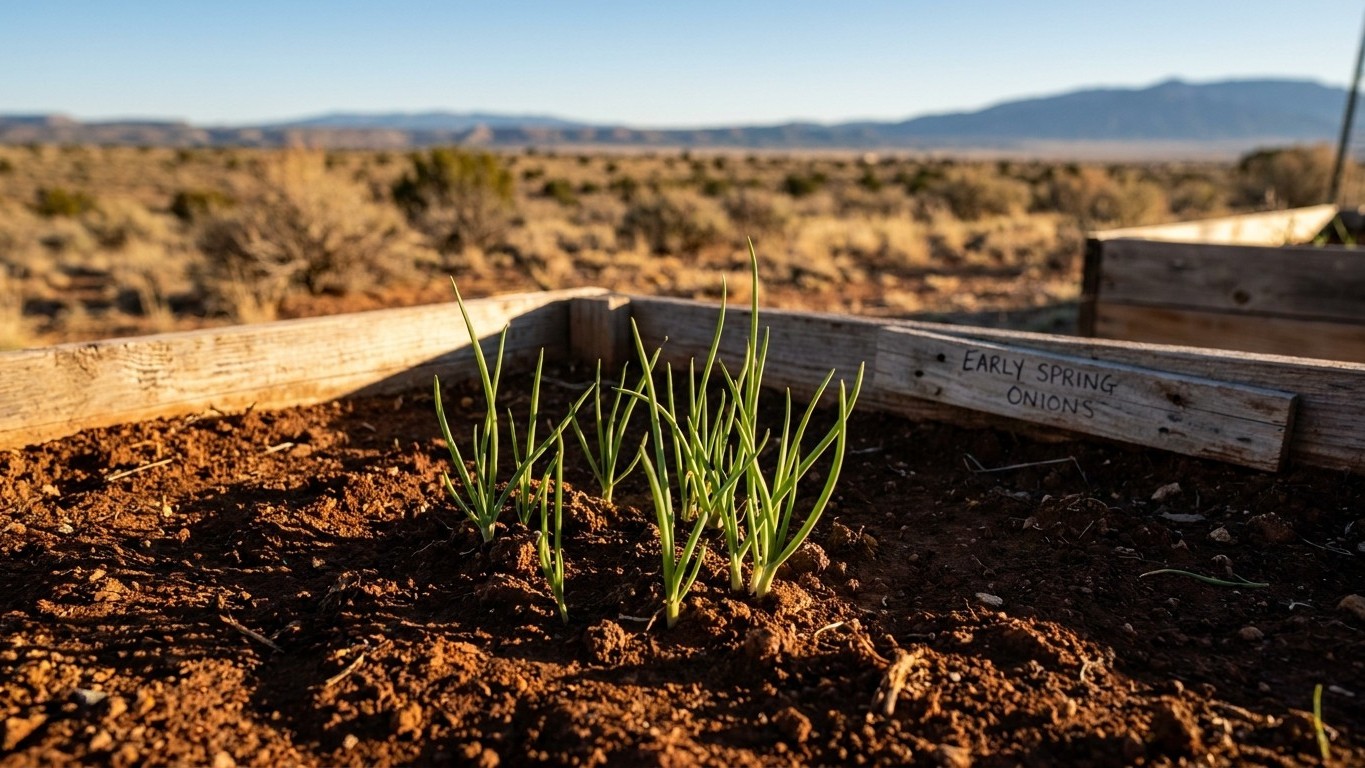

Onions in New Mexico are governed by day length more than by calendar dates, and the numbers tell the story fast. Albuquerque sits at 35.04 degrees north latitude, where the longest day of the year delivers 14 hours and 22 minutes of daylight. That single figure explains why the state plants later than the Deep South, why certain catalog varieties simply won’t work here, and why the right window is late winter into early spring rather than fall.
The short answer for New Mexico

New Mexico sits in what growers call intermediate-day territory. At 35.04 degrees north, the state gets more summer daylight than the true short-day South (think southern Texas or the Gulf Coast) but less than the long-day North (the Dakotas, Minnesota, the northern tier of states). Onions respond to that daylight threshold, not to soil temperature or the calendar on your wall. An onion bulbs when day length crosses its genetic trigger point, and everywhere in New Mexico, that trigger arrives when the days stretch toward roughly 12 to 14 hours.
That’s why the planting season here looks different from a place like Georgia. In truly mild-winter regions, gardeners tuck onion sets or transplants into the ground in fall, let them overwinter as small plants, and watch them take off with the lengthening days of spring. New Mexico’s high desert climate doesn’t cooperate with that plan. Even in the southern parts of the state, winters bring hard freezes that can kill young onion plants outright, especially at the elevations common across the Rio Grande valley and points north.
The practical answer, then, is late winter to early spring. Onion transplants or sets go into the ground once the worst of the winter freeze risk has passed but while the plants still have several weeks of cool weather to build leaf mass before the days get long enough to trigger bulbing. That leaf mass matters enormously, and it’s the subject of the next section, because it determines how big your onions actually get.
Because New Mexico falls into the intermediate-day band, the varieties that make sense here are the ones bred for 12- to 14-hour daylight triggers, not the short-day types built for the Deep South’s 10- to 12-hour summers, and not the long-day types that need 14- to 16-hour days to even start forming a bulb. Get the timing right, but also get the variety right. One without the other still leaves you with a disappointing harvest.
What will not work here
Some onion varieties are simply not built for New Mexico’s latitude, and no amount of good soil, water, or timing will fix that. These are long-day varieties (plus one intermediate type) whose published range starts north of 35.04 degrees, meaning they need day lengths New Mexico’s summer never produces. Plant them here and you don’t get a small onion. You get no onion at all: the plant spends the whole season making leaves, waiting for a daylight trigger that never arrives, and eventually the bulb rots in the ground or in storage.
- Ailsa Craig (long-day, 38-60N), needs day lengths only reached well north of New Mexico
- Barolo (long-day, 38-55N), same daylight gap; never triggers bulbing here
- Blush (long-day, 38-55N), leaves all season, no bulb
- Frontier (long-day, 40-50N), built for latitudes far north of Albuquerque
- New York Early (long-day, 38-50N), misleading name; still needs northern daylight
- Patterson (long-day, 38-55N), a storage classic, but not for this latitude
- Powell (long-day, 43-47N), a narrow northern band, well past New Mexico
- Red Carpet (long-day, 40-45N), same story, no trigger reached
- Red Long of Florence (intermediate-day, 38-50N), even as an intermediate type, its range starts above New Mexico’s latitude
- Redwing (long-day, 43-65N), built for far northern gardens
- Rossa di Milano (long-day, 38-50N), no bulbing trigger this far south
- Safrane (long-day, 42-50N), needs daylight New Mexico’s summer doesn’t provide
- Talon (long-day, 42-50N), same daylight ceiling problem
There’s a second way New Mexico gardeners lose their harvest, and it has nothing to do with variety choice: planting too late in spring. It’s tempting to assume a late start just delays the harvest by a few weeks. It doesn’t work that way. Once day length crosses the bulbing threshold, the plant stops putting energy into leaves and starts putting it into the bulb, whatever size that plant happens to be at that moment. Set your transplants out late, and the plant hasn’t built the leaf mass it needs, so the bulb it forms is small, sometimes barely bigger than a marble. Late planting doesn’t shrink the calendar. It shrinks the onion.
What changes across New Mexico
New Mexico runs roughly six degrees of latitude from its southern border near Las Cruces up to the Colorado line near Farmington and Taos, and Albuquerque sits close to the middle of that span. The 35.04-degree figure and the 14-hour-22-minute daylight number both belong to Albuquerque specifically, pulled from the same weather station that produces the region’s official climate data. A gardener in Las Cruces or Farmington is not gardening under the exact same sky.
Southern New Mexico, closer to 32 degrees north, edges toward the short-day zone. That’s the range where a variety like Red Rock (short-day, 30-36N) starts to make sense, something that would be a poor fit further north in the state. Northern New Mexico, up near 37 degrees, edges toward the long-day zone, and it’s the part of the state where varieties like Bridger (long-day, 35-50N) or Walla Walla Sweet (long-day, 35-55N) begin to have a real shot at bulbing properly, since their published range starts right around New Mexico’s own latitude.
| Region | Approximate latitude | Day length on longest day | What it changes |
|---|---|---|---|
| Southern NM (Las Cruces area) | ~32N | A bit less than Albuquerque’s 14h22 | Leans toward short-day varieties; long-day types even less viable |
| Albuquerque (reference city) | 35.04N | 14h22 | Solidly intermediate-day territory |
| Northern NM (Farmington/Taos area) | ~37N | A bit more than Albuquerque’s 14h22 | Some long-day varieties starting at 35N become worth trying |
The five varieties sitting right at the edge of their published range, within about a degree and a half of 35.04 degrees, deserve a mention too: Gabriella, Madalyn, Red Sensation, Texas Grano 1015Y, and Vidora (all short-day, published up to 35N). These aren’t a flat yes or no for New Mexico. They may bulb here, particularly in the southern part of the state, but a gardener trying them should treat it as an experiment, not a guarantee.
Sweet now, or onions that last
New Mexico’s spot in the intermediate-day band puts gardeners in the middle of a trade-off that plays out across the whole country: sweet onions don’t store, and pungent onions do. According to University of Missouri Extension, sweet varieties consistently store worse than the more pungent types, and the reason isn’t marketing, it’s chemistry. The volatile sulfur compounds that give an onion its sharp bite are the same compounds that protect the bulb from breaking down in storage. Fewer of those compounds means a milder onion on your cutting board today and a softer, spoiled one in the pantry by January.
Short-day varieties, the ones suited to New Mexico’s southern edge, tend to run sweeter and lighter on those sulfur compounds. Long-day varieties, better suited to the state’s northern reaches, run sharper and hold up far longer in storage. Intermediate types, the group that fits Albuquerque and most of central New Mexico, land somewhere between the two: not as candy-sweet as a Deep South onion, not as long-storing as a Minnesota keeper, but a reasonable compromise for a gardener who wants both a decent eating onion in July and something left in the pantry come Thanksgiving.
What this means in practice: a New Mexico gardener growing a short-day or borderline variety in the southern part of the state should plan to eat those onions through fall rather than count on them for winter cooking. A gardener further north, growing something closer to the long-day end of the spectrum, has a real shot at onions still holding up in the pantry come March. The choice isn’t really about taste alone. It’s about how long you want that harvest to feed you.
Checking this against your own garden
Every figure in this article comes from Albuquerque’s coordinates and the daylight math tied to them. If you’re gardening in Las Cruces, Roswell, Farmington, or anywhere well outside the middle of the state, don’t assume Albuquerque’s numbers describe your yard exactly. A few things are worth confirming before you buy seed or set out transplants:
- Look up your own latitude if your town sits noticeably north or south of Albuquerque; a couple of degrees can shift which onion group actually bulbs for you.
- Check your local average last spring frost date and first fall frost date, since these determine your safe planting window far than a statewide estimate can.
- Contact your county’s Cooperative Extension office; New Mexico State University maintains extension offices across the state, and they track local soil and frost conditions county by county.
- Note your elevation, since higher ground in New Mexico often means a shorter frost-free season even at a similar latitude.
- Confirm which onion varieties are actually stocked by local nurseries in your part of the state, since availability tends to already skew toward what performs well regionally.