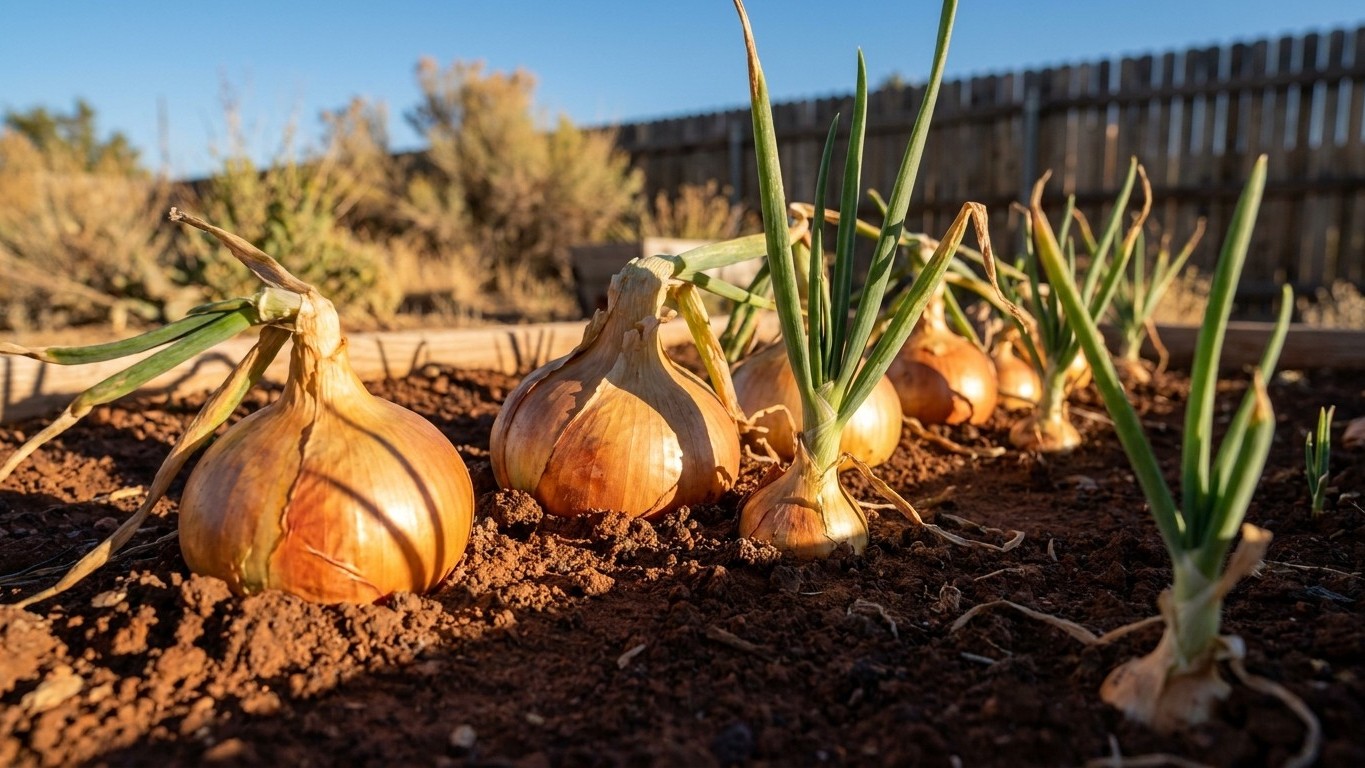

At Albuquerque’s latitude, the longest day of the year gives roughly 14 hours and 22 minutes of daylight, which lands squarely in intermediate-day onion territory. That single fact determines which varieties will bulb here and which ones will simply grow tall, green tops and never form an onion at all. Here’s what that means for your garden.
How long your longest day is

Albuquerque sits at 35.04 degrees north latitude, and on the summer solstice the sun is up there for 14 hours and 22 minutes. That number matters more than temperature, more than soil, more than how much you water. Onions decide when to stop growing leaves and start forming a bulb based on how many hours of daylight they’re getting, not how hot it is outside.
Where 14 hours and 22 minutes puts you
Short-day onions start bulbing once daylight reaches about 12 hours, a threshold documented by Clemson Cooperative Extension. That’s easy to hit almost anywhere. Long-day onions wait for 14 to 16 hours before they’ll bulb, and some varieties need the full 16 to trigger reliably. Albuquerque’s 14-hour-22-minute ceiling clears the low end of that long-day range but doesn’t come close to the top of it. That’s why this territory sits mostly in intermediate-day country, with room for a handful of long-day varieties whose requirements start low enough to work here, and none of the varieties that demand the deep summer daylight of the far north.
New Mexico is a big state, though, and 35.04 degrees is just Albuquerque’s number. A gardener near Raton, close to the Colorado line, gets a longer summer day than someone in Las Cruces near the Texas border. If you’re gardening near either edge of the state, it’s worth checking your own latitude rather than assuming Albuquerque’s figure applies to you exactly.
Which varieties bulb in New Mexico
Out of 31 onion varieties documented across this site, 13 have published latitude ranges that cover Albuquerque’s 35.04 degrees. That’s the group most likely to actually form a bulb in a New Mexico garden, and you can see the full breakdown in The Best Onion Varieties for New Mexico. Once you’ve picked a variety, When to Plant Onions in New Mexico will help you time it right.
Varieties likely to bulb in New Mexico gardens
- Bridger (long-day, 35-50N)
- Cabernet (intermediate-day, 35-45N)
- Calibra (intermediate-day, 35-45N)
- Candy (intermediate-day, 33-40N)
- Elsye (intermediate-day, 32-45N)
- Expression (intermediate-day, 32-45N)
- Monastrell (intermediate-day, 35-46N)
- Red Long of Tropea (intermediate-day, 35-48N)
- Red Rock (short-day, 30-36N)
- Scout (intermediate-day, 32-46N)
- Sierra Blanca (intermediate-day, 32-45N)
- Walla Walla Sweet (long-day, 35-55N)
- White Castle (short-day, 30-38N)
Five more sit within a degree and a half of a published boundary, in what’s really a blurred zone rather than a hard line: Gabriella, Madalyn, Red Sensation, Texas Grano 1015Y, and Vidora, all short-day types with ranges topping out around 35 degrees. These may bulb in Albuquerque or points south, but they’re at the edge of their documented range, not a safe bet.
Varieties that will not bulb here
Thirteen varieties have published ranges that start north of 35.04 degrees, and this is the list worth reading twice if you’ve ever bought a bag of onion sets at a supermarket without checking the label. Plant these in New Mexico and the day never gets long enough to flip the switch from leaf growth to bulb growth. The plant doesn’t stall or give you a small onion. It keeps making leaves all summer, then rots at the base once cool weather arrives, with nothing underground to show for it.
- Ailsa Craig (long-day, 38-60N)
- Barolo (long-day, 38-55N)
- Blush (long-day, 38-55N)
- Frontier (long-day, 40-50N)
- New York Early (long-day, 38-50N)
- Patterson (long-day, 38-55N)
- Powell (long-day, 43-47N)
- Red Carpet (long-day, 40-45N)
- Red Long of Florence (intermediate-day, 38-50N)
- Redwing (long-day, 43-65N)
- Rossa di Milano (long-day, 38-50N)
- Safrane (long-day, 42-50N)
- Talon (long-day, 42-50N)
If a package of these ends up in your cart because it was on sale or came from a mail-order catalog aimed at northern growers, it’s not a matter of trying harder or watering more. The latitude requirement is fixed. Choose from the covers list instead.
When to plant onions in New Mexico
Because Albuquerque’s day length puts this territory mostly in intermediate-day range, planting timing splits depending on which variety you’re growing and where in the state you garden. That’s different from a true short-day state further south, and different from a long-day state up near the Canadian border.
Working around Albuquerque’s frost window
At the Albuquerque airport station, the last spring freeze typically falls between March 31 and April 12, and the first fall freeze arrives between October 29 and November 9. Those are 1991-2020 averages from NOAA’s Climate Normals, not guarantees, and they come from an airport weather station, not your backyard. Suburban and rural gardens around New Mexico often see frost linger a week or two later in spring and arrive a week or two earlier in fall, especially at higher elevation, which describes a lot of the state.
| Event | Albuquerque average window |
|---|---|
| Last spring freeze (32°F) | March 31 to April 12 |
| First fall freeze (32°F) | October 29 to November 9 |
For the intermediate-day varieties that make up most of the covers list, onion sets or transplants generally go in the ground in late winter to early spring, timed so plants are established well before the longest days of June trigger bulbing. Onion seedlings tolerate a light frost, so gardeners often set plants out a few weeks ahead of the average last freeze rather than waiting for it to pass entirely. In the milder, lower-elevation pockets of southern New Mexico, gardeners growing short-day types like Red Rock or White Castle sometimes plant in fall instead, letting the onion overwinter as a small plant and bulb up once spring daylight lengthens. Check your own county’s frost record before committing to either window, particularly if you garden above 6,000 feet.
Sweet onions or onions that keep
Every onion faces the same trade-off, and it comes down to chemistry rather than luck. The bite in a raw onion comes from volatile sulfur compounds, and University of Missouri Extension notes that sweet varieties carry fewer of them. Fewer sulfur compounds means a milder onion at the cutting board, but those same compounds are what protect a bulb in storage. Take them away and you get something great on a sandwich in July that turns soft and spoiled by October.
What that means for a New Mexico pantry
Most of the varieties suited to Albuquerque’s day length skew toward the intermediate and short-day side, which tends to track sweeter and shorter-keeping. Candy, Texas Grano 1015Y, and the short-day types like Red Rock and White Castle fall into that category: good eating soon after harvest, not built for a long winter in a mesh bag. Walla Walla Sweet is worth flagging as the exception that proves the rule. It’s a long-day onion, but it’s bred for sweetness rather than storage, so despite qualifying on latitude, it won’t keep the way a typical long-day onion does further north.
If you want onions that carry you into late winter, look toward the more pungent intermediate-day varieties on the covers list, such as Cabernet or Monastrell, and plan to use the sweeter harvest first. A New Mexico garden built entirely around sweet varieties will hand you a great August and September, and an empty onion basket by the time seed catalogs start arriving again.