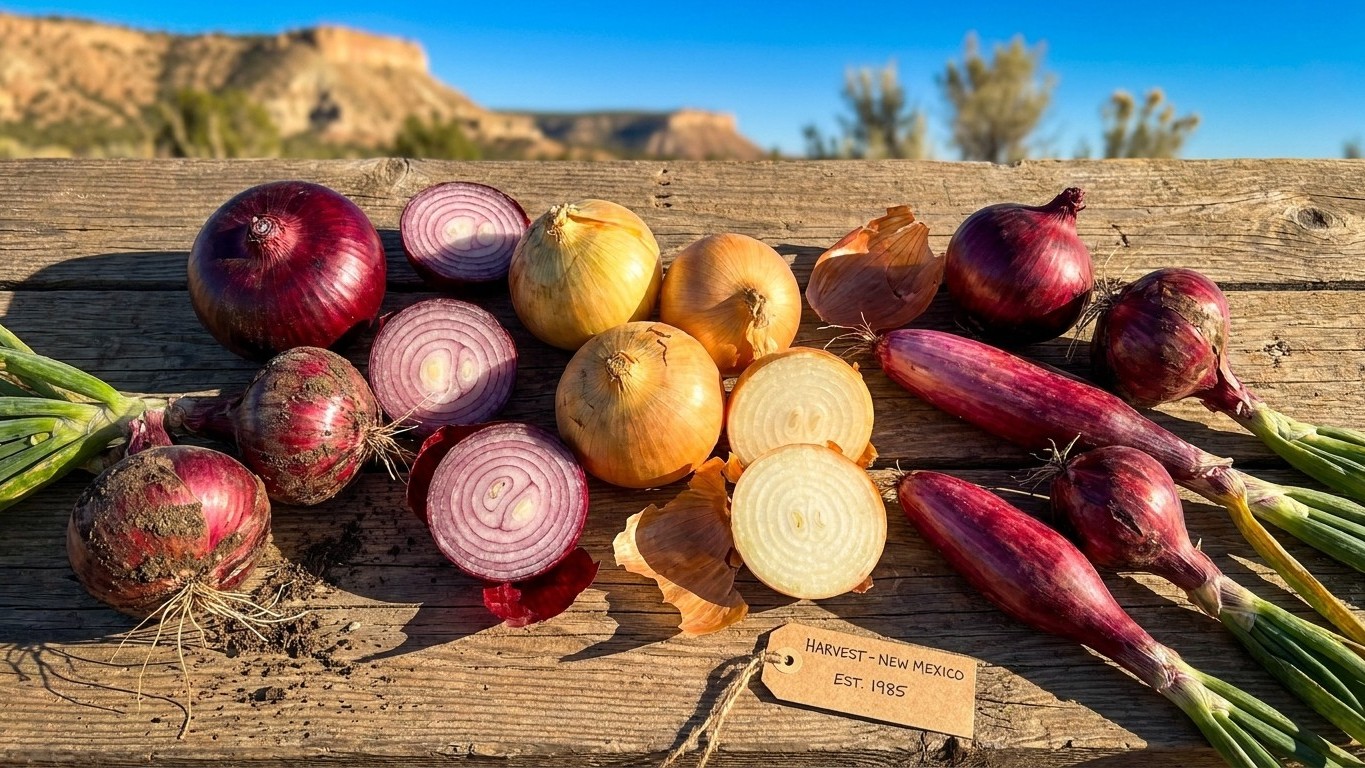

New Mexico sits at 35.04 degrees north latitude (measured at Albuquerque, the reference point for these figures), where the longest day of the year delivers 14 hours and 22 minutes of daylight. That number puts most of the state squarely in intermediate-day onion territory, with a few long-day and short-day varieties reaching the edge of their range here too. The varieties that actually bulb reliably: Cabernet, Calibra, Candy, Elsye, Expression, Monastrell, Red Long of Tropea, Scout, and Sierra Blanca.
The short answer for New Mexico

An onion doesn’t care how hot your July gets. It cares how long the sun stays up. Bulbing is triggered by day length, not temperature, and at 35.04 degrees north the longest day tops out at 14 hours and 22 minutes. That’s enough to satisfy intermediate-day varieties, which typically need somewhere between 12 and 14 hours to switch from making leaves to making a bulb. It’s not quite enough, most years, to reliably satisfy the longer-day types that want 14 to 16 hours.
Thirteen documented varieties have published ranges that cover 35.04N, which means Albuquerque and similar latitudes fall inside their working zone. Most of them are intermediate-day: Cabernet and Calibra (35-45N), Candy (33-40N), Elsye and Expression (32-45N), Monastrell (35-46N), Red Long of Tropea (35-48N), Scout (32-46N), and Sierra Blanca (32-45N). These are the safest bets for a garden near the reference latitude.
Two long-day varieties, Bridger (35-50N) and Walla Walla Sweet (35-55N), list 35N as the very bottom of their range. They can work at Albuquerque’s latitude, but they’re at the southern edge of what they’re bred for, so expect them to perform better as you move north within the state. On the opposite side, two short-day varieties, Red Rock (30-36N) and White Castle (30-38N), sit near the top of their range here. Neither has a page of its own on this site, but both are documented as workable at this latitude.
The takeaway: intermediate-day is the safe middle lane for most of New Mexico, with long-day options available if you’re in the northern part of the state and short-day options available if you’re in the south.
What will not work here
This is the part that saves a wasted growing season. Thirteen long-day varieties have published ranges that start at 38 degrees north or higher, meaning the plant needs more daylight than New Mexico’s longest day ever provides. Plant one of these and the result isn’t a smaller onion. It’s no onion at all. The plant reads the day length, never gets the 14-to-16-hour signal it’s waiting for, and just keeps producing leaves through the whole season. Then the cold arrives and the bulb, such as it is, rots in the ground.
- Ailsa Craig (38-60N) — needs more daylight than New Mexico’s summer ever provides
- Barolo (38-55N) — same problem, leaves without a bulbing trigger
- Blush (38-55N) — requires latitudes well north of the state
- Frontier (40-50N) — a five-degree gap between its minimum and New Mexico’s reference latitude
- New York Early (38-50N) — bred for longer summer days than this state gets
- Patterson (38-55N) — a storage onion that never gets the signal to start storing
- Powell (43-47N) — an eight-degree shortfall at minimum
- Red Carpet (40-45N) — needs day length New Mexico doesn’t reach
- Red Long of Florence (38-50N) — an intermediate-day variety, but still too far north-adapted
- Redwing (43-65N) — the widest gap on this list
- Rossa di Milano (38-50N) — same daylight mismatch
- Safrane (42-50N) — will produce leaves all season and nothing else
- Talon (42-50N) — another variety that never sees its trigger day length
None of these are marginal cases. Every one of them needs a minimum latitude at least three degrees north of Albuquerque’s 35.04. Buy the seed by mistake and you’ll get a summer’s worth of green tops and a fall of mush. There’s no fertilizer or watering schedule that fixes a mismatch this fundamental, because the problem isn’t the soil. It’s the sun’s angle.
What changes across New Mexico
New Mexico runs roughly from just above the Mexican border near 31.8 degrees north to the Colorado state line at 37 degrees north. That’s more than five degrees of latitude, enough to shift a gardener from one day-length group into another depending on where they live. Albuquerque, the reference city for the figures on this page, sits almost exactly in the middle at 35.04N. A gardener near Las Cruces in the south, or one near Farmington in the north, is not gardening under the same sky.
| Region | Approximate latitude | What changes |
|---|---|---|
| Southern NM (Las Cruces area) | ~32.3N | Shorter summer days; short-day varieties like Red Rock and White Castle sit more comfortably mid-range instead of at their upper edge |
| Central NM (Albuquerque, reference city) | 35.04N | 14h22 longest day; intermediate-day is the reliable choice, long-day varieties at their lower limit |
| Northern NM (Farmington area) | ~36.7N | Slightly longer summer days; long-day varieties such as Bridger and Walla Walla Sweet move further from their range’s edge |
The practical effect: a reader gardening near the New Mexico-Colorado border can lean harder into long-day varieties and expect steadier results than someone at Albuquerque’s latitude, where those same varieties are working at the bottom of their tolerance. A reader near the state’s southern tip is closer to the range where the short-day varieties in the blurred zone (Gabriella, Madalyn, Red Sensation, Texas Grano 1015Y, and Vidora, all published for 20-35N or 25-35N) might actually bulb well, rather than sitting at the outer edge of their zone the way they would at Albuquerque’s latitude.
None of this is a small correction. Five degrees of latitude is roughly the same daylight swing that separates growing zones in entirely different states. Treating New Mexico as one uniform latitude would be a mistake for anyone gardening near either end of it.
Sweet now, or onions that last
Every onion gardener eventually runs into the same trade-off, and it isn’t about taste preference so much as chemistry. The compounds that make an onion sharp, the volatile sulfur compounds responsible for pungency and tears, are the same compounds that protect the bulb once it’s in storage. University of Missouri Extension puts it plainly: sweet onions do not store as well as the more pungent types. Fewer sulfur compounds means a milder bite raw, but also a shorter shelf life.
Day length lines up with this trade almost perfectly. Short-day varieties, the ones suited to the southern edge of New Mexico, tend to run sweeter and mature faster in the shorter daylight windows they’re bred for. Long-day varieties, the ones that do better toward the state’s northern border, tend to be sharper and keep longer in a cool, dry pantry. Most of New Mexico’s intermediate-day varieties, Candy among them, land somewhere in the middle: not as sweet as a true short-day onion, not as long-keeping as a true long-day one.
What this means for a New Mexico kitchen depends on where in the state that kitchen sits. A garden near Las Cruces, leaning on short-day and blurred-zone varieties, will produce onions best eaten within a few months of harvest. A garden near Farmington, with more room for long-day types like Bridger or Walla Walla Sweet, has a better shot at onions still firm on a shelf in March. For most of the state, sitting in the intermediate zone, the honest expectation is somewhere in between: good keepers, not great ones, and best used up well before the following summer’s crop comes in.
Checking this against your own garden
Every figure on this page comes from a single reference point, Albuquerque at 35.04 degrees north. That’s a useful anchor, but it isn’t a guarantee for every yard in the state. Before ordering seed based on any of the varieties named above, a few things are worth confirming locally.
- Look up your own latitude if you live north of Farmington or south of Las Cruces. A few degrees in either direction can shift you into a different day-length group than the one described here.
- Check your local frost dates rather than relying on a statewide average. Elevation swings hard across New Mexico, and a mountain valley can lag weeks behind a desert basin at the same latitude.
- Call your county extension office. They track which onion varieties have actually performed well in trials near you, not just which ones are theoretically in range.
- Note your garden’s microclimate. A south-facing slope or a spot next to a heat-absorbing wall can push your effective growing conditions closer to those of a lower latitude.
- Watch the first season’s results before committing to a variety long-term. A plant that bulbs small or bolts early is telling you something about your specific site that no published range can predict.