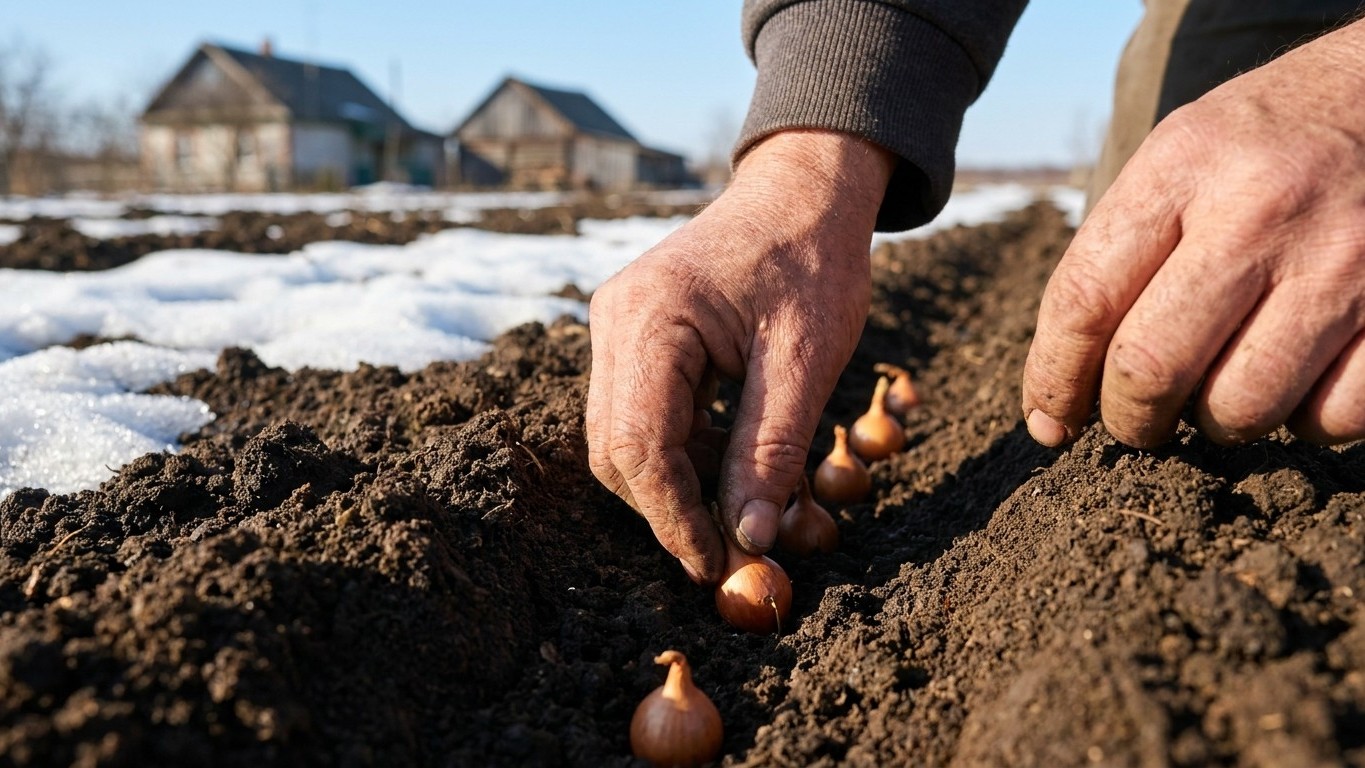

North Dakota gardeners plant onions in late winter to early spring, starting seed indoors as early as January and moving transplants or sets into the ground four to six weeks before the last frost, not in fall the way growers in milder states do. At 46.93 degrees north, the latitude of Fargo, the growing season is short and the daylight window that triggers bulbing arrives fast. Miss the spring window and the plant simply runs out of time to size up before the solstice tells it to stop growing leaves.
The short answer for North Dakota

Fargo sits at 46.93 degrees north, and on the longest day of the year the sun gives that latitude 15 hours and 41 minutes of daylight. That number matters more than any calendar date, because an onion does not bulb because it feels warm weather. It bulbs when the day length crosses a threshold hard-wired into the variety. For North Dakota, that means long-day onions, the group that waits for 14 to 16 hours of daylight before switching from leaf production to bulb production. At 15 hours 41 minutes, Fargo comfortably clears that bar, which is exactly why long-day types are the only sensible choice this far north.
Timing follows from that biology. Southern states with mild winters can Plant Onions in October or November, let the small plants overwinter in the ground, and harvest a mature bulb the following summer. North Dakota winters make that impossible outside of the hardiest experiments; the ground freezes deep and stays frozen for months. So the planting window shifts entirely into spring. Seed started indoors eight to ten weeks before the last frost gives transplants enough of a head start to reach a decent size by the time the solstice arrives. Sets and nursery transplants go outside about four weeks before that last frost date, since young onion plants tolerate a light freeze far better than most vegetable starts.
The goal of all this scheduling is simple: build as much leaf mass as possible before the day length hits that 14-to-16-hour trigger. Every leaf an onion plant grows before bulbing starts becomes potential bulb size once it starts. Plant too late in spring, even by a couple of weeks, and the plant enters bulbing with fewer leaves than it should have. It still bulbs on schedule. It just bulbs small.
What will not work here
This is the part most planting guides skip, and it is the reason a lot of gardeners end up with green tops and no onion underneath. Planting an onion late does not push the harvest back the way it would with tomatoes or beans. Day length, not the calendar, decides when bulbing starts, so a late-planted onion hits the same trigger date as an on-time one. It just hits it with a smaller plant. The result is a bulb the size of a golf ball instead of a fist, because whatever leaf mass exists on the day length switches is roughly the bulb size you get.
Variety choice compounds the problem. Short-day and most intermediate-day onions are built for latitudes far south of North Dakota, where the day only needs to reach 12 to 14 hours to trigger bulbing. Planted at 46.93 degrees north, those varieties hit their bulbing trigger almost as soon as the days get long enough in early summer, while the plant is still tiny. The leaves keep growing through the rest of the season since the trigger has already fired, but the bulb stays undersized, and the plant often rots in the ground before fall because it was never bred to handle a season this long. It is a variety mismatch, not a fertilizing or watering mistake, and no amount of extra care fixes it.
Based on published latitude ranges, these varieties fall below the range that covers North Dakota and will not perform here:
- Cabernet (intermediate-day, 35-45N): bulbing trigger arrives before the plant has built enough leaf mass.
- Calibra (intermediate-day, 35-45N): same mismatch, bulbs stay small and can rot before harvest.
- Candy (intermediate-day, 33-40N): bred for a shorter summer day than North Dakota provides.
- Elsye (intermediate-day, 32-45N): bulbing starts too early relative to plant size this far north.
- Expression (intermediate-day, 32-45N): outside its published range, undersized bulbs are the likely result.
- Gabriella (short-day, 20-35N): a deep-south variety, far outside North Dakota’s daylight profile.
- Madalyn (short-day, 20-35N): triggers weeks before the plant is ready.
- Red Carpet (long-day, 40-45N): its upper bound falls just short of Fargo’s latitude.
- Red Rock (short-day, 30-36N): a warm-climate short-day type, not suited to this daylight range.
- Red Sensation (short-day, 25-35N): bulbs would size up long before the growing season allows.
- Sierra Blanca (intermediate-day, 32-45N): edges close to viable but published range still falls short.
- Texas Grano 1015Y (short-day, 25-35N): a classic deep-south variety, wrong daylight group entirely.
- Vidora (short-day, 25-35N): same short-day mismatch as the others in this group.
- White Castle (short-day, 30-38N): outside the range where North Dakota’s summer daylight would work.
Monastrell (intermediate-day, 35-46N) and Scout (intermediate-day, 32-46N) sit close enough to the edge of their published ranges that they may bulb in a Fargo-latitude garden, but a gardener planting either one is working at the margin, not with a safe bet.
What changes across North Dakota
North Dakota is not a single point on the map, and the advice above is anchored to Fargo’s 46.93 degrees north. The state actually runs from roughly 45.9 degrees north near the South Dakota line up to about 49 degrees north along the Canadian border, a spread of more than three degrees of latitude. That is enough to matter for anyone gardening well north or south of Fargo.
| Location | Approximate latitude | What it changes |
|---|---|---|
| Northern North Dakota (near the Canadian border) | ~49°N | More summer daylight than Fargo, so long-day onions bulb with room to spare, but the growing season before and after summer is shorter |
| Fargo (reference city) | 46.93°N | 15 hours 41 minutes on the longest day; the baseline this planting calendar is built around |
| Southern North Dakota (near the South Dakota line) | ~46°N | Marginally less daylight than Fargo, a small and mostly negligible shift within the same long-day territory |
Gardeners near the Canadian border should treat frost dates as the bigger variable, not variety selection: long-day onions still work well up there, but the frost-free window closes earlier in fall and opens later in spring, so starting seed indoors a week or two earlier than a Fargo gardener would is a reasonable adjustment. Gardeners near the southern edge of the state are close enough to Fargo’s numbers that no adjustment is really needed. The variety recommendations for long-day onions hold across nearly the entire state; it is the planting and harvest dates that shift by a week or two at either extreme.
Sweet now, or onions that last
North Dakota’s daylight profile pushes gardeners toward long-day onions, and long-day onions tend to run sharper and store longer than their southern, short-day counterparts. That is not a coincidence of breeding preference. It comes down to chemistry. The volatile sulfur compounds that give an onion its bite are the same compounds that protect the bulb from rot in storage. University of Missouri Extension puts it plainly: sweet onion varieties do not store as well as the more pungent types, because they simply contain less of the sulfur chemistry that acts as a natural preservative.
Southern gardens, growing short-day varieties bred for mild winters and lower latitudes, tend to produce sweeter onions that need to be eaten within weeks of harvest. North Dakota’s long-day varieties, several of them published for latitude ranges that stretch north of Fargo, such as Redwing (43-65N) and Powell (43-47N), trade some of that sweetness for shelf life. That is generally the right trade for a state with a short growing season and a long winter to feed through.
What that means in practical terms: a North Dakota pantry stocked with home-grown onions in October can reasonably still hold usable bulbs in March, five or six months later, as long as they were cured properly and stored cool and dry. A gardener chasing sweetness for fresh eating can still grow a milder long-day variety like Walla Walla Sweet (35-55N), but should expect to use those onions up within a couple of months rather than count on them for the whole winter.
Checking this against your own garden
Every figure in this article is tied to Fargo’s coordinates and its measured daylight on the summer solstice. A garden thirty or sixty miles away is still close enough that the numbers hold, but a garden near either edge of the state, or at a noticeably different elevation, is worth double-checking rather than assuming.
- Look up your own latitude if you garden well north of Fargo or south near the North Dakota-South Dakota line; a simple map search gives a close enough figure.
- Confirm your local average last spring frost date and first fall frost date, since these shift by a week or more across the state and directly set your planting and curing schedule.
- Check whether your soil is workable in early spring, since heavy clay or poorly drained ground may need extra weeks to dry out before onion sets or transplants can go in.
- Contact your county extension office, part of the North Dakota State University Extension system, for frost-date data and variety trial results specific to your county.
- Note your garden’s exposure; a south-facing slope or windbreak can shift effective planting dates by several days compared to an open, low-lying site nearby.