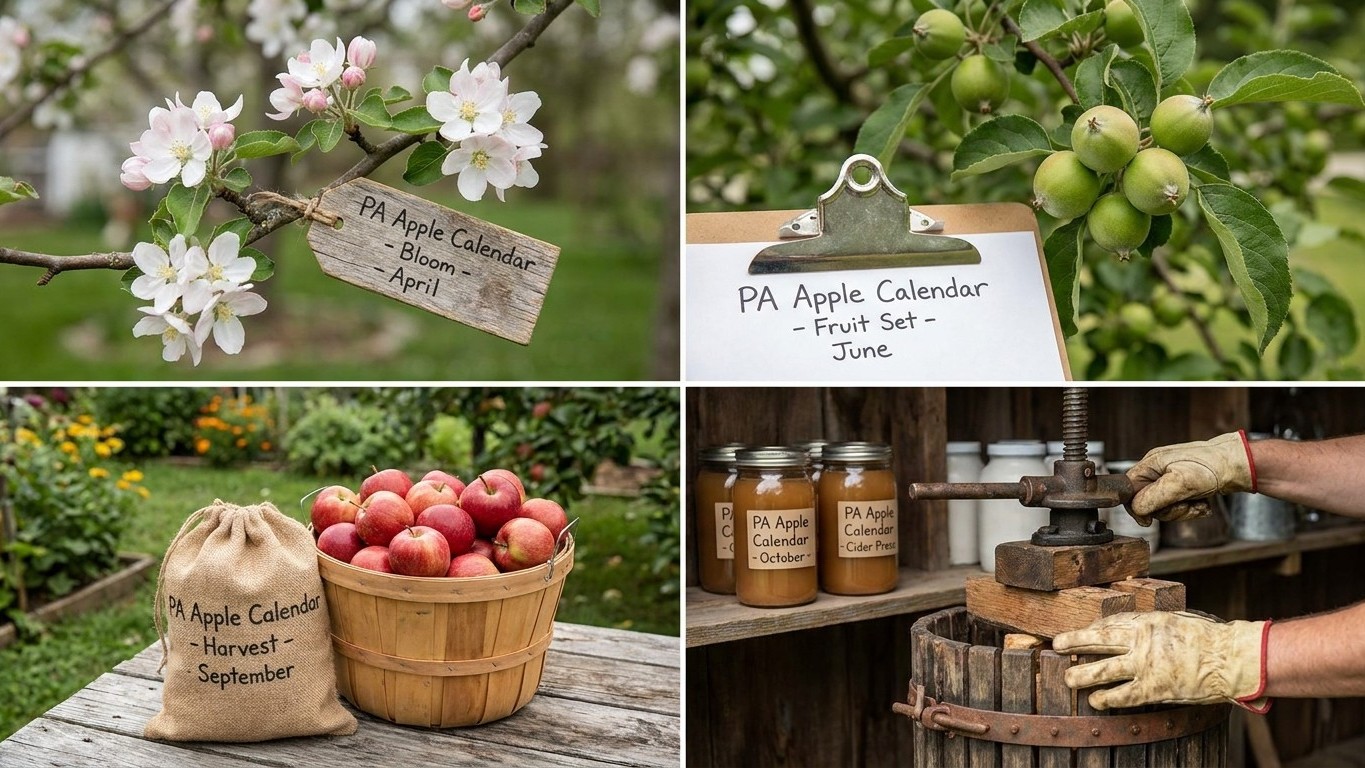

Pennsylvania’s apple year runs on tree stage, not the calendar page. Near Philadelphia, NOAA’s 1991-2020 climate normals put the last spring freeze between March 29 and April 6, and the first fall freeze between November 5 and November 16, though the northern tier and the Alleghenies lag two to four weeks behind that. The one thing to check before anything else: what bud stage your tree has actually reached when a frost is forecast, because a tree at pink is far more vulnerable than one still dormant.
The short answer for Pennsylvania
Pennsylvania apple trees don’t run on a wall calendar — they run on bud stage, and that’s the one thing worth checking before you check the weather. A tree still dormant and tight can shrug off a hard freeze; the same tree at pink or in bloom can lose its whole crop to one bad night. So before you worry about a forecast frost, walk out to the orchard and see which stage those buds are actually sitting in right now.
What the answer depends on is where in the state you’re standing. Philadelphia sits in the mildest corner of Pennsylvania, and NOAA’s own normals note that spring frost risk elsewhere in the state persists two to four weeks later than the dates above. That pushes green tip, pink and bloom back by roughly the same span in those regions. It also depends on winter chill, a separate filter from cold hardiness. A tree can survive a Pennsylvania winter without ever banking the accumulated cold hours it needs to flower evenly the following spring, and hardiness alone tells you nothing about that. Variety matters too. An early bloomer reaches the vulnerable pink and bloom stages while frost odds are still real in a given region, while a late bloomer clears that window with more margin to spare.
Working through it

Every stage carries its own frost tolerance, and that tolerance, not the date on the wall, is what should set your calendar. If you haven’t picked a site or a tree yet, Growing Apples in Pennsylvania covers what a young tree needs before it ever reaches its first dormant season.
Dormancy

The tree sits with tight, closed buds and no green tissue anywhere. Near Philadelphia, NOAA’s 1991-2020 normals put the coldest month’s average daily minimum at 25.6°F, mild enough that most named cultivars ride out a Pennsylvania winter with no wood damage. This is the window for dormant pruning and for any dormant oil spray, because there’s no live green tissue left for the oil to scorch.
Green tip

Bud scales split and a small point of green leaf tissue shows through. This stage typically arrives as the region’s own last-frost window is closing out or has just passed, and it still tolerates a light freeze better than the stages that follow it. It’s the last easy stage to spray a dormant-rate fungicide before bloom pressure starts building.
Pink

Flower buds swell and show solid pink, still closed. Frost tolerance drops sharply here compared with green tip. Near Philadelphia this stage tends to fall close to the tail end of the March 29 to April 6 NOAA freeze window, which means a late cold snap inside that window can still catch a tree at pink and thin the coming bloom.
Bloom

Open white flowers with a pink blush at the edges are the single most frost-sensitive stage in the whole calendar. Growers further north or at higher elevation, where the region’s own frost window runs two to four weeks later than Philadelphia’s, should expect bloom to land correspondingly later, not on the Philadelphia date. Anyone still choosing a cultivar for bloom timing can weigh the options in The Best Apple Varieties for Pennsylvania.
Petal fall

Petals brown and drop, exposing a small pale fruitlet at the center of each cluster. Frost risk drops sharply once petals are down, though a hard late freeze can still thin a heavy set.
Fruit set

Small green fruitlets harden along the spur and the tree shifts its energy from flowering to growth. This is the practical thinning window, well clear of frost risk in most years.
Harvest
Most mid-season cultivars come off the tree well before the first fall freeze, which NOAA’s normals put at November 5 to November 16 near Philadelphia. Late-season keepers are picked closer to that window, and a grower in a colder part of the state should shift that picking window back by the same two to four weeks the spring side runs late.
What changes across Pennsylvania
The Philadelphia dates above describe the Piedmont corner of the state, and NOAA’s own normals are explicit that the rest of Pennsylvania runs behind that by two to four weeks in spring. Three parts of the territory account for most of that spread.
The Allegheny Plateau and the northern tier, running along the New York border, sit at higher elevation and hold cold air longer into spring, which is the main driver behind the later end of that two-to-four-week range. The ridge-and-valley country through the center of the state has its own local effect: cold air drains off the ridges at night and pools in the valley floors, so an orchard on a valley floor can see a harder frost than one on the slope just above it, even at the same elevation and same latitude. The Lake Erie shoreline in the northwest corner works the other way. The lake itself moderates both ends of the season, delaying the first hard freeze in fall and softening the last frost risk in spring compared with inland sites at a similar latitude, which is part of why that shoreline has long supported fruit orchards.
The Piedmont near Philadelphia, where the NOAA figures on this page were measured, is the mildest of the four. A grower anywhere else in the state should treat every date above as a starting point to push later, not as the date itself.
The mistakes this climate punishes
An early-blooming cultivar planted in a region running the late end of Pennsylvania’s frost spread is the most common loss. The bloom itself isn’t the problem. The problem is that bloom lands inside a frost window the grower assumed had already closed, because they used a date from a warmer part of the state instead of their own region’s later window.
A high-chill cultivar in a mild winter is a quieter loss, and it shows up as uneven, patchy bloom rather than a dead tree. Winter chill and cold hardiness are separate filters. A tree can survive a Philadelphia-area winter, where NOAA’s normals put the coldest month’s average minimum at 25.6°F, without banking the chill hours a high-chill selection needs, and the result is scattered bloom over several weeks instead of one strong flush.
Feeding late is the mistake that shows up in fall, not spring. Nitrogen applied in mid to late summer pushes soft new growth that hasn’t hardened off by the time the first fall freeze arrives, which NOAA’s normals put at November 5 to November 16 near Philadelphia and later still further north. That soft wood is what gets nipped, and the damage doesn’t show until the following spring when those shoots fail to leaf out.
Checking this against your county
Every date and figure on this page is measured at or near Philadelphia, and Pennsylvania is a large enough state that a county two hours away can run a genuinely different calendar. Penn State Extension, the USDA’s land-grant extension service for the state, is the right place to confirm local frost timing, chill accumulation and cultivar performance for your own county before you commit to a planting or a spray schedule. Their site is at extension.psu.edu, and most county offices will also take a call directly.
Common questions
How do I know if my tree is at pink or already at bloom?
Pink buds are swollen, colored and still closed. Once you can see separated petals opening away from the center of the cluster, the tree has moved into bloom, and its frost tolerance has already dropped further.
Can I still grow apples if I’m way up in the northern tier?
Yes. Growers well north of Philadelphia grow apples successfully every year, they just work off a frost window that NOAA’s own data notes runs two to four weeks later there, and their whole stage calendar shifts back with it.
Does a late frost after bloom always mean no apples that year?
No. A light frost after petal fall usually only thins the set, and a tree that sets fruit heavily often benefits from that natural thinning. A hard freeze during full bloom is the one that does real damage.
Why did my tree bloom over three weeks instead of all at once?
That spread-out bloom is usually a chill problem rather than a hardiness problem. A cultivar bred for a colder climate than the one it’s planted in can flower unevenly in a mild winter because it never banked enough cold hours to break dormancy cleanly.