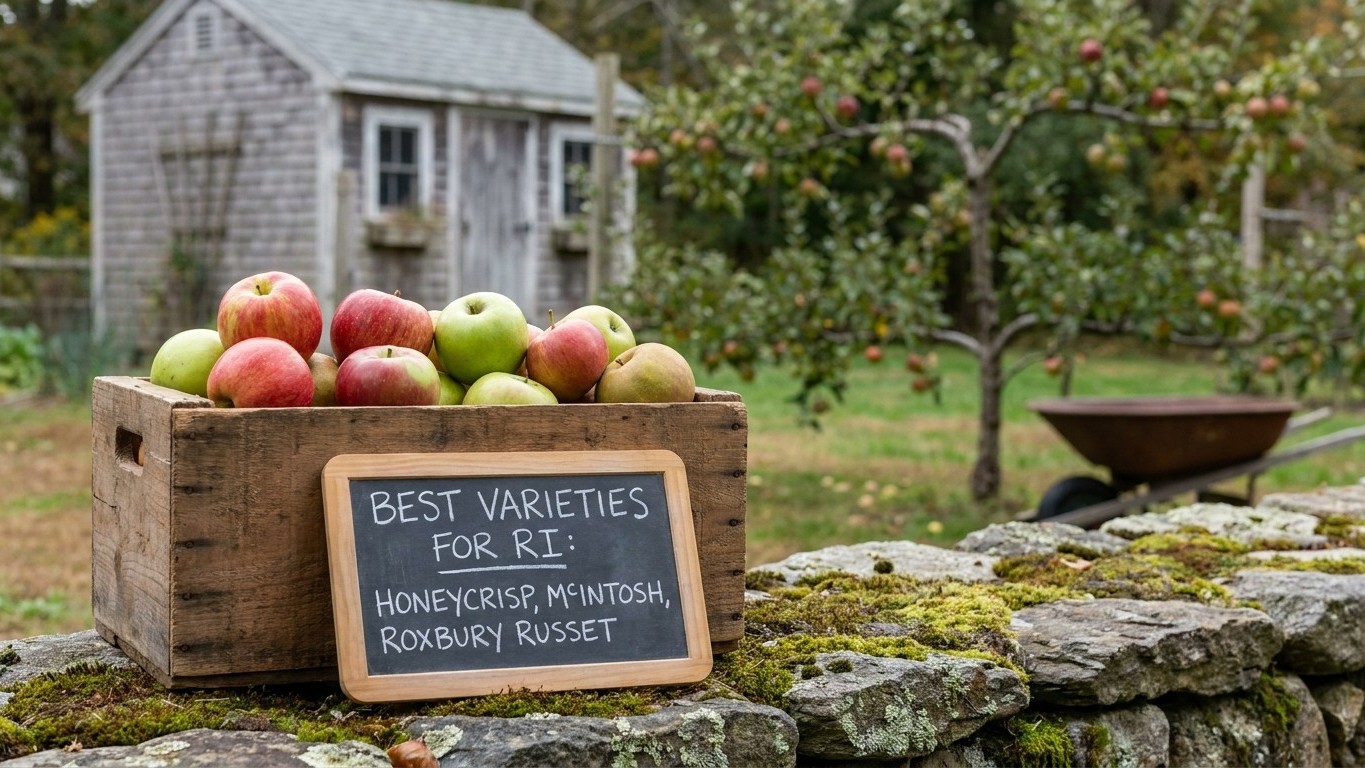

Later-blooming apple varieties are the safer bet almost anywhere in Rhode Island. Winter cold here is a non-issue — the coldest month still averages a mild-enough 21°F, easily within what any northern apple tolerates, and chill hours pile up well past what’s needed for normal flowering. The real threat lands in spring, when blossoms open into a last-freeze window that typically runs April 7 to April 17. Trees that flower after that stretch simply dodge more danger.
The short answer for Rhode Island
For most of Rhode Island, apple trees survive the winter without any real difficulty. The question that actually decides the crop is whether the blossoms escape the last frost of spring. NOAA’s NCEI 1991-2020 normals for the reference station near Providence put that last freeze at April 7 to April 17 in most years. An apple tree in full bloom during that stretch can lose part or all of its crop to a single cold night, even though the tree itself takes no lasting damage.
Why winter cold isn’t the limit
Winter cold is not the constraint here. NOAA’s NCEI data set puts the coldest month’s average daily minimum at 21.0°F at the Providence-area reference station, and that’s well within the range every apple type sold for northern growing tolerates. It also delivers more accumulated winter chill than these trees need to break dormancy and flower normally the following spring. Hardiness and chill are both settled in the tree’s favor in this climate. Bloom timing against frost is the variable that actually decides the outcome each year.
What to do with a frost-prone site
The practical answer is to favor a later-blooming apple type over an early one if your site has any history of frost pockets, and to treat the Providence window as a starting point rather than a guarantee. NOAA’s own caution on this data set is that suburban and rural yards away from the airport station typically see their last frost one to two weeks later than the reference figure, and low-lying or inland sites can run later still. A gardener in a frost-prone hollow should plan around the late end of that range, not the early end.
None of this rules out an early-blooming apple in Rhode Island. It just means the grower needs a site with reliably good air drainage, or the willingness to protect blossoms on a threatened night. Anyone still weighing whether the crop is worth the effort should start with the broader planning guide for Growing Apples in Rhode Island, which covers site selection and rootstock choice in more depth.
Working through it

The bloom-stage sequence
Apple bloom in Rhode Island follows a set order of stages, and each one is what decides the next move, not the date on the calendar. Dormancy runs from leaf drop through late winter, and it’s the safest time for pruning because the tree isn’t pushing new growth. Green tip follows once temperatures climb consistently in early spring, and it’s the point to finish any dormant oil or copper spray before the buds open further. Pink stage comes next, when the blossom is visible but not yet open, and it’s the last easy window to treat for scab before flowers are at risk from spray injury.
Bloom is the stage that matters most against this territory’s frost record. NOAA’s NCEI normals put the Providence-area last freeze at April 7 to April 17, and a tree in bloom during that stretch is exposed even though the calendar might suggest the frost season is nearly over. Petal fall and fruit set follow bloom by roughly a week or two, and a light frost at petal fall does less damage than the same frost during full bloom, since some blossoms have already set fruit. Harvest arrives months later and carries almost no frost risk in Rhode Island, since NOAA’s normals put the first fall freeze near Providence at October 24 to November 3, well after most dessert apples are picked. The full progression from dormancy to harvest, staged against these same frost dates, is laid out at The Rhode Island Apple Calendar, Stage by Stage.
Comparing bloom-timing categories
Because bloom timing is the deciding factor, the most useful way to compare apple types for this climate is by when they flower relative to the April frost window, not by name.
| Bloom timing | Frost risk during bloom | Disease pressure to watch | Harvest relative to first fall frost |
|---|---|---|---|
| Early-blooming | Highest, can open before the Providence-area window closes | Scab pressure builds fast in damp early-spring weather | Ripens well ahead of the October 24 to November 3 freeze window |
| Mid-season | Moderate, usually opens near the tail end of the frost window | Standard, manageable with a normal pink-to-petal-fall spray schedule | Ripens comfortably ahead of first fall frost |
| Late-blooming | Lowest, opens after most years’ last frost has passed | Lower scab pressure since bloom misses the wettest cold spells | May ripen close to, or need picking before, the freeze window |
The trade-off holds across all three groups: the later a variety blooms, the safer its blossoms are from an April frost, but the later it also tends to ripen, which narrows the harvest window before the first fall freeze arrives. A grower on a frost-prone site trades some autumn margin for spring insurance. A grower on a well-drained slope with good air movement can afford to plant earlier-blooming types and take the frost risk, since that kind of site runs a few degrees warmer on a cold night than a low-lying yard.
What changes across Rhode Island
The frost dates above come from the NOAA NCEI station near Providence, and they describe conditions at that one site, not the whole state. Rhode Island is small, but it isn’t uniform.
The coast versus the interior
The coastal strip along Narragansett Bay and the shoreline around Newport and Westerly holds heat longer into the fall and warms more slowly in spring, thanks to the moderating effect of open water. Orchards close to the bay often see a later last frost in spring and a later first frost in fall than the Providence figure suggests, which can favor an earlier-blooming apple type in those specific yards.
Inland and northern parts of the state run the other way. The hill towns of the northwest corner, around Glocester and Chepachet, sit at higher elevation and away from the bay’s moderating effect, and cold air draining downhill into low-lying fields and valleys settles into cold-air pockets on a still, clear night. A grower in one of those pockets should expect frost risk to run later into spring and earlier into fall than the Providence reference figure, and should lean toward a later-blooming apple type as a result.
Block Island’s exception
Block Island, out in the Atlantic, is its own case. Surrounded entirely by water, it tends to run milder than either the coast or the interior on both ends of the frost season, though no NOAA station on the island is cited in the normals used here, so a grower there should treat the mainland figures as a rough guide rather than a match.
None of this changes whether apples can be grown in a given part of Rhode Island. It changes which bloom-timing category is the safer bet, and how much slack to build in before trusting a tree’s blossoms to a given week in April.
The mistakes this climate punishes
Frost timing mistakes
The most common mistake is planting an early-blooming apple type on a site with no history of good air drainage, and assuming the Providence frost dates apply exactly to that yard. NOAA’s own data notes that suburban and rural gardens away from the airport station typically see their last spring frost run one to two weeks later than the April 7 to April 17 window, and a low-lying yard can run later still. A tree that blooms right on schedule for the reference date can still get caught if the actual yard lags behind it, and the damage shows up as a thin or missing crop that same summer, with no other symptom to explain it.
A related mistake is treating a light frost after bloom as harmless because the hard freezes of winter are long over. A frost during petal fall or the earliest days of fruit set can still knock the youngest, most tender fruitlets off the tree, and the loss doesn’t show until early summer when the count of apples on the branch turns out lower than the bloom promised.
Feeding and pruning mistakes
Feeding a tree, especially a young one, too late in the season is the third mistake. Nitrogen applied in mid to late summer pushes soft new growth right when the tree should be hardening off for winter. That kind of soft, actively growing shoots going into the season’s end is exactly what suffers first when the first fall freeze arrives. NOAA’s normals put that freeze near Providence at October 24 to November 3, earlier in the interior and later along the coast, and a tree still pushing growth going into that window is far more likely to show dieback the following spring than one that hardened off normally.
The fourth is pruning too early during a mild stretch of late winter, mistaking a warm week for the start of spring. Cuts made just before a hard cold snap heal poorly, and the exposed wood is the part most likely to suffer winter injury even though the rest of the dormant tree is unaffected.
Checking this against your county
The frost and chill figures above are all read from the NOAA NCEI station near Providence, and Rhode Island’s coast, interior, and islands each depart from that reference in a different direction. Before you commit to a bloom-timing category or a planting date, check your own county’s frost history against these reference figures with the University of Rhode Island Cooperative Extension, which maintains local growing guidance at web.uri.edu/coopext. Extension staff can also help identify whether your specific site sits in a frost pocket or on ground that drains cold air well, which matters more to an apple crop than the county line does.
Common questions
Do I need two apple trees for pollination?
Most apple varieties need pollen from a different variety blooming at roughly the same time to set a full crop, so a single tree standing alone in a yard usually bears lightly at best. A neighbor’s tree or a nearby crabapple can serve as the second variety if you don’t have room for two.
What if my yard still frosts in May?
That’s later than the April 7 to April 17 window NOAA’s Providence-area normals describe, so it’s worth treating your yard as a genuine frost pocket rather than an unlucky exception. Favor a later-blooming apple type there, and keep row cover or old sheets on hand to throw over young trees on a threatened night during bloom.
How do I tell if my site is a frost pocket?
Watch where frost lingers longest on a cold clear morning. A spot that stays white after the rest of the yard has cleared, or a low corner where cold air visibly settles on a still night, is a frost pocket, and it will run behind the Providence reference dates given here.
Does a mild winter hurt the crop the way a late frost does?
Not in Rhode Island. The state’s winters, with a coldest-month average minimum of 21.0°F per NOAA’s NCEI normals, deliver far more chill than apple trees need to flower properly, so a mild winter here still clears the bar. Spring frost timing, not winter mildness, is the risk worth planning around.