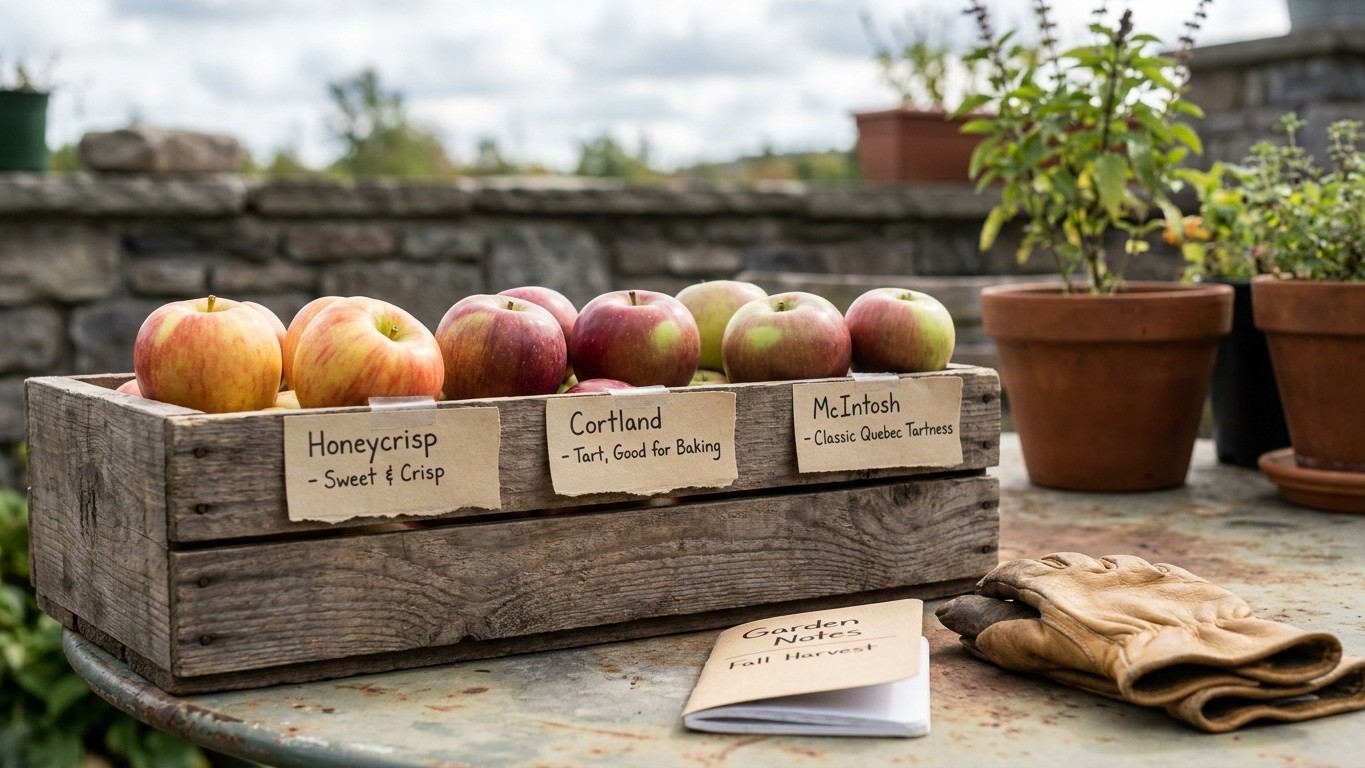

A Honeycrisp sapling set out near St-Hubert can bloom in late April, get caught by a frost that lands three weeks after the “average” last one, and lose its whole crop before June — not because the tree was weak, but because nobody checked its bloom date against this region’s frost calendar. Others die a slower way, hardy enough to flower but not to survive a night that dips far past the usual winter low. Both failures trace back to the same two numbers, checked in the wrong order or not at all.
The short answer for Quebec
There is no single named variety that works everywhere in the province, because the two things that decide success move independently: winter hardiness and bloom timing. At Montreal/St-Hubert A, Environment and Climate Change Canada’s 1981-2010 normals put the coldest month’s average daily minimum at -14.1 °C and the average frost-free window between May 6 (last spring frost) and October 5 (first fall frost). Any tree planted here has to survive that cold and bloom and ripen inside that window, and that’s the whole test before a variety name even enters the conversation.
Those figures are averages, not guarantees. ECCC’s normals describe the midpoint of a range, meaning frost lands later than May 6, or earlier than October 5, in roughly half the years on record at that station. A hard winter also drops well past -14.1 °C for at least a few nights. Treat both numbers as the center of a moving target, not a date to plant around exactly.
What decides the shortlist
In practice, this means choosing rootstock and scion rated to survive comfortably below the Montreal minimum if the orchard sits anywhere colder than the St. Lawrence lowlands, and choosing a bloom date with enough buffer that a late frost in one year out of two doesn’t wipe out the crop. A local nursery, or a walk through Growing Apples in Quebec, can help match a specific rootstock to a site once those two numbers are in hand.
Working through it

Ranking apple types for Quebec without naming individual cultivars still gives a working order, because the trade-off is consistent: the toughest wood is rarely the sweetest fruit, and the earliest bloomer is rarely the one that blooms safely. Four broad categories cover most of what’s actually planted in the province, and each carries a different cost.
Very hardy, short-season dessert types
These are bred or selected for northern and boreal conditions and generally tolerate winter minimums well below Montreal’s -14.1 °C figure with a comfortable margin. The trade-off shows up in the fruit: it tends to run smaller, tarter, and shorter-storing than dessert apples bred for milder regions, and these trees often need a cross-pollinator planted nearby because they don’t self-pollinate reliably.
Mid-season dual-purpose types
These sit closer to the hardiness line that Montreal’s own average defines, meaning a genuinely hard winter, not just an average one, is what actually tests them. They bloom later than the short-season group, buying some insurance against the average May 6 last-frost date, but that pushes harvest later too, closer to the average October 5 first fall frost, which leaves less margin if autumn turns cold early.
Cider-specific and heirloom types
Many of these were selected for flavor and tannin rather than for hardiness, and a fair number need a longer growing season than the Montreal frost window offers with any comfort. These belong on a warm, sheltered site with good drainage, not on a first orchard block or an exposed slope.
Crab apple rootstock and pollinator stock
Almost every dessert or cider variety above needs a hardy rootstock underneath it and, in many cases, a crab apple or compatible pollinator variety within bee range. Rootstock hardiness is a separate rating from scion hardiness, and a hardy top grafted onto a marginal rootstock still fails from the ground up.
| Category | Relative hardiness need | Bloom timing risk | Main cost |
|---|---|---|---|
| Very hardy, short-season dessert | Low bar to clear | Blooms early, more exposed to frost after the May 6 average | Smaller, tarter fruit |
| Mid-season dual-purpose | Moderate, tested only in a hard winter | Blooms later, safer from spring frost | Later harvest, tighter margin to the October 5 average |
| Cider and heirloom | Often marginal | Needs a longer season than the frost window comfortably gives | Site-dependent, needs shelter |
| Rootstock and pollinator | Must match or exceed the scion’s need | Not applicable | A weak link undoes a hardy scion |
Exactly when a given tree hits green tip, pink, and bloom relative to the May 6 average is worth walking through on its own: The Quebec Apple Calendar, Stage by Stage lays out what triggers each stage and how far it can drift from the calendar date in either direction.
What changes across Quebec
Every figure above comes from one station, Montreal/St-Hubert A, and a province this size is nothing like a single climate zone. Move away from the St. Lawrence lowlands and both the hardiness bar and the frost window shift, sometimes by weeks.
Where it runs milder
The Montérégie and the St. Lawrence River corridor around Montreal are the mildest apple-growing ground in the province, warmed by the river and sitting at the lowest elevation in the south. This is the ground the ECCC figures above actually describe, which is worth remembering every time those numbers get applied somewhere else.
Where it runs harsher
Head into the Eastern Townships (Estrie) and the Laurentides uplands and elevation adds real cold. Higher ground cools faster at night and holds frost in the low spots between hills, so the last spring frost and the first fall frost both run less favorably than the Montreal normal, spring later and fall earlier, shortening the working season on both ends.
Farther north and east, the Saguenay-Lac-Saint-Jean region and the Gaspésie peninsula run considerably colder than the Montreal reference, and no station-level normal for either area is included in the figures this page uses. A grower there should treat the Montreal numbers as the mild end of the provincial range, not as a working figure for a home orchard. The Îles-de-la-Madeleine sit at the opposite extreme from an upland frost pocket. Surrounded by the Gulf of St. Lawrence, the islands see a slower spring warm-up and a milder winter minimum than the mainland at a similar latitude, because a large body of water changes temperature more slowly than land does. No station normal for the islands appears here either, so treat this as a direction of change rather than a number to plan against.
The mistakes this climate punishes
Three mistakes show up over and over in Quebec orchards, and each one is a direct mismatch with a number named above, not bad luck.
- Planting for the average last frost, not the range around it. ECCC’s May 6 figure is a mean, and frost arrives later than that in roughly half of all years at Montreal/St-Hubert. A variety that blooms right at the edge of that average gets caught by a late frost on a fairly regular basis, and bloom damage that year means no crop, not a smaller one.
- Choosing hardiness against an average winter, not the coldest one on record. The -14.1 °C figure is the mean daily minimum of the coldest month, not the lowest temperature the wood will ever see. A tree with only a thin margin above that average survives most winters and dies in the one that actually matters.
- Feeding or pruning late enough to push soft new growth into fall. Nitrogen applied in mid to late summer, or a hard prune that forces a flush of new shoots, leaves unhardened tissue on the tree right as the average October 5 first fall frost approaches, and that tissue is what dies first.
Why the fix is a summer job, not a winter one
All three mistakes are decided in the weeks around the two ECCC frost dates, not in mid-winter. By the time a hard January cold snap kills a branch, the mistake that set it up was usually made in August or September, when the tree was fed, pruned, or watered as though the season had more room left in it than the calendar actually gives.
A fourth, quieter mistake is buying a tree rated for hardiness alone and assuming that settles the question. Hardiness answers whether the wood survives. It says nothing about whether the tree banks enough cold hours over winter to break dormancy cleanly the following spring. A tree that comes through an unusually mild winter without enough accumulated chill can leaf out unevenly and bloom over a stretched-out window, a different failure than winterkill and easy to mistake for it after the fact.
Checking this against your county
Every figure on this page is anchored to one station, Montreal/St-Hubert, and there is a lot of ground in the province that station does not describe. Before ordering a tree, check current trial results and frost history for the specific county or MRC with Quebec’s Ministère de l’Agriculture, des Pêcheries et de l’Alimentation, known as MAPAQ, which works at a finer grain than a single reference city can.
A local extension agent or horticultural society can also say which named cultivars have actually fruited reliably in a given township over the past several winters, which is a better guide for a specific orchard than any general hardiness rating on its own.
Common questions
Do I need two apple trees to get fruit?
Most dessert apples are not reliably self-fertile, so plan on a second variety, or a crab apple, blooming at the same time within bee range. Check with the nursery whether the specific tree being sold is self-fertile before assuming one tree is enough.
How many years before a new apple tree bears fruit?
That depends mainly on the rootstock and how the tree was raised, more than on where in Quebec it’s planted. A dwarfing rootstock generally comes into bearing sooner than a full-size seedling rootstock. Ask the nursery for the typical bearing age of the specific rootstock, since there’s no single province-wide figure for this.
Can I still grow apples north of Montreal or up in the Laurentians?
Yes, but both the hardiness bar and the bloom timing get tougher the farther north or the higher up you go. Choose from the hardiest category available and confirm with MAPAQ or a local orchard which named varieties have actually fruited in that specific area over recent winters.
What’s the actual difference between hardiness zone and chill hours?
Hardiness zone measures whether the wood and buds survive winter cold; chill hours measure whether the tree banks enough accumulated cold to break dormancy and bloom normally. A tree can be hardy enough to survive a Quebec winter and still bloom poorly if a particular winter runs too short or too mild for its chill requirement, though that risk shows up far less often here than in milder climates.