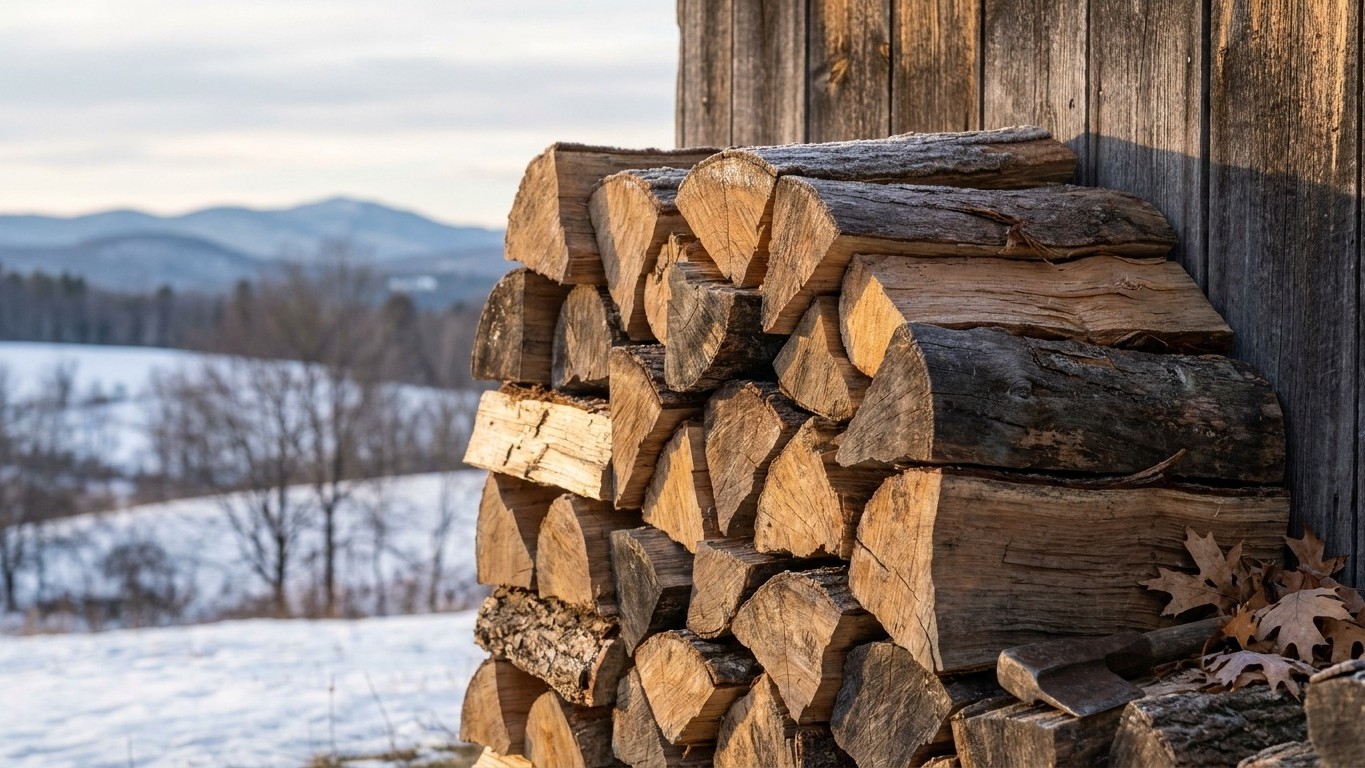

Burlington’s coldest month bottoms out at an average low of 12.9°F, and that single number should decide how you buy, stack, and burn wood this winter. It rules out casual choices: at that temperature, firewood isn’t ambiance, it’s furnace fuel, and the species and seasoning you pick determine whether your house stays warm at 2 a.m. or you’re up feeding the stove every hour.
How cold it actually gets here

The reference figure for this region, drawn from NOAA’s 1991-2020 Climate Normals at the Burlington station, is 12.9°F. That’s the average daily minimum for the coldest month, not the record low and not a monthly average temperature. It’s the number that tells you what a typical cold night looks like, over and over, for weeks at a stretch.
Twelve degrees above zero is not a mild figure. It sits well below the point where wood heat becomes optional. In climates where winter lows hover in the 40s, a fire is a nice-to-have, something for atmosphere on a chilly evening. Here, it’s closer to a survival tool if the power goes out, and a genuine cost-saving tool if you’re running a wood stove or insert alongside a furnace all season.
What that cold actually demands
A winter that dips into the low teens on an average night, with real cold snaps pushing well below that, asks two things of your wood supply. First, it needs to hold a fire through long overnight stretches without you getting up to reload every two hours. Second, it needs to throw real heat fast when a cold snap hits and the furnace can’t quite keep up on its own.
Both of those needs point in the same direction: density. A loosely packed, fast-burning wood might be pleasant on a 35-degree evening. At 13 degrees, with wind rattling the windows, it just burns out and leaves you cold by 3 a.m. This is the climate that makes the difference between “good enough” firewood and the right firewood actually matter.
Which woods are worth the effort here
Once you accept that the cold here is real and sustained, the wood question becomes a density question. A cord is a fixed volume, a stack measuring 4 feet by 4 feet by 8 feet, or 128 cubic feet, no matter what species fills it. That means a cord of dense hardwood packs far more actual wood mass, and far more stored heat, than the same size stack of a lighter species. Well-seasoned hardwood, on average, delivers around 20 million BTU per cord, roughly the heat equivalent of 145 gallons of #2 fuel oil or 215 gallons of LP gas, according to Michigan State University Extension. That average, though, hides a wide spread depending on what’s actually in the stack.
Dense species run above that average and are worth the extra weight to split and haul. Red oak is the classic example in this region: heavy, coal-forming, and built for long overnight burns exactly when a 13-degree night demands them. It’s also the species most likely to trip up a first-time buyer, because it dries slower than almost anything else you’ll stack, a point worth remembering before you count on it for this coming winter.
Lighter, quicker-burning species sit below that average BTU output. They’re not a waste, they just have a different job: starting a fire fast, carrying you through the shoulder season in October or April when you don’t need an all-night burn, or filling in when the dense stuff runs low. Treating them as your main winter fuel in a climate that bottoms out near 13°F usually means feeding the stove far more often than you’d like.
Comparing what’s actually available
| Species | Heat output vs. seasoned hardwood average | Smoke | Sparks |
|---|---|---|---|
| Red oak | Above average, dense, long coal life | Moderate once dry | Low to moderate |
| Ash | Near average, splits easily even semi-green | Low | Low |
| Sugar maple | Near to above average | Low to moderate | Low |
| Yellow birch | Near average, burns hot but faster | Moderate | Moderate |
| White pine | Well below average | Heavy, resinous | High |
| Poplar/aspen | Well below average | Moderate to heavy | Low |
A table like this only matters if the wood is actually in your area and actually dry. A species that looks great on paper but that no local supplier carries seasoned, or that you can’t season yourself before the cold sets in, is worse than a modest wood you can reliably get ready in time. Local availability decides as much as density does.
How much wood a winter takes
Any number you see published for “cords per winter” in Vermont is close to meaningless on its own. It can’t account for your house, your heating setup, or how bad the particular winter turns out to be. What actually determines your usage is a combination of three variables, and running your own situation down this list gets you a far more honest estimate than any generic figure.
- How cold it gets and for how long: a winter that sits near that 12.9°F average low for weeks straight burns through wood differently than one with a few sharp cold snaps and milder stretches between them.
- How well your house holds heat: insulation, air sealing, window quality, even how exposed your house is to wind all change how fast heat escapes once you’ve made it.
- Whether wood is your main heat source or a supplement: a stove running the whole house day and night burns through a completely different volume than a stove used to take the edge off while a furnace carries the load.
The mechanism that makes this estimate swing so widely is simple: a poorly insulated house working through a hard winter can burn through roughly double what a tight, well-sealed house uses in that same climate, heating the same square footage. That’s not a rounding error, that’s the difference between three cords and six. Before you order or cut wood for the season, an honest look at your house’s insulation and air sealing tells you more than any regional average ever will.
Drying wood in this climate
Species matters, but seasoning decides almost everything else, and it decides it before the wood ever reaches your stove. Green wood can hold over 60 percent moisture. Burning wood at that level means a large share of the fire’s energy goes toward boiling off water trapped in the cells, heat that never makes it into your room. The target, regardless of what climate you’re in, is 20 percent moisture or less, according to Michigan State University Extension.
What gets wood from green to burn-ready is air and time working through split wood, not direct sun on a woodpile. Split rounds stacked so air can move freely through the pile, typically reach that 20 percent mark after one full summer of seasoning. Left whole, or stacked tight against a wall with no airflow, the same wood can sit far wetter come November.
Red oak is the named exception worth remembering here: its cell structure makes it dry more slowly than other hardwoods, so a single summer often isn’t enough. Given how attractive oak is for overnight winter burns, that’s exactly the wood most likely to catch someone off guard.
This is where the local mistake happens most often. Wood cut and split in spring for the winter that follows almost never has enough time to season properly here, especially if it’s oak or another slow-drying hardwood. The wood that goes into your stove this January should, in most cases, have been split and stacked at least a full year earlier, not a few months before the first hard freeze.