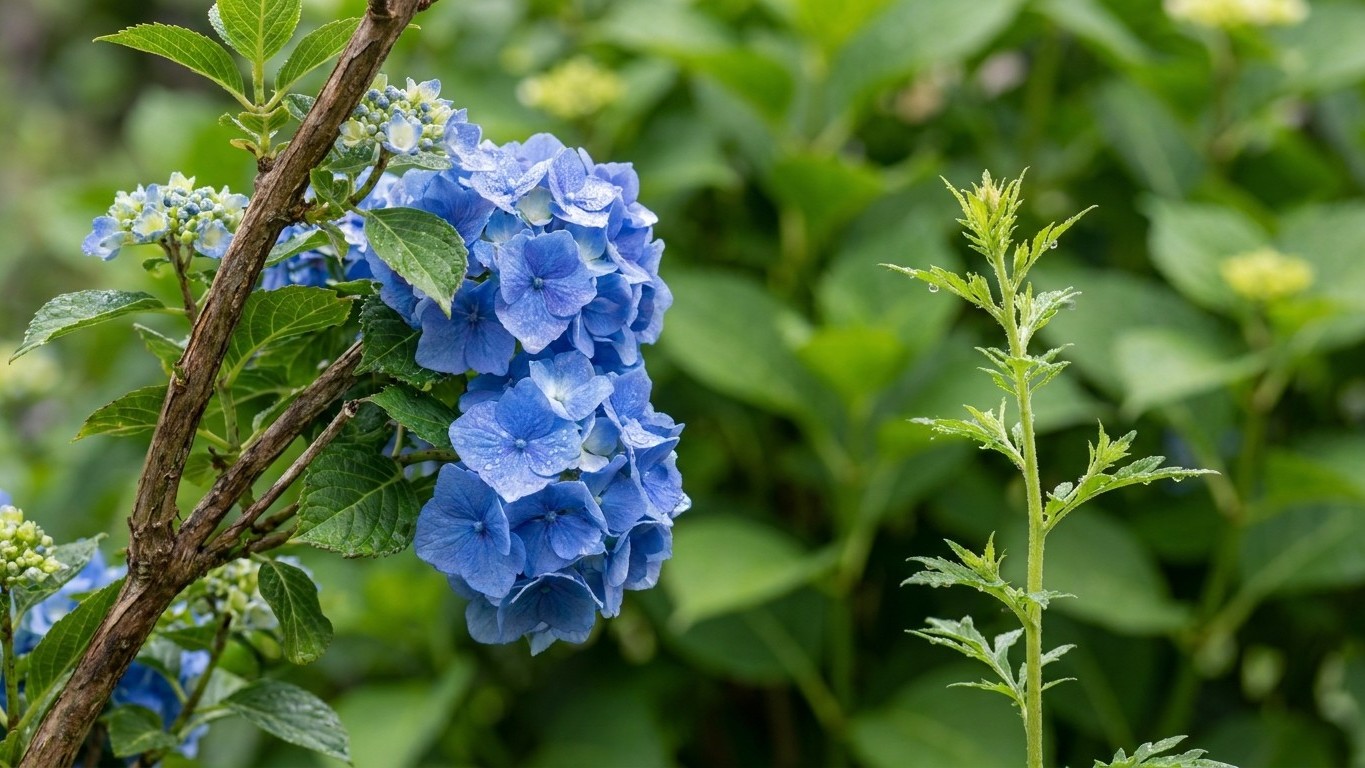

Hydrangeas flower pink when the soil holds little usable aluminum. That happens often in Vermont beds that have been limed, fed with a high-phosphorus fertilizer, or planted beside a concrete foundation. Blue flowers need acidic soil, roughly pH 5.2 to 5.5, so aluminum can dissolve and reach the roots. Only bigleaf and mountain hydrangeas shift color this way. They also have to get through a Vermont winter with their flower buds alive. Test the soil first, then change it in stages.
What this comes down to in Vermont

Bigleaf hydrangeas flower pink wherever the soil sits near neutral or carries a lot of phosphorus, and they can be pushed toward blue by making the soil more acidic and keeping it that way. The color only matters if the buds survive, and in Burlington, the reference city for the frost window, the last spring frost falls between April 30 and May 10 and the first fall frost between October 3 and October 13. Burlington sits on Lake Champlain, one of the milder parts of the state. Growing seasons in the Green Mountains and the Northeast Kingdom are shorter.
The cold side matters as much as the soil side. The USDA Plant Hardiness Zone Map, which rates zones by the average annual extreme minimum temperature, puts the state between zones 3b and 5b. That is a wide spread, and it explains why a blue bigleaf thrives in one Vermont yard and sulks in another twenty miles away.
What makes a hydrangea pink or blue?
The pigment is the same in both colors. What changes is whether the plant can take up aluminum. Most soils contain plenty of it, but aluminum dissolves only when the soil is acidic. Around pH 5.2 to 5.5 the shrub drinks it up and the sepals turn blue. At about 6.0 to 6.2 and above, aluminum stays locked in the soil and the flowers come out pink. In between you get purple, or a shrub with blue and pink heads side by side.
Phosphorus complicates this. It binds aluminum inside the plant and in the soil, so a bed that tests acidic can still produce pink flowers if it has been fed heavily with phosphorus over the years. Vermont gardeners who have fertilized a lawn or vegetable patch for decades often have exactly that.
Which hydrangeas change color at all?
Only bigleaf hydrangeas (Hydrangea macrophylla) and, to a lesser degree, mountain hydrangeas (H. serrata) respond to soil chemistry. The Endless Summer series and old favorites like Nikko Blue belong to that group. Smooth hydrangeas such as Annabelle stay white or green whatever you do. Panicle types like Limelight blush pink in fall as the flowers age and nights cool, which has nothing to do with soil. A cultivar bred with pink flowers, such as the smooth hydrangea Invincibelle Spirit, stays pink for life. Before you touch the soil, confirm that your plant is a type that can turn.
Working it out for your own garden
Start with a soil test, because guessing at pH is how people end up with burned roots and the same pink flowers. Pull small samples from several spots under the shrub’s dripline, a few inches down, mix them, and send them in through the extension’s soil testing service. The report gives pH and usually phosphorus. If pH is already near 5.5 and the flowers are still pink, phosphorus is the likely culprit.
Next, measure the gap. Say the test comes back at pH 6.8 and you want 5.5. That is more than a full point, and each point on the pH scale is a tenfold change in acidity. One application will not do it. Plan on two or three seasons of treatment, with a retest each fall to see how far you have moved.
Timing follows the frost window. Soil treatments go on once the ground has thawed and growth has started, which in Burlington means after the April 30 to May 10 range for the last spring frost has passed. Repeat once or twice through early summer and stop by midsummer. Old-wood bloomers set next year’s flower buds in late summer, well before the first fall frost between October 3 and October 13, so the aluminum needs to be available while those buds form. Sulfur works slowly and gently. Aluminum sulfate works faster but can injure roots if you overdo it, so follow the label and water it in well.
A worked example shows where the line falls. Take a reblooming bigleaf from the Endless Summer family. Growers rate it for zone 4 and warmer, and it flowers on both old and new wood. If winter kills the old-wood buds, it still produces flowers on new growth, so it can still produce blooms to color. Treat the soil in spring and early summer, and the new-wood flowers can shift toward blue within a season or two.
Now take Nikko Blue. It blooms on old wood only, and catalogs rate it for warmer zones than most of Vermont. In the colder parts of the state its buds often freeze over winter, so the shrub leafs out green and never flowers. You can get the soil to a perfect 5.5 and still see no blue, because there is nothing to color. If your bigleaf has not bloomed in years, solve the winter-survival problem before you buy acidifier. The timing of when to prune hydrangeas in Vermont matters here too, since cutting old wood in spring removes the buds.
What changes across the state
Soil chemistry in Vermont shifts more than most gardeners expect. The Champlain Valley and parts of the western side of the state sit over limestone and marble-bearing bedrock. Soils there tend toward neutral or alkaline, and well water can be hard. Pink hydrangeas are the default in those areas, and holding blue takes steady work.
Move east into the Green Mountains and across to the Northeast Kingdom, and the soils turn thinner, stonier, and more naturally acidic, often under conifer and hardwood forest. Blue comes easier there, which sounds like good news until you add the climate. Higher elevations and the colder north bring the shorter seasons and lower winter minimums that the 3b end of the zone range describes. Flower buds on old wood are at far greater risk, and a late frost after leaf-out can take the season’s bloom.
Those two gradients rarely line up in your favor. The warm, lake-moderated valley has the soil that fights blue, and the cold hills have the soil that favors it. Valley gardeners fight chemistry. Hill gardeners fight winter. Elevation within a single town can matter, too, since a low spot where cold air pools behaves differently from a south-facing slope a few hundred feet higher. Treat Burlington’s frost dates as a starting point and shift them later in spring and earlier in fall as you climb or head north.
The mistakes this state punishes

Liming near the shrub is a common error. Vermont gardeners lime lawns and vegetable beds routinely, and runoff or a spreader pass can raise pH around a hydrangea. Wood ash does the same. With so many wood stoves in the state, ash tossed on the garden is a quiet pH raiser. Keep both away from any hydrangea you want blue.
Concrete is next. A foundation, a walkway, or a poured step leaches lime into the soil for years. A hydrangea planted against a foundation often stays pink no matter how much acidifier goes on. Moving it a few feet out, or growing it in a large container with an acidic mix, usually works better than fighting the wall.
Fertilizer choice matters as well. Bloom-booster formulas with a high middle number feed the phosphorus that locks up aluminum. Use a balanced or low-phosphorus fertilizer on hydrangeas you want blue, and let the soil test tell you whether phosphorus is already high.
Warm spells in March and April cause a different kind of trouble. A few mild weeks tempt people to apply treatments or pull winter protection early, and then a frost in the April 30 to May 10 range (or later in colder parts of the state) hits newly swollen buds. Wait until the frost window has passed in your area, and keep some cover handy.
Last, expecting a one-season change leads gardeners to pile on more product. Heavy doses burn roots. Apply on schedule, retest in fall, and accept that a shift from pink to a muddy purple in the first year is normal progress.
Checking this against your county
The dates and zone range above come from Burlington and a statewide map, so they are a starting point for your yard. University of Vermont Extension and its regional offices can help with soil testing, local frost patterns, and what survives winters in your part of the state. For the rest of the basics, from siting to winter protection, read the state guide to growing hydrangeas in Vermont.
Common questions
Can I turn a pink hydrangea blue in one season?
Rarely all the way. Flower buds on old-wood types are already formed by late summer, so a spring treatment often gives purple or mixed heads first. Blue usually comes in the second or third year, as long as the soil keeps moving toward the target pH.
Will white hydrangeas turn blue if I acidify the soil?
No. White varieties like Annabelle and most panicle types lack the pigment that reacts to aluminum. Their fall pink blush comes from aging and cool nights.
Do coffee grounds turn hydrangeas blue?
Used grounds change soil pH very little. A soil test and a measured dose of sulfur or aluminum sulfate give far more reliable results.
Why did my blue hydrangea turn pink over the years?
The soil probably drifted back toward neutral. Hard well water, lime from a nearby foundation, wood ash, or phosphorus-rich fertilizer can all do it. Retest the soil and repeat the acidifier in spring.