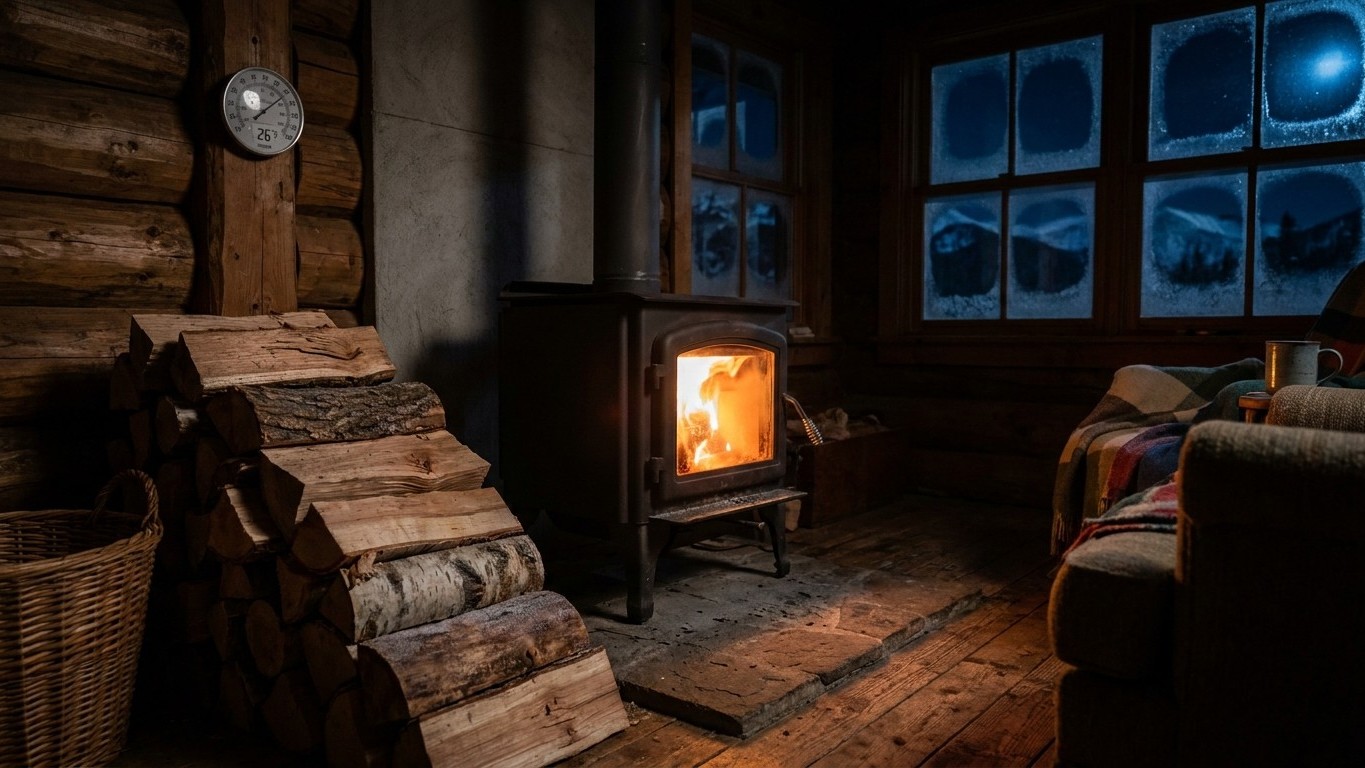

Firewood in West Virginia has to answer to one number: an average low of 26.1°F in the coldest month, measured at Charleston. That’s not a record low, it’s the normal nightly floor, and it means wood heat here has to actually perform, not just look good in a stove window. Which species you burn, how much you stack, and how long you dry it all trace back to that single figure.
How cold it actually gets here

The number to remember is 26.1°F. That’s the mean daily minimum for the coldest month at the Charleston reference station, per NOAA’s 1991-2020 Climate Normals. Not the coldest night ever recorded, not a monthly average that blends day and night together, but the number that tells you what a typical night in the depth of winter actually does to a house. It’s the figure that decides winter hardiness for a lot of things in this state, firewood included.
A winter that bottoms out in the mid-20s on a normal night, repeatedly, over weeks, is a winter where wood heat has a job to do. This isn’t the kind of climate where a fire is mostly ambiance and the furnace quietly does the real work in the background. When outdoor temperatures sit in the 20s for stretches of December through February, a wood stove or insert has to hold a house’s heat load through eight, nine, ten hours of dark without the fire dying out and the house cooling toward that 26°F outdoor floor.
What that means for how you burn
Practically, it means two things. First, an overnight burn matters. If you load a stove at 10 p.m. and the fire’s out by 3 a.m., the house is losing ground for the coldest hours of the night, right when the outdoor temperature is closest to that 26.1°F normal low. Second, the wood itself needs to carry enough energy per load to make that overnight burn realistic, which is where density becomes the deciding factor rather than a nice-to-have.
This is squarely a hard-winter climate for firewood purposes, not a mild one where the question is decorative. Rural households across the state that heat with wood as a primary or major supplemental source are managing real heating load, not ambiance. That reality should shape every other decision on this page, starting with which species are worth the labor of cutting, splitting, and stacking them.
Which woods are worth the effort here
Once you accept that West Virginia winters demand real heat output overnight, density stops being a minor preference and becomes the main variable. A cord is a fixed volume, a stack 4 feet by 4 feet by 8 feet, or 128 cubic feet, whether you fill it with a light wood or a heavy one. A denser species packs more wood fiber, and more potential heat, into that same 128 cubic feet. Michigan State University Extension puts well-seasoned hardwood at roughly 20 million BTU per cord on average, comparable to about 145 gallons of #2 fuel oil or 215 gallons of LP gas. Denser hardwoods run above that average line, lighter woods well below it.
For the coldest nights and the overnight burn that a 26.1°F normal low demands, dense hardwoods common across the state, oak, hickory, and black locust among them, are the ones worth the sweat of splitting. They burn longer per load, hold coals better into early morning, and give you the best odds of a house that hasn’t lost much ground by the time you reload. Lighter, faster-burning woods like poplar or pine have their place too: they’re easier to split, they catch quickly, and they’re the right call for starting a fire, for the shoulder-season weeks in October or April when a full hardwood load would be overkill, or for keeping a fire going without needing it to hold overnight.
Availability beats the spec sheet
None of that matters if you can’t get a species seasoned and dry by the time you need it. A modest hardwood you can actually source, split, and stack in time to hit 20 percent moisture beats a theoretically superior species sitting green in someone’s log yard three counties over. Local sawmills, tree services, and firewood sellers in your part of the state will usually tell you what’s actually coming through in volume, and that supply reality should weigh as much as any BTU comparison.
| Species | Heat output vs. 20M BTU/cord average | Smoke | Sparks |
|---|---|---|---|
| Oak (white, red) | Above average, dense | Low once seasoned | Low |
| Hickory | Above average, dense | Low | Low to moderate |
| Black locust | Above average, very dense | Low | Low |
| Poplar | Below average, light | Moderate | Low |
| Pine | Below average, light | Higher, resinous | Higher |
How much wood a winter takes
Any flat “cords per winter” number you read is close to useless without knowing three things about your own situation, so treat that kind of figure as a starting guess at best. What actually determines how much wood you’ll burn between October and April comes down to how cold your winter runs, how well your house holds the heat you make, and whether wood is carrying the whole heating load or just taking the edge off a furnace or heat pump.
- The cold figure for your area: a normal low near 26.1°F, like Charleston’s, demands more fuel than a milder pocket of the state, and colder counties in the higher elevations demand more still.
- How tight the house is: insulation, air sealing, and window quality decide how much of the heat you make actually stays inside overnight.
- Wood’s role in the heating mix: a house burning wood as its only heat source needs far more cords than one using a stove to supplement a furnace on the coldest days only.
The mechanism that makes these numbers swing so widely is simple: a poorly insulated house sitting through a hard winter can burn roughly double what a tight, well-sealed house uses in that same climate, loading stove after stove just to replace heat that’s leaking straight through walls, attic, and old windows. That’s why two neighbors in the same West Virginia county, both heating with wood, can report cord counts a full multiple apart and both be telling the truth. Run your own numbers down that list, honestly, before you commit to buying or cutting a fixed amount for the season ahead.
Drying wood in this climate
Seasoning matters more than species choice everywhere wood is burned, and West Virginia’s summer humidity makes that timeline longer than it would be in a drier climate. Green wood can hold more than 60 percent moisture, and all of that water has to boil off before the wood gives up any of the heat you’re counting on. Burning wood that’s still wet means spending part of your fire’s energy just evaporating water, heat that never reaches the room.
The target, regardless of climate or species, is 20 percent moisture or less. What gets wood there is air moving through split pieces and time, not direct sun exposure. A woodpile sitting in full sun but stacked tight, with no airflow between rows, dries slower than a shaded pile stacked loosely enough for wind to pass through it. Split wood before stacking, not after, and leave gaps in the row rather than jamming pieces together.
Under normal conditions, wood split and stacked properly reaches 20 percent moisture after one full summer of drying. Red oak is the documented exception: its cell structure holds moisture longer than most other hardwoods, so it needs more than a single summer to season properly, seasons dried under the same stacking conditions as other species will still leave it wetter. That single fact catches a lot of West Virginia burners off guard, because it means wood cut and split in spring for that same winter almost never has time to reach 20 percent before the cold arrives at that 26.1°F normal low. The wood you’ll burn this January should already be sitting split and stacked from last spring or earlier, not fresh off the saw this fall.