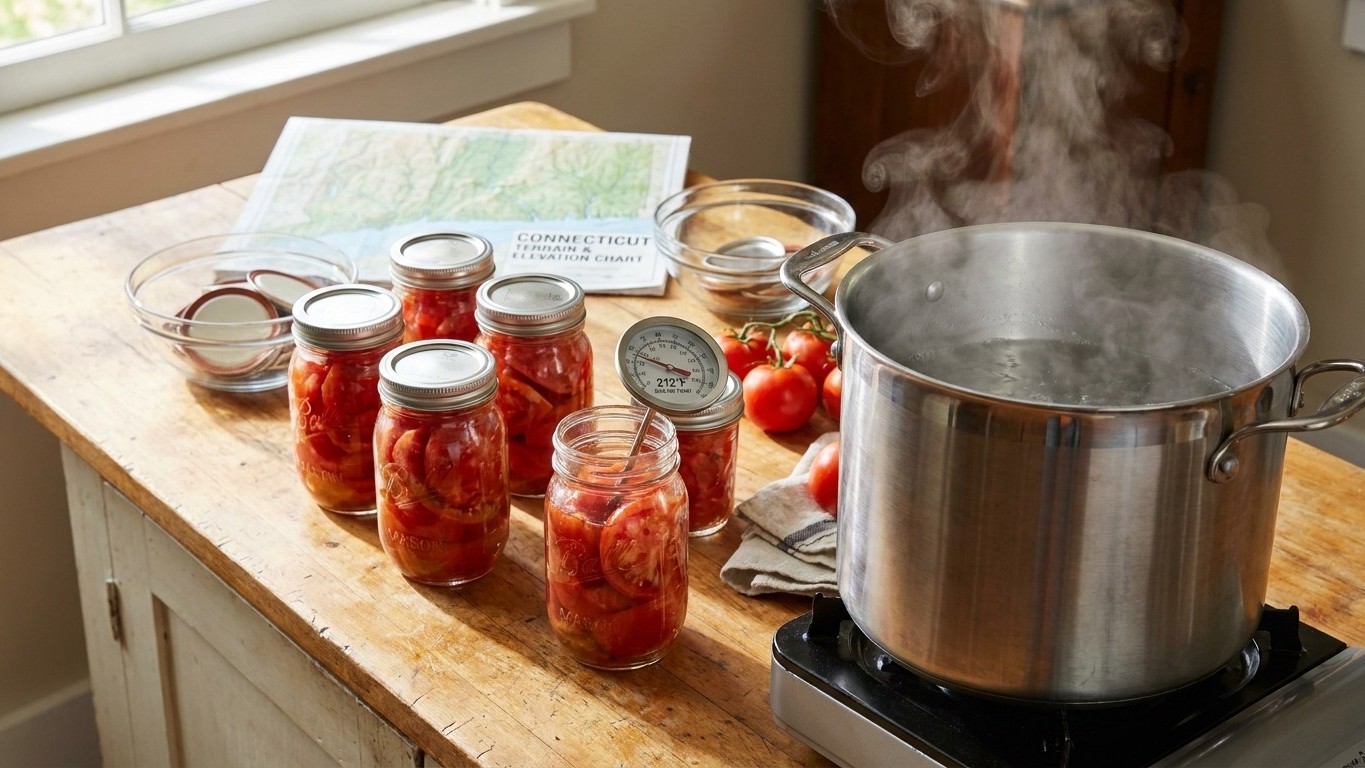

Bridgeport sits at 3 feet above sea level, and water there boils in the same 208°F to 212°F band as the rest of coastal Connecticut. That’s the reference point for this whole conversation. For most home canners in the state, elevation changes nothing about how a jar is processed. But your own elevation, not Bridgeport’s, is the number that matters, and Connecticut’s terrain climbs enough in places to make that number worth checking.
The short answer

Connecticut is not a flat state, even though it feels that way if you’re canning tomatoes in a kitchen near Long Island Sound. Bridgeport, used here as the reference city, sits at just 3 feet of elevation. That places it squarely in the 0 to 2,000 foot band, where the USDA Complete Guide to Home Canning lists water boiling somewhere between 208°F and 212°F. At sea level, under standard atmospheric pressure, that number lands right at 212°F. As you climb even modestly within that band, it drifts down a degree or two.
For a canner working from Bridgeport, or anywhere else in that same low band, this range means no altitude adjustment is needed for boiling-water canning. The process times published in a tested recipe already assume you’re somewhere in that zero-adjustment zone. That’s the practical takeaway: at 3 feet, altitude is a non-issue.
But Bridgeport is not Connecticut
Here’s the part that trips people up. A state figure like “Bridgeport: 3 feet” describes one city, not the whole territory. Connecticut’s elevation actually runs from sea level along the coast up past 2,300 feet at the state’s highest points in the northwest corner, near the Massachusetts and New York borders. Somewhere in that climb, most home canners cross the first altitude threshold where boiling-water canning times start needing an adjustment, and pressure canners need a bump in gauge pressure too.
So the honest way to read this figure is as an anchor, not a verdict. If you live in Bridgeport, New Haven, Stamford, or anywhere close to the coast, you’re almost certainly canning at an elevation low enough that the standard tested times apply as written. If you live inland, especially toward the Litchfield Hills or the higher ridgelines in the northwest, you may be canning at an elevation where those same times fall short. The only way to know is to look up where you actually are, not where the state’s biggest city happens to sit.
Why a lower boil is a weaker process
Water’s boiling point isn’t a fixed number. It depends on how much air is pressing down on it. At sea level, that atmospheric pressure holds water at 212°F before it turns to vapor. Climb higher, and there’s less air overhead, less pressure holding the water molecules in place, so they escape into steam at a lower temperature. At 10,000 feet, water boils at roughly 194°F. It’s still boiling. It’s just boiling cooler.
That distinction matters more in a canning jar than almost anywhere else in the kitchen. Boiling-water canning relies on sustained heat to destroy molds, yeasts, and enzymes in high-acid foods. A boil at 194°F does less of that work per minute than a boil at 212°F. The processing times published for high-acid foods, jams, pickles, tomatoes with added acid, are calibrated to a specific boiling temperature. Take that temperature down a few degrees and the same number of minutes no longer delivers the same kill.
Why boiling harder doesn’t fix it
A natural instinct is to crank the burner and get a more violent boil, thinking that a rolling, aggressive boil must be hotter than a gentle one. It isn’t. Once water reaches its boiling point at a given elevation, it stays at that temperature no matter how hard it’s boiling. A furious boil and a lazy boil are the same temperature. Adding more heat just makes the water boil away faster; it doesn’t raise the ceiling. That ceiling is set by air pressure, not by the stove.
The only way to compensate for a lower boiling point is to change something else in the process. For boiling-water canning, that means adding more minutes to the processing time, giving the cooler temperature more time to do the same job. For pressure canning, it means raising the pounds of pressure in the canner, which raises the temperature inside the sealed pot beyond what an open boil could ever reach, regardless of elevation. Both fixes exist precisely because a lower boil is a weaker process, and something has to make up the difference.
Finding your own elevation
The Bridgeport figure tells you nothing about your own kitchen. Before you can decide whether your process times need adjusting, you need your specific elevation, not your county’s average and not your nearest city’s number.
- Start with the National Center for Home Food Preservation, which publishes a “Find Your Elevation” resource built for exactly this purpose. It’s the same organization behind the tested recipes you’ll be using, so the numbers line up.
- Enter your address or the nearest town center if you’re in a rural area. The tool returns an elevation in feet above sea level.
- Compare that number against the elevation bands used in canning guidance: 0 to 1,000 feet, 1,001 to 3,000, 3,001 to 6,000, and so on. Each band carries its own adjustment for boiling-water processing, and pressure canners use their own pressure tables at these same breakpoints.
- Write the elevation down somewhere you’ll actually see it again, a note on the inside of a cabinet door, a line in your canning notebook. Elevation doesn’t change, so this is a one-time lookup, not something to repeat every canning season.
- When you sit down with a tested recipe, match your elevation band to the adjustment table printed with that recipe, not a table from a different food or a different guide. Adjustments are specific to the process, not universal across every jar you’ll ever can.
What goes wrong
- A jar that looks perfect but wasn’t processed long enough. A properly sealed lid and a clear jar tell you nothing about whether the contents reached a safe temperature for a safe duration. If the process time used didn’t account for elevation, the jar can seal, sit on a shelf looking flawless, and still carry organisms that a fully adjusted process would have destroyed. The fix is procedural, not visual: confirm the elevation adjustment before processing, not after.
- A recipe pulled from a sea-level source without checking its assumptions. Older cookbooks, recipes shared between relatives, and print material from decades ago often assume the writer’s own low elevation without saying so. If a recipe doesn’t mention elevation adjustment at all, treat that silence as a warning sign rather than reassurance, and check the food against a current tested source like the NCHFP.
- A pressure gauge read as if elevation doesn’t exist. Pressure canners need higher psi as elevation increases, exactly the way boiling-water canners need more minutes. Someone who sets their canner to a pressure that would be correct at sea level, while canning at a meaningfully higher elevation inland, is running an under-processed batch even though the gauge needle looks steady and correct to them.
- Assuming a dial gauge and a weighted gauge behave the same way. Dial gauges need to be checked periodically for accuracy and read in whole pounds; weighted gauges jump in fixed increments. Elevation adjustments interact differently with each type, which is one more reason to follow the specific canner’s manual alongside the tested recipe.
Where the exact adjustment comes from
This page won’t hand you a processing time or a canner pressure, and that’s deliberate. The right adjustment depends on the specific food, its acidity, the jar size, and the tested process behind that particular recipe, not on elevation alone. Combining pieces from different sources, a time from one place and a pressure from another, is how mistakes creep in.
For the actual figures, go to the National Center for Home Food Preservation, which maintains the tested recipes and elevation adjustment tables referenced throughout this guide. The reason this level of caution matters: botulinum toxin, the organism at stake in under-processed low-acid canning, has no taste and no smell. A jar can look, smell, and taste completely normal and still be dangerous. There’s no shortcut around using a tested source for the exact number your food and your elevation require.
Common questions
Does Connecticut have one official elevation for canning purposes?
No. Connecticut spans elevations from sea level along the coast to over 2,300 feet in the northwest hills. Bridgeport’s 3 feet is a reference point for the coastal band, not a statewide figure. Your own elevation is the one that determines any adjustment.
If I live near Bridgeport, do I need to adjust my canning times?
At 3 feet, within the 0 to 2,000 foot band where water boils between 208°F and 212°F, most tested recipes require no elevation adjustment. Confirm your specific address’s elevation through the NCHFP tool rather than assuming based on the nearest city.
Why does a cooler boil matter if the water is still boiling?
Boiling-water canning relies on sustained heat at a known temperature to destroy microorganisms. A boil at 208°F does less of that work per minute than a boil at 212°F, even though both are technically boiling. That’s why lower elevations get shorter times and higher elevations need longer ones.
Can I just boil the water harder at higher elevation instead of adjusting the time?
No. Once water reaches its boiling point for a given elevation, more heat just makes it boil away faster, it doesn’t raise the temperature. The only real fixes are adding processing minutes for boiling-water canning or increasing pressure for pressure canning.