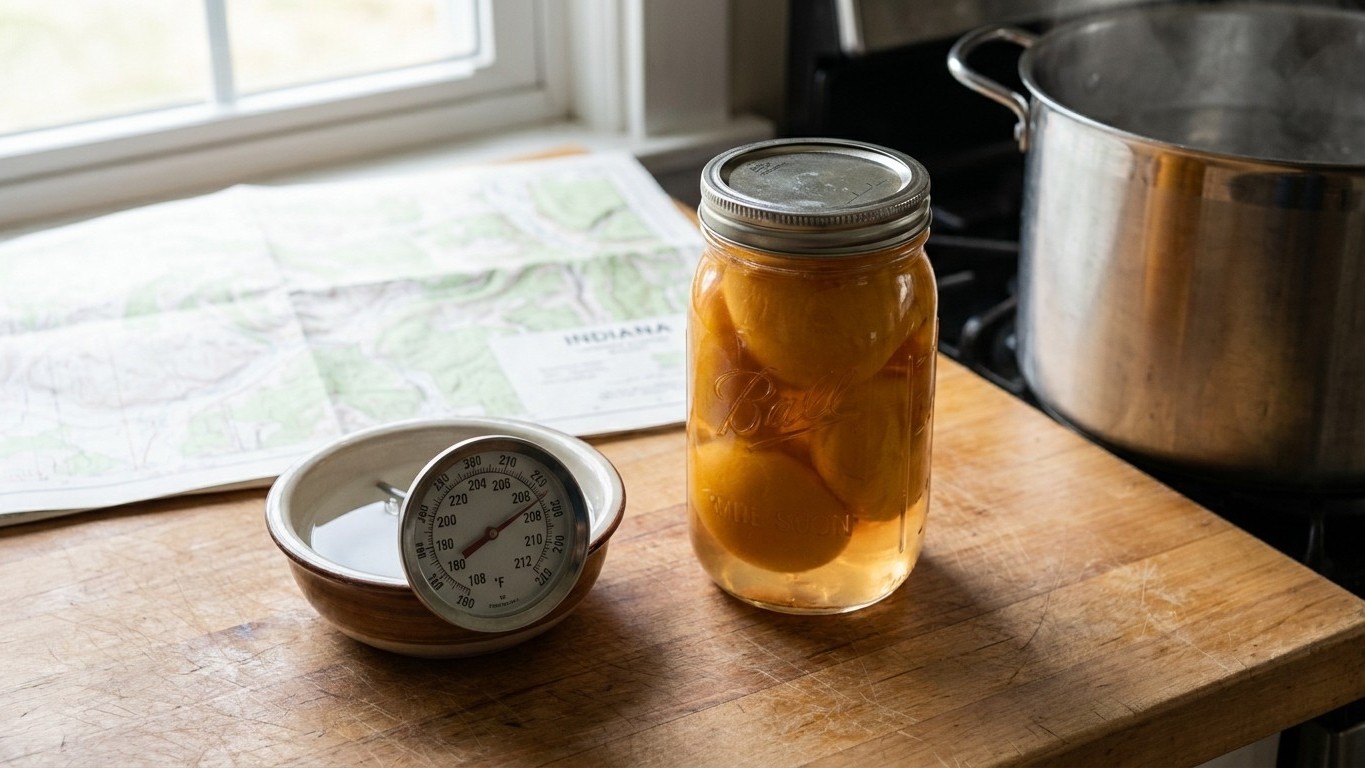

For most Indiana canners, altitude barely enters the picture. Indianapolis sits at 715 feet, water there boils somewhere between 208°F and 212°F, and that narrow range keeps most tested recipes running at their standard sea-level times. The catch: the state stretches across dunes near Lake Michigan and rolling hills down south, so your own address, not the capital’s, is what decides whether you adjust anything at all.
The short answer

Indianapolis, the reference city for this figure, sits at 715 feet above sea level. At that height, published data puts the boiling point of water between 208°F and 212°F, according to the USDA Complete Guide to Home Canning as reproduced by the National Center for Home Food Preservation. That’s a narrow window. It means the water in a boiling-water canner set up in most of central Indiana behaves almost exactly like the water a tested recipe assumes when it was developed and timed.
Does this change anything for the average home canner in the state? At 715 feet, not much. Compare that to a canner working at 6,000 feet, where the boiling point drops several degrees further and every single jar needs a longer processing time or a higher pressure to reach the same lethality. Indiana’s low-lying geography means a large share of its residents fall into the same low-altitude category as Indianapolis, where standard processing guidance is written to apply without modification.
A state is not a single elevation
It’s worth being blunt about what this 715-foot figure actually represents: it’s Indianapolis, one city, used as a reference point. Indiana is not flat everywhere. The northern edge near the Michigan border sits at different heights than the hill country toward the Ohio River, and southern Indiana’s terrain climbs and dips in ways the state capital’s flat downtown never will. A canner working from a kitchen in the Whitewater Valley or up near the dunes could be sitting at a meaningfully different elevation than 715 feet, even if the difference isn’t dramatic by national standards.
That’s the whole reason altitude adjustment tables exist in the first place. They’re not written for “Indiana.” They’re written for elevation bands, and a home canner’s job is to figure out which band their own kitchen falls into, not to assume the state capital’s number applies to their pantry.
Why a lower boil is a weaker process
Here’s the physics that makes all of this matter. Water boils when its vapor pressure matches the surrounding atmospheric pressure. At sea level, that happens at 212°F. Climb higher, and the air thins, atmospheric pressure drops, and water boils at a lower temperature to compensate. By 10,000 feet, water is boiling at just 194°F, a full 18 degrees cooler than at sea level, according to the same USDA guide referenced above.
A cooler boil kills less. That’s the entire mechanism, stripped down to its essentials. The bacteria, spores, and enzymes that home canning is designed to destroy respond to temperature and time together. Drop the temperature, and you need more time at that temperature to achieve the same destructive effect. This is not a minor technicality. It’s the difference between a jar that’s genuinely safe to store on a shelf for a year and one that looks identical but harbors a live threat.
People sometimes assume that boiling harder, cranking up the burner, watching the water churn more violently, somehow makes up the difference. It doesn’t. Boiling water does not get hotter no matter how vigorously it boils. Once water reaches its boiling point at a given elevation, it stays at that temperature until it fully evaporates. A rolling boil and a gentle boil are the same temperature. The only way to compensate for a lower boiling point is to change something else in the equation.
For boiling-water canning, that means more time in the canner. The jars sit in the water bath longer, giving the lower-temperature environment the extra minutes it needs to reach an equivalent level of safety. For pressure canning, the compensation works differently: more pressure inside the sealed canner raises the internal temperature above what boiling water alone could achieve at that elevation, again restoring the process to an equivalent level of lethality. Both approaches solve the same problem from different directions, and both depend on knowing exactly how high above sea level the kitchen actually sits.
Finding your own elevation
- Start with your home address rather than your city’s downtown or your county seat; even a few miles can shift elevation enough to matter in borderline cases.
- Use the National Center for Home Food Preservation’s “Find Your Elevation” page, built specifically so home canners can look up their own number instead of guessing from a state or regional average.
- Write the figure down in feet, not meters, since every canning table in U.S. references is built around feet above sea level.
- Compare that number against the elevation bands listed in your specific tested recipe, whether it’s a boiling-water process or a pressure-canning process, since the two methods use separate adjustment tables.
- Recheck if you move, can at a relative’s house, or process food at a shared community kitchen; the elevation that matters is wherever the canner is actually sitting on the stove, not wherever the produce was grown.
What goes wrong
- An under-processed jar that looks perfectly normal. A jar sealed at a lower-than-needed processing time can look, smell, and taste completely fine while still harboring a hazard, because the visual and sensory cues people rely on don’t reveal whether the internal temperature and duration were sufficient. The remedy is following the elevation-adjusted time or pressure from a tested recipe every single time, not just when something seems off.
- A recipe pulled from a sea-level source without adjustment. Plenty of recipes circulating online or handed down through family were developed and tested at or near sea level, and using their times unmodified at a higher elevation quietly weakens the process. The fix is checking the recipe’s assumed elevation against your own before touching a single jar, and adjusting according to the source’s own altitude chart if one exists.
- A pressure gauge read as if elevation didn’t exist. Dial gauges and weighted gauges both need to be set according to elevation, and treating every kitchen as if it sits at sea level produces a canner that’s actually running under-pressured for that altitude. Checking the pressure adjustment for your specific elevation band before processing closes this gap.
- Assuming a hotter boil fixes a lower boiling point. Turning up the heat to get a harder rolling boil doesn’t raise water’s temperature past its elevation-determined ceiling, so it does nothing to compensate for altitude. Extending the processing time or increasing the pressure, per a tested recipe, is the only mechanism that actually works.
Where the exact adjustment comes from
Nothing on this page gives you a processing time or a pressure setting, and that’s intentional. The right adjustment depends entirely on the specific food being canned, whether it’s low-acid or high-acid, whether it’s processed in a boiling-water canner or a pressure canner, and the size of the jar. Those variables all come from a tested recipe, not from a general elevation guide.
For the correct figures, go directly to the National Center for Home Food Preservation, which publishes elevation-adjusted processing times and pressures for its tested recipes. This matters because botulinum toxin, the danger an under-processed low-acid jar can harbor, has no taste and no smell. A jar can seem perfectly fine and still not be safe, which is exactly why the adjustment has to come from a source that tested the specific food, not from a general rule of thumb about altitude.
Common questions
Does every part of Indiana need an altitude adjustment?
No. Much of the state sits within the lower elevation bands where Indianapolis, at 715 feet, falls, and tested recipes generally apply without modification in that range. But some areas of the state sit higher, so checking your own elevation rather than assuming the state capital’s number applies is still the safer approach.
Why does the boiling point matter if I’m just processing jars in a water bath?
The entire safety of a boiling-water canning process depends on how hot the water actually gets and for how long. Since water can’t exceed its elevation-determined boiling point no matter how hard it’s boiled, a lower boiling point means the standard processing time may not deliver enough heat, which is why tested tables lengthen the time at higher elevations.
Can I just add a few extra minutes to be safe if I’m not sure of my elevation?
Guessing isn’t a substitute for knowing your actual elevation and following the corresponding figure from a tested recipe. Adding random extra time might undershoot what’s needed at a higher elevation, or it might overcook the food at a lower one, so looking up your specific number through the NCHFP’s elevation tool is the more reliable step.
Does altitude affect the acid content of foods I’m canning?
No, elevation doesn’t change a food’s natural acidity. What it changes is the boiling temperature of water, which affects how thoroughly heat penetrates the jar during processing. Acid level and elevation are separate factors that both feed into which tested recipe and which processing method apply.