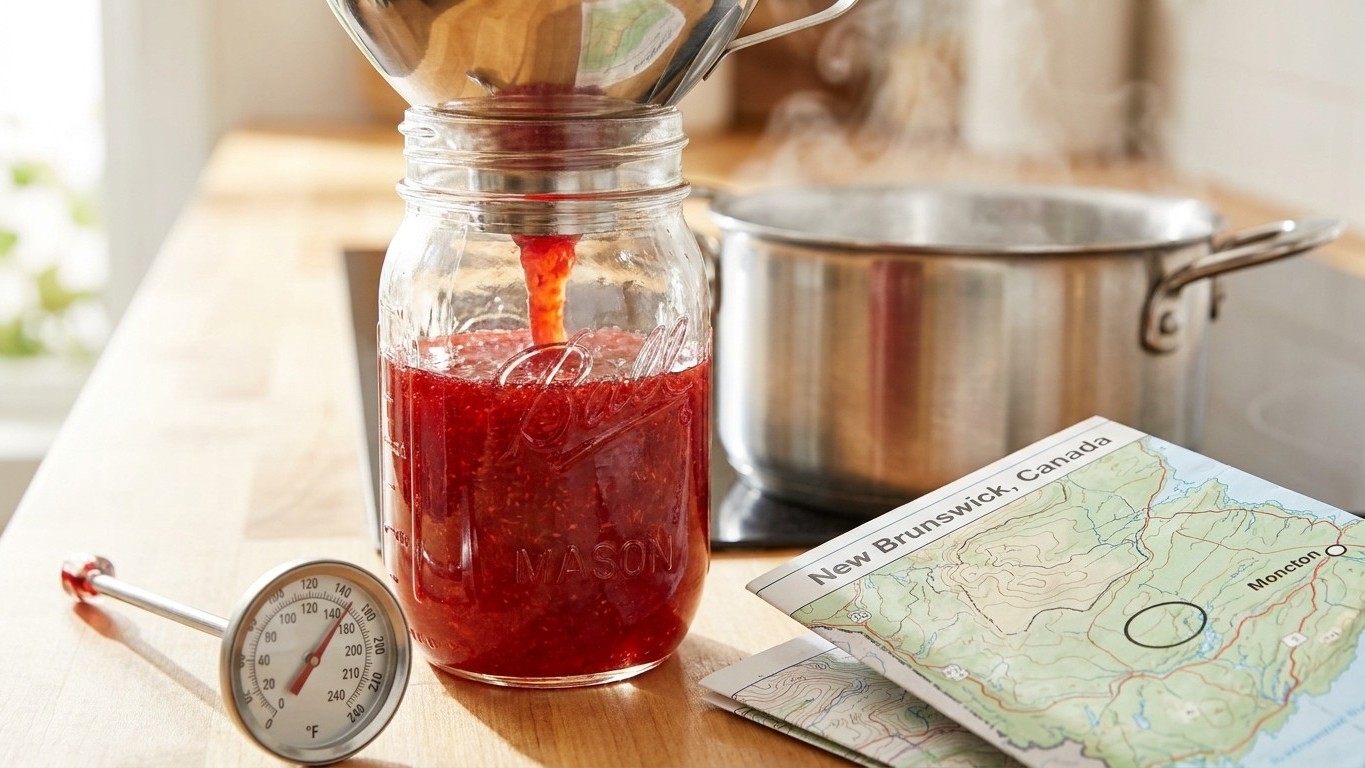

Moncton sits at 98 feet above sea level, and water there boils somewhere between 208°F and 212°F depending on the day’s weather. That elevation falls into the lowest altitude band used for home canning, the one that runs from sea level up to 2,000 feet. For most of New Brunswick, that means the boiling-water and pressure-canner instructions printed on a tested recipe apply without any altitude adjustment at all. But that answer belongs to Moncton, not to the whole province.
The short answer

New Brunswick is not one elevation. It’s a stretch of coastline, river valleys, and inland hills, and a single reference figure can only describe one point on that map. Moncton, used here because it’s a commonly cited reference city, sits at 98 feet, and the boiling point of water there falls between 208°F and 212°F, per the USDA Complete Guide to Home Canning as published by the National Center for Home Food Preservation. That band, 208 to 212 degrees, reflects normal day-to-day variation in atmospheric pressure at low elevation, not a range you need to track for canning purposes.
At 98 feet, the practical answer is simple: no altitude adjustment applies. The USDA’s altitude bands for home canning start at sea level and run to 2,000 feet as the first tier, and Moncton’s elevation sits well inside it. If you can and live in or near Moncton, you follow the base processing time or base pressure listed on your tested recipe, full stop.
Why this doesn’t scale to the whole province
The mistake would be reading “New Brunswick’s elevation is 98 feet” and stopping there. That number describes one city. Drive inland toward the highlands or up into hillier terrain and elevation climbs, sometimes by hundreds of feet within a single county. Every foot above that 2,000-foot mark shifts you into a different altitude band, and each band carries its own adjustment for boiling-water canning time or pressure-canner setting.
Three feet of difference changes nothing. Six thousand feet changes everything, because it changes the temperature your food actually reaches inside the jar during processing. The gap between those two extremes is exactly why “what’s my state’s altitude” is the wrong question. The right one is “what’s my address’s altitude,” and that’s a number worth pinning down before you can anything, regardless of what a reference city happens to say.
Why a lower boil is a weaker process
Water’s boiling point drops as elevation rises. At sea level it boils at 212°F. Climb to 10,000 feet and it boils at 194°F, a full 18 degrees cooler, according to the same USDA guide. That single fact is the entire mechanism behind every altitude adjustment in home canning. A boiling-water canner never gets hotter than the boiling point of the water inside it, and if that ceiling is lower, the jars inside process at a lower temperature too.
A lower processing temperature kills fewer microorganisms in the same amount of time. Spores that would be destroyed at 212°F over a given number of minutes can survive a milder 200°F bath run for that same stretch. This matters most with low-acid foods, the ones that depend on heat alone (or heat plus pressure) to destroy Clostridium botulinum spores, because there’s no acidity in the jar doing extra work.
People sometimes assume cranking the burner higher solves the problem. It doesn’t, and this is worth being blunt about: boiling water does not get hotter no matter how hard it boils. Once water reaches its boiling point at a given elevation, additional heat just makes it boil more vigorously and evaporate faster. It does not push the temperature past that ceiling. A rolling, aggressive boil at 5,000 feet is still capped at roughly 203°F, not a degree warmer, regardless of flame intensity.
Because the temperature ceiling can’t move, the only variables left are time and pressure. In a boiling-water canner, the fix is longer processing, giving the milder heat more minutes to do the same job a hotter boil would do faster. In a pressure canner, the fix runs the other direction: raising the pressure raises the temperature inside the sealed canner beyond what boiling water alone could reach, compensating for the thinner air outside. Both approaches solve the same underlying problem from different directions, and both numbers, the added minutes or the added pounds of pressure, come from the tested recipe for that specific food, not from a general rule of thumb.
Finding your own elevation
- Start with your actual address, not your city’s downtown or a nearby landmark; elevation can shift within a few miles, especially near hills or river valleys.
- Use a reliable elevation lookup tool rather than guessing from memory or from what a neighboring town’s elevation happens to be.
- Visit the National Center for Home Food Preservation’s “Find Your Elevation” page, built specifically to help home canners identify their local elevation before choosing a processing time or pressure.
- Enter your location and note the elevation in feet, rounding to the nearest hundred if the tool gives more precision than you need.
- Match that figure to the altitude band listed in your tested recipe’s adjustment table, whether that recipe comes from the NCHFP, a USDA publication, or a current edition of a canning guide built on USDA research.
- Recheck this if you move, can at a relative’s house farther inland, or start using a cabin or seasonal property at a different elevation than your primary residence.
What goes wrong
- An under-processed jar that looks perfectly normal. A jar canned at the sea-level time despite sitting at 3,000 feet can seal, seem shelf-stable, and show no cloudiness or bulging, while still failing to reach a temperature high enough to destroy botulinum spores. The fix is using the altitude-adjusted time from the start, not judging the jar’s safety by its appearance later.
- A recipe pulled from a sea-level source without checking its origin. Older family recipes, and some online recipes, were written for a specific low elevation and never mention altitude at all. The fix is treating every processing time as tied to sea level unless the source explicitly states otherwise, then adjusting from there using your own elevation.
- A pressure gauge read as if elevation didn’t matter. Dial-gauge and weighted-gauge pressure canners both need their target pressure adjusted upward as elevation increases, and the increments aren’t identical between the two gauge types. The fix is checking which target pressure applies to your specific canner style at your elevation before you seal the lid.
- Splitting the difference between two altitude bands. Averaging the times listed for two adjacent bands, or rounding down to the lower one because it seems close enough, quietly removes the safety margin the tested process was built around. The fix is using the band that actually contains your elevation, even if it sits close to the boundary.
Where the exact adjustment comes from
This page won’t give you a processing time or a pressure-canner setting, and that’s intentional. The correct number depends on the specific food, the jar size, the recipe’s acidity, and your elevation together, and it belongs to a tested recipe, not to a general article about altitude. For that number, go to the National Center for Home Food Preservation, the University of Georgia-affiliated program that maintains USDA-based, tested canning recipes and their altitude adjustment tables.
The reason for this caution isn’t bureaucratic. Botulinum toxin, the danger an under-processed low-acid jar can harbor, has no taste and no smell. A jar can look, smell, and taste completely normal and still be unsafe. Getting the elevation adjustment from a tested source, rather than approximating it, is the entire margin of safety.
Common questions
Does New Brunswick have one official elevation for canning purposes?
No. Elevation varies across the province, and the 98-foot figure cited here describes Moncton specifically, used as a reference point, not a province-wide number. Your own address may sit in a different altitude band entirely.
If I’m near Moncton, can I skip altitude adjustments altogether?
At 98 feet, you’re inside the lowest altitude band (sea level to 2,000 feet), so base processing times and pressures from a tested recipe typically apply without modification. Confirm your own elevation rather than assuming it matches Moncton’s exactly.
Why does boiling the water harder not fix the altitude problem?
Because water’s boiling point is a ceiling, not a target you can push past with more heat. Once water reaches that ceiling for a given elevation, extra heat just increases evaporation and vigor, not temperature.
What happens if I use a sea-level processing time at a higher elevation by mistake?
The jar likely still seals, but the lower boiling temperature means less heat penetrated the food, raising the risk that harmful spores survived the process, particularly in low-acid foods that rely on heat alone for safety.