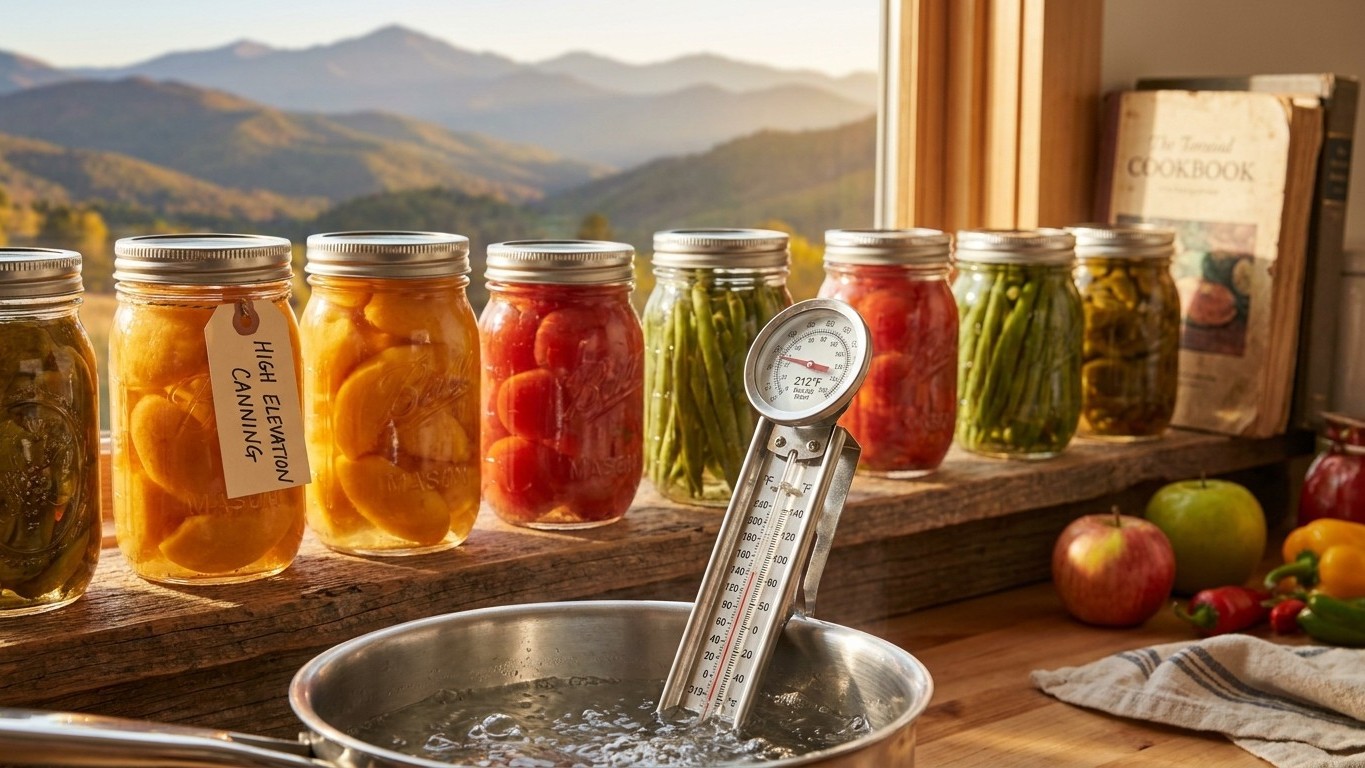

North Carolina runs from sea-level marsh near Wilmington to peaks above 6,000 feet in the Blue Ridge, so a canning question that starts with “what’s my altitude” doesn’t have one statewide answer. If you’re canning near Charlotte, the adjustment is minor to none. If you’re canning in Boone or Asheville, it’s not optional. The only way to know which camp you’re in is to check the elevation where your kitchen actually sits.
The short answer

Charlotte, used here as the state’s reference city, sits at 751 feet in elevation. At that height, water in an open pot boils somewhere between 208°F and 212°F, the range published by the USDA’s Complete Guide to Home Canning for elevations from sea level up to 2,000 feet. That’s the entire physical fact this article rests on: a number of feet, and a bracket of boiling temperatures that comes with it.
This figure describes Charlotte, not North Carolina. The state has no single elevation. Charlotte’s 751 feet says nothing about a kitchen in Cherokee County at 2,000 feet, or one in Asheville pushing past 2,100, or a homestead higher still in the Smokies. Each of those kitchens boils water at a slightly different temperature, and each one falls into a different adjustment band in the tested canning charts. The reference city gives you a feel for the low end of the state’s range; it doesn’t give you your own number.
Does 751 feet change anything for a canner working near Charlotte? Not much, and that’s worth saying plainly rather than hedging. Water at that elevation boils close enough to the full 212°F that it sits at the bottom edge of the standard adjustment bands used in tested USDA and NCHFP recipes. Compare that to a kitchen at 6,000 feet, where the boiling point has dropped several degrees further and every single tested recipe, boiling-water or pressure, calls for a different number than the one printed for sea level. The gap between “doesn’t matter” and “matters for every jar” is exactly the gap between Charlotte’s foothills and North Carolina’s mountains.
Why the bracket matters more than a single number
USDA publishes boiling points as ranges tied to elevation bands rather than exact points tied to exact feet, because the boiling point also shifts a little with weather and barometric pressure on a given day. That’s why Charlotte gets a bracket, 208°F to 212°F, instead of one fixed figure. The practical takeaway isn’t the exact decimal. It’s the band: know which elevation band your kitchen sits in, because that band is what a tested recipe’s processing chart is built around, not the city you happen to live near.
Why a lower boil is a weaker process
Water boils at a lower temperature as elevation increases. That’s it, that’s the entire mechanism, and everything else in altitude canning follows from that one line. At sea level, boiling water hits 212°F. Climb to 10,000 feet and boiling water tops out around 194°F. The water is still boiling, vigorously, with all the bubbling and rolling a canner expects to see. It’s just boiling at a lower temperature, and a lower temperature kills fewer of the organisms and spores that home canning is designed to destroy.
This is the part that trips people up: cranking the burner higher doesn’t fix it. Boiling water cannot get hotter than its boiling point, no matter how hard it boils. A rolling, aggressive boil at 6,500 feet is still a boil at whatever temperature water boils at 6,500 feet, and no amount of extra flame pushes it past that ceiling. A canner who assumes a harder boil compensates for altitude is working from a misunderstanding of basic physics, not a shortcut that happens to work.
What actually compensates is time, or pressure, depending on the method. In a boiling-water canner, the fix is a longer processing time at the same 212°F-adjusted boiling temperature the elevation allows, giving the lower heat more minutes to do the job a hotter boil would have done faster. In a pressure canner, the fix runs the other direction: pressure, not just heat, forces the temperature inside the sealed canner higher than any open pot could reach at that elevation, and at altitude that pressure has to be dialed up beyond the sea-level setting to hit the same internal temperature a lower elevation would need.
Either way, the compensation exists because the tested recipe accounts for a real, measurable gap between “what temperature this jar needs to reach” and “what temperature an open or sealed pot naturally reaches at this elevation.” Skip the adjustment and that gap doesn’t close itself. The jar looks identical to one processed correctly. What’s different is invisible, and that’s precisely the problem.
Finding your own elevation
Charlotte’s 751 feet is a reference point, not a substitute for the number that matters, which is the elevation where your canner actually sits. Finding it takes a few minutes.
- Start with the National Center for Home Food Preservation’s “Find Your Elevation” page, built specifically for canners who need this one number and nothing else.
- Enter your city, town, or zip code rather than guessing from a nearby landmark; two addresses a few miles apart in hilly parts of North Carolina can sit in different elevation bands.
- Note the figure in feet, not meters, since every USDA and NCHFP canning chart is built around foot-based elevation bands.
- Round up if you’re near a band boundary. If your address lands close to a threshold, treating yourself as the higher band costs a little extra time or pressure and costs nothing in safety.
- Write the number down somewhere permanent, like inside your canning notebook or taped to the inside of a cabinet, so it’s not something you have to relook up every canning season.
That single number, once found, is what you carry into every tested recipe from here forward. It doesn’t change unless you move.
What goes wrong
- An under-processed jar that looks perfectly normal. The seal pops down, the color looks right, the jar sits on the shelf for months without any sign of trouble. Altitude-related under-processing doesn’t announce itself with a bulging lid or an off smell; it can leave a jar that passes every visual check while still carrying live spores. The remedy is procedural, not visual: apply the elevation adjustment before processing, every time, rather than relying on how the finished jar looks afterward.
- A recipe pulled from a sea-level source. Plenty of recipes circulating online, in older family notebooks, or in general cookbooks were written and tested at or near sea level, with no altitude guidance built in. Using one of those at any elevation above the lowest band means processing for less time or less pressure than the food actually needs. The fix is checking that any recipe used is a tested one from NCHFP or USDA, and applying that source’s own altitude chart rather than assuming the printed time already covers you.
- A pressure gauge read as though elevation doesn’t exist. Dial gauges and weighted gauges both need altitude-specific settings, and it’s easy to set a canner to the number printed for sea level out of habit or because that’s the figure most memorized. The remedy is matching the gauge setting to the elevation band for that specific canner type and that specific food, checked against the tested chart rather than against memory.
Where the exact adjustment comes from
This page won’t give you a processing time or a canner pressure, and that’s deliberate. The right adjustment depends on the specific food, the jar size, and the method, boiling-water or pressure, and those numbers live in tested recipes, not in a general article about elevation. For the actual figures, go to the National Center for Home Food Preservation, the authority that publishes tested processing charts built around elevation bands for each food it covers.
The reason to take this seriously rather than estimate is simple: botulinum toxin has no taste and no smell. A jar that’s under-processed because the elevation adjustment was skipped or guessed at gives no warning sign before it’s opened and eaten. The adjustment isn’t a formality layered onto an already-safe process. It’s part of what makes the process safe in the first place.
Common questions
Does every part of North Carolina need an altitude adjustment?
No. Kitchens at low elevations, like much of the Piedmont and coastal plain near Charlotte’s 751-foot reference point, fall within the lowest published elevation band and need little to no adjustment. Kitchens in the western mountains, sitting well above 2,000 feet, fall into higher bands where tested recipes call for real changes to time or pressure.
Can I just boil jars longer to be safe, regardless of my elevation?
Adding random extra time isn’t the same as applying the correct elevation adjustment from a tested recipe. The safest approach is finding your actual elevation and following the specific chart for your food and method, rather than guessing at “longer is safer.”
Does altitude affect pressure canning and boiling-water canning the same way?
Both are affected by the same underlying mechanism, a lower boiling point at higher elevation, but the compensation differs. Boiling-water canning adjusts processing time; pressure canning adjusts the pressure setting on the gauge. Both adjustments come from tested charts specific to the method.
Where do I find my exact elevation if I don’t know it?
The National Center for Home Food Preservation publishes a “Find Your Elevation” page built for this purpose. Entering your city, town, or zip code there gives you the number, in feet, needed to match your kitchen to the correct elevation band.