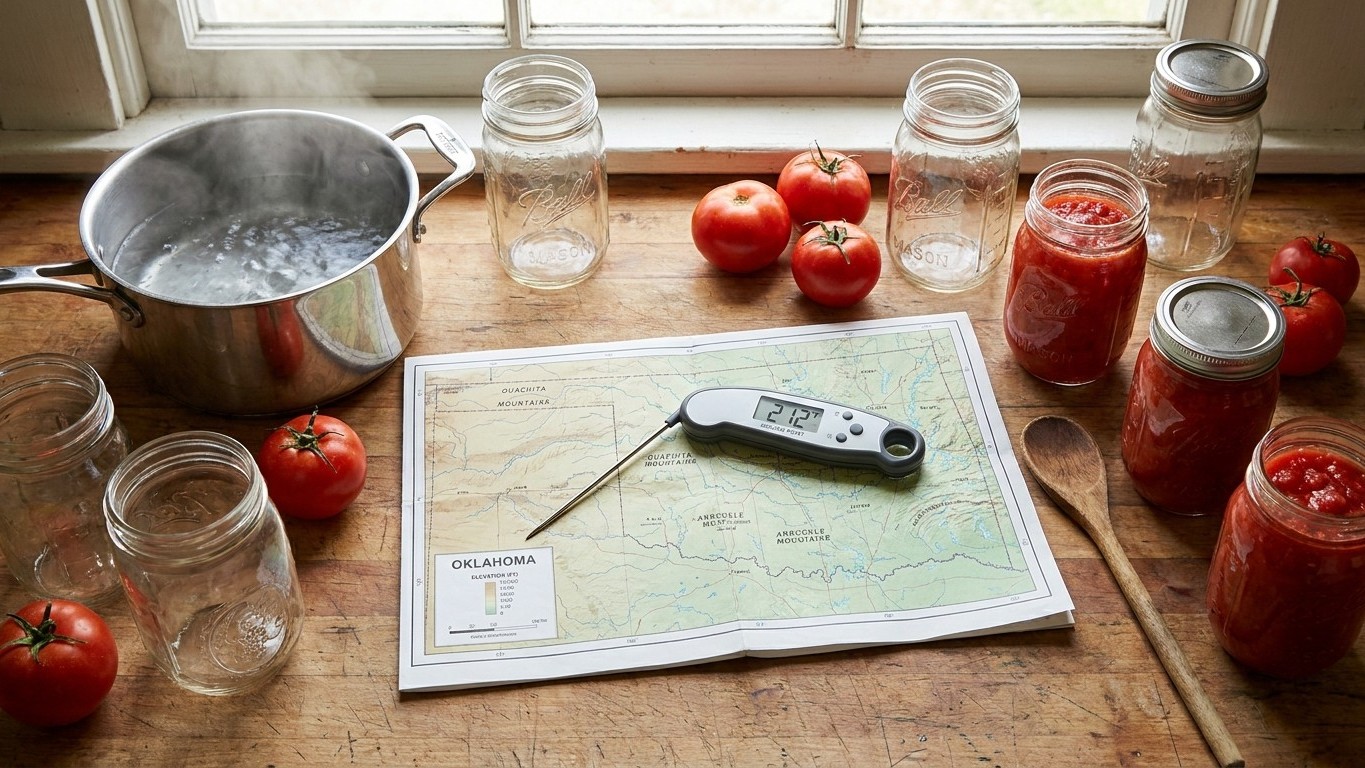

Oklahoma City sits at 1,201 feet, and water there boils somewhere between 208°F and 212°F depending on the day’s barometric pressure. That’s the number this whole guide hangs on. But Oklahoma is not one elevation. It runs from river-bottom flats in the east to the Panhandle’s high plains near 4,000 feet, so what applies to a kitchen in the capital may not apply to a kitchen three hours away.
The short answer

Start with the reference point: Oklahoma City, elevation 1,201 feet, where published boiling temperatures fall between 208°F and 212°F. That’s a narrow band, and it sits near the low end of the ranges most canning guides split into altitude tiers. For a home canner working from that exact elevation, it matters less than it would for someone in Kenton or Boise City, where the ground climbs toward a mile above sea level.
The figure above describes a city, not a state. That distinction isn’t a technicality, it’s the whole reason this article exists. Oklahoma’s elevation profile stretches from around 300 feet along the Red River valley in the southeast to nearly 4,973 feet at Black Mesa in the far northwest corner of the Panhandle. Someone canning tomatoes in Idabel and someone canning tomatoes in Guymon are working with meaningfully different boiling points, even though both live in the same state and might be using the exact same recipe card.
This is why “Oklahoma canning altitude” isn’t a single answer you can look up once and forget. The reference city gives you a benchmark, a way to understand the mechanism and see roughly where the state’s population centers fall. It does not give you your own number. If you live near Tulsa, Norman, or Oklahoma City itself, you’re working with elevations reasonably close to that 1,201-foot mark. If you live in the western third of the state, especially up in the Panhandle or along the western edge near the Texas and New Mexico borders, your actual elevation could sit hundreds or even thousands of feet higher, and that changes the boiling point you’re actually working with in your own kitchen.
The practical upshot: treat the Oklahoma City figure as an illustration of how altitude and boiling point relate, not as a shortcut that lets you skip finding your own elevation. A few hundred feet of difference rarely changes the story much. A few thousand feet does, every time.
Why a lower boil is a weaker process
Here’s the physical fact underneath everything else in this article: water boils at a lower temperature as elevation increases. At sea level, water boils at 212°F. Climb higher, and atmospheric pressure drops, so water reaches its boiling point sooner, at a cooler temperature. At 10,000 feet, water boils at just 194°F. That’s not a small difference when the entire safety of a canned jar of green beans or salsa depends on heat killing off harmful organisms and their spores.
Canning relies on temperature, and specifically on sustained temperature, to destroy microorganisms that can spoil food or, worse, produce toxins. A boil that tops out at 205°F instead of 212°F is a weaker process even though the water is, technically, boiling just as hard. This trips people up constantly. The instinct is to think a rolling, vigorous boil must be doing more work than a gentler one. It isn’t. Boiling water cannot get hotter than its boiling point no matter how hard it bubbles. Crank the burner up all you want; at a given elevation, boiling water stays at that elevation’s boiling temperature. A furious boil at 206°F is still a 206°F process, not a hotter one.
So if the water itself won’t get hotter, something else has to compensate for the lower temperature, and canning guides handle this in one of two ways depending on the method. For boiling-water canning, the compensation is time. The jars stay in the boiling water for a longer processing period, giving the milder heat more time to do the job that a shorter process would accomplish at sea level. For pressure canning, the compensation is pressure. Adding pressure inside a sealed canner raises the temperature of the steam beyond what a simple boil could reach, and canners at higher elevations need more of it to hit the same internal temperature a sea-level canner reaches at a lower pressure setting.
Neither fix is optional, and neither is something to estimate by feel. The adjustment is specific to the food being canned, the size of the jar, and the exact elevation of the kitchen doing the work. That’s a detail for a later section. What matters here is the logic: lower boiling point, weaker process, and a real compensation required in either added minutes or added pressure to bring the process back up to a safe standard.
Finding your own elevation
- Start with a reliable elevation source rather than guessing from memory or from a nearby town’s reputation for being “high” or “low.” Local landmarks and general impressions aren’t precise enough for this purpose.
- Use an online elevation lookup tool tied to your specific address or your ZIP code, since elevation can shift meaningfully even within a single county.
- Check the figure against a second source if the number seems surprising or if your area sits near a known altitude boundary, since small errors in either direction can push you into a different adjustment tier.
- Write the elevation down somewhere you’ll actually see it again, like taped inside a cabinet door near your canning supplies, so you’re not re-searching for it every canning season.
- Visit the National Center for Home Food Preservation’s “Find Your Elevation” page, built specifically to help home canners locate this number and connect it to the adjustment tables used in tested recipes.
- Match your confirmed elevation to the specific recipe you’re using, since the correct adjustment depends on both your elevation and the particular food and processing method, not on elevation alone.
What goes wrong
- An under-processed jar that looks completely normal. A jar can seal, look clear, and sit on a shelf for months looking exactly like a properly processed one, while the process itself never reached a safe temperature for long enough. The seal tells you the jar closed. It tells you nothing about whether the contents were heated adequately. The remedy is following the elevation-adjusted time or pressure from a tested recipe every single time, not just when something seems off.
- A recipe pulled from a sea-level source. Plenty of recipes circulating online, in older family cookbooks, or on general recipe sites were written without any altitude guidance at all, often because whoever wrote them lived somewhere close to sea level and never needed to think about it. Using that recipe unmodified at 1,201 feet, let alone at 3,500 feet in western Oklahoma, means processing for a time that may not be adequate. The fix is cross-checking any recipe against a tested source that explicitly states elevation adjustments, like the NCHFP database, before trusting it.
- A pressure gauge read as though elevation doesn’t exist. Pressure canner dial gauges and weighted gauges both need to be set according to elevation, and it’s a common mistake to set the pressure based only on what the recipe says for sea level, ignoring that higher elevation requires more pressure to reach the same internal temperature. The remedy is checking the specific pressure adjustment for both the food and the elevation before starting the canner, and having a dial gauge tested for accuracy periodically, since a gauge that reads incorrectly compounds an elevation error rather than correcting it.
Where the exact adjustment comes from
This article won’t hand you a processing time or a pressure setting, and that’s deliberate. The correct adjustment depends on the specific food, the jar size, the canning method, and your exact elevation together, not on any one of those alone. The right source is the tested recipe for that particular food, found through the National Center for Home Food Preservation.
The reason for this caution isn’t bureaucratic caution for its own sake. Under-processed low-acid food can allow Clostridium botulinum to grow and produce a toxin that has no taste, no smell, and no visible sign in the jar. A jar can look, smell, and taste completely fine and still be dangerous. That’s exactly why the adjustment has to come from a tested source matched to your real elevation, rather than from a general rule of thumb applied loosely across every recipe in the pantry.
Common questions
Does every part of Oklahoma need an altitude adjustment for canning?
Not necessarily. Areas close to the reference elevation of Oklahoma City, around 1,201 feet, sit at the lower end of the range where adjustments become significant. Areas farther west and in the Panhandle, where elevation climbs much higher, are far more likely to need one. The only way to know for certain is to check your own elevation rather than assuming based on the state as a whole.
Can I just boil food longer to be safe, regardless of elevation?
Guessing at extra time isn’t a substitute for using the correct, tested adjustment for your specific elevation and recipe. Too little time risks an unsafe jar; the safest path is always matching your confirmed elevation to a tested recipe’s stated adjustment, not estimating.
Why does boiling water canning need more time at altitude instead of more heat?
Because boiling water cannot exceed its boiling point at a given elevation, no matter how vigorously it boils. Since the temperature itself can’t be raised through a harder boil, the only way to compensate for a weaker, cooler boil is to extend how long the jars stay in that boiling water.
Is elevation the only thing that affects my canning process?
No. The food being canned, its acidity, the size of the jar, and the method (boiling-water versus pressure canning) all factor into the correct process alongside elevation. That’s why the National Center for Home Food Preservation matches adjustments to specific recipes rather than publishing one universal altitude rule.