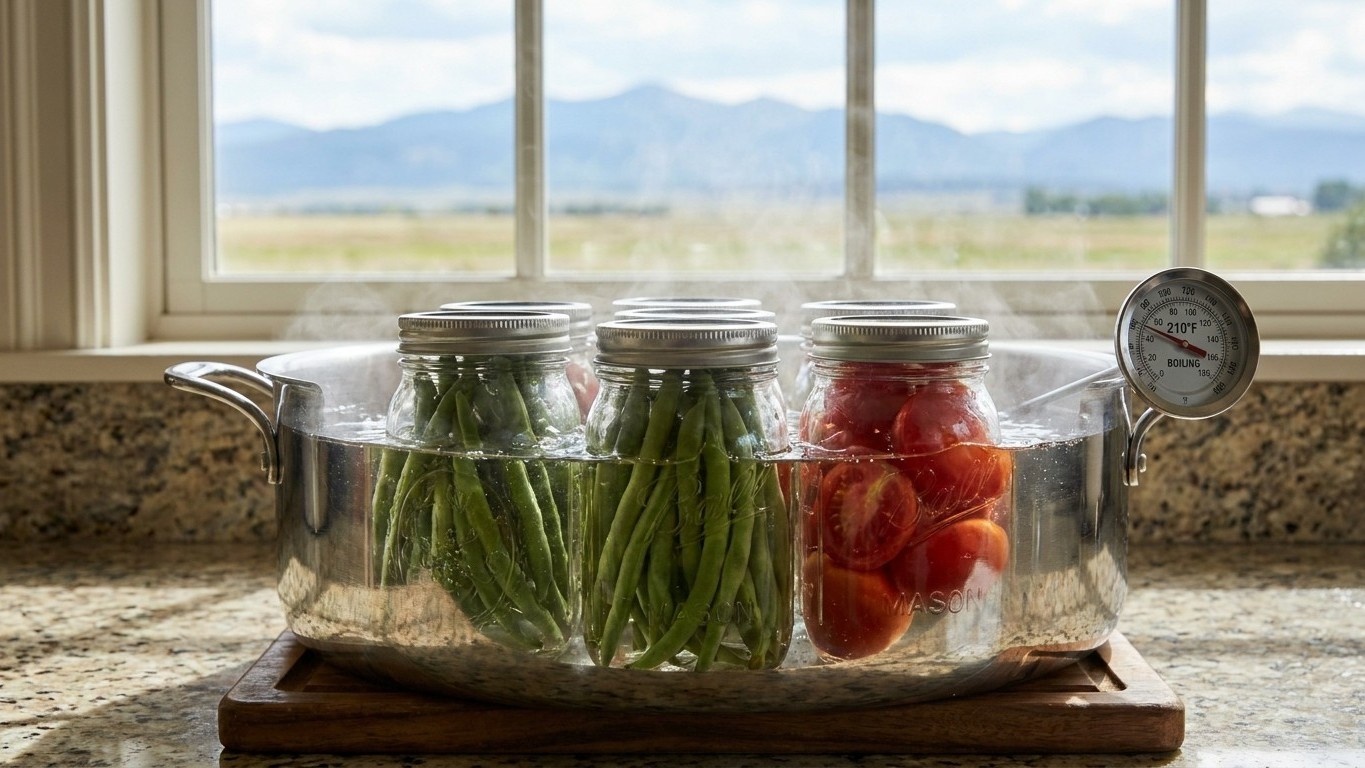

At 10 feet above sea level, Virginia Beach changes nothing about how you can. Water there boils close to the textbook 212°F, and a tested recipe’s processing time works as written. But Virginia isn’t one elevation. Head toward the Blue Ridge or the Highlands and the same jar of green beans needs a longer boil or more pressure, because the water in your canner is cooler than the recipe assumes.
The short answer

Virginia Beach, the reference city for this piece, sits at 10 feet above sea level. That places it in the 0 to 2,000 foot elevation band that covers most of the state’s coastal plain and Piedmont. Across that band, published boiling temperatures for water run between 208°F and 212°F, according to the USDA’s Complete Guide to Home Canning as published by the National Center for Home Food Preservation. At Virginia Beach’s actual 10 feet, the boil sits right at the top of that range, essentially the familiar 212°F most canning recipes are written around.
For a reader canning tomatoes or green beans in Virginia Beach, Norfolk, or anywhere else close to sea level, this is not an altitude that changes anything. A tested recipe’s stated processing time already assumes a full boil at or near 212°F, and that’s what you’ll get. No extra minutes, no adjusted pressure gauge, nothing to add.
But this is a reference city, not the state
Here’s the part that trips people up: a state figure like “Virginia Beach, 10 feet” describes one city, not Virginia. The commonwealth stretches from tidal marsh at sea level to ridgelines in the Appalachians thousands of feet higher. Somewhere between those two extremes, the boiling point of water drops enough that a recipe timed for sea level no longer delivers a safe process. The canning adjustment you need follows your own elevation, not the state’s average, not its capital, and not its biggest city.
That distinction matters because a lot of home canners assume “I live in Virginia, so I don’t need to worry about altitude.” That’s only true if you’re actually near sea level. A kitchen in the Shenandoah Valley or up in the mountains west of Roanoke is a different story entirely, and the only way to know which side of that line you’re on is to check your own address, not the state’s name.
Why a lower boil is a weaker process
The mechanism is simple physics, and it’s the whole reason altitude matters to canning at all. Water boils when its vapor pressure matches the surrounding air pressure. At sea level, air pressure is highest, so water has to reach 212°F before it boils. Climb higher and the air thins out, air pressure drops, and water boils at a lower temperature to compensate. At 10,000 feet, for example, water boils around 194°F instead of 212°F. It’s still boiling, vigorously even, but it’s boiling cooler.
That cooler boil is a weaker process for one reason: heat kills. Canning relies on sustained heat to destroy the microorganisms and enzymes that spoil food and, more seriously, to destroy the spores of Clostridium botulinum, the organism responsible for botulism. A boiling-water canner timed for 212°F assumes a specific rate of heat penetration into the jar. Drop that boil to 200°F or 194°F and the same number of minutes delivers less total heat to the food inside. The jar might look identical to one processed at sea level. It is not identical inside.
This is why cranking up the burner does nothing to fix the problem. Boiling water cannot get hotter than its boiling point, no matter how hard it boils. A rolling, aggressive boil at 194°F is still 194°F. Turning up the heat just makes the water evaporate faster and boil more violently; it doesn’t raise the temperature past the point where the water turns to steam. That’s a fact of physics, not stove power, and it trips up a lot of well-meaning canners who assume a harder boil is a hotter boil.
What actually compensates for a lower boiling point is time or pressure. In a boiling-water canner, the fix is a longer processing time, giving the cooler water more minutes to deliver the same cumulative heat. In a pressure canner, the fix is different: pressure canners don’t rely on water’s boiling point at all past a certain elevation. Instead, the canner is sealed and pressurized, and at altitude the gauge needs to run higher to reach the same internal temperature the recipe was tested at. Either way, something has to give: more minutes, or more pressure, to make up for the weaker boil.
Finding your own elevation
Since the adjustment follows your address and not Virginia Beach’s, the first job is finding out where you actually stand.
- Start with your street address or the nearest town center, since elevation can shift by hundreds of feet even within a single county.
- Use the National Center for Home Food Preservation’s “Find Your Elevation” page, built for exactly this purpose, to look up the number for your location.
- Write down the figure in feet, not meters, since USDA canning charts are built around feet.
- Compare that number against the elevation bands used in USDA canning charts (the same charts referenced by the National Center for Home Food Preservation) to see which range you fall into.
- Recheck if you can, garden centers, county extension offices, and topographic map tools sometimes give slightly different readings depending on the exact point measured, so a second source is a reasonable habit.
- Keep that elevation figure somewhere you’ll see it again, a note taped inside a cupboard, a line in a canning notebook, because you’ll need it every time you pick a processing time or set a pressure gauge.
None of this takes more than a few minutes, and it’s a one-time task unless you move. But skipping it means guessing, and guessing at altitude is exactly how under-processed jars end up on a pantry shelf.
What goes wrong
- An under-processed jar that looks perfectly normal. The lid seals, the liquid looks clear, nothing seems off. But if the elevation adjustment was skipped, the food inside may not have reached a temperature high enough to destroy botulinum spores. There’s no visible warning sign for this. The fix is simple: always apply the elevation adjustment listed for your food and your actual elevation before you can, not after.
- A recipe pulled from a sea-level source. Plenty of canning instructions circulating online, in old family recipe cards, or in general cookbooks were written without any altitude in mind, often assuming a coastal or low-elevation kitchen. If your elevation is different, that timing is wrong for you. The remedy is checking the recipe’s origin and cross-referencing it against a tested source that includes altitude charts, like those from the National Center for Home Food Preservation, before trusting the stated time.
- A pressure gauge read as if elevation didn’t exist. Pressure canner instructions often list one pressure for sea level and assume the canner operator will adjust upward at altitude. Reading the gauge at the sea-level number regardless of where you live undercuts the whole process, since the canner needs to run at a higher pressure to reach the same internal temperature once you’re above the lowest elevation bands. The fix is checking your elevation against the pressure adjustment chart for your specific canner type and food, every time, not just the first time you canned.
- Assuming the state’s biggest city applies to you. Because “Virginia” gets treated as a single data point, some canners look up a well-known city’s elevation and use it for their own kitchen, even when they live somewhere higher. The remedy is the same step from the previous section: find your own elevation, not the state’s most cited one.
Where the exact adjustment comes from
This page won’t give you a processing time or a pressure setting, and that’s deliberate. The correct adjustment depends on the specific food, the recipe, the jar size, and your elevation together, and that combination belongs to a tested recipe, not a general explainer. For the actual minutes or pounds of pressure, go to the National Center for Home Food Preservation’s canning resources, which publish elevation-adjusted charts alongside each tested recipe.
The reason this matters more than it might seem: botulinum toxin has no taste and no smell. A jar that’s been under-processed because the altitude adjustment was skipped can look, smell, and taste completely normal right up until it isn’t. There’s no shortcut around checking the tested figure for your food and your elevation before you seal a single jar.
Common questions
Does Virginia Beach need any altitude adjustment for canning?
No. At 10 feet above sea level, Virginia Beach sits close enough to sea level that the standard, unadjusted processing times and pressures in tested recipes apply as written.
Why does the boiling point matter if the water is still boiling?
Because boiling water can’t exceed its own boiling point no matter how hard it boils. At lower air pressure, that boiling point drops below 212°F, so the water delivers less heat over the same amount of time, and the canning process has to compensate with more minutes or more pressure.
Can I just look up Virginia’s elevation and use that number?
No. Virginia spans a wide range of elevations from the coast to the mountains, and a single state-level number doesn’t reflect where you actually live. Use the National Center for Home Food Preservation’s “Find Your Elevation” page to get your own figure.
What happens if I skip the altitude adjustment entirely?
The jar can seal and look completely normal while still being under-processed, meaning it may not have reached a temperature high enough to destroy botulinum spores. Since the toxin has no taste or smell, there’s no way to detect this by looking at or tasting the food.