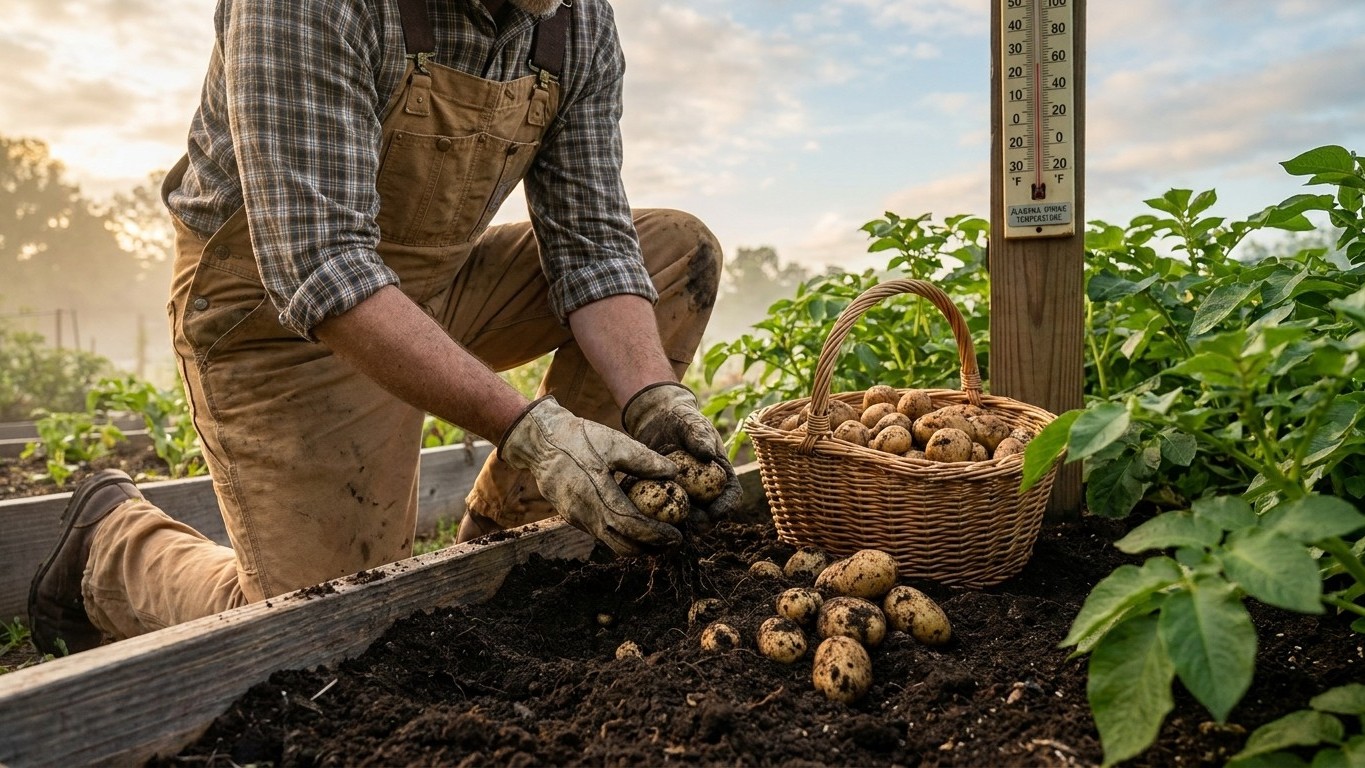

In Huntsville, Alabama, the last spring frost typically falls between March 19 and April 3, and the growing season that follows racks up an average of 58.5 days a year at 90 F or hotter, according to NOAA NCEI Climate Normals. That combination means Alabama gardeners are working a narrow spring window, not a long summer one. Get the timing right and potatoes size up before the heat arrives. Miss it, and the plant simply stops working.
The short answer

Alabama can grow a full, satisfying potato crop, but the state’s climate hands gardeners one clear rule: plant early, harvest before the deep heat sets in, and don’t expect a second summer planting to behave like a spring one. The two numbers that decide everything are the last frost window in Huntsville (March 19 to April 3, per NOAA NCEI 1991-2020 Climate Normals) and the count of 90 F days that follow it, 58.5 per year on average at that same reference station.
That 58.5 figure comes from Utah State University Extension’s framework for reading heat load on potato crops, and it matters because potatoes don’t respond to heat the way tomatoes or peppers do. They don’t wilt and recover. Once soil temperatures climb past 90 F, the plant’s underground machinery for setting and filling tubers effectively shuts down. Alabama’s spring is usually cool enough and short enough to get a crop through before that ceiling hits, provided planting happens on time. The state’s early summer is not.
What this means for the calendar
A gardener in Huntsville, or anywhere with a similar frost pattern, is really only trying to hit one target: get plants in the ground while soil is still cool from winter but has crossed the minimum warmth potatoes need to sprout. That’s a much narrower window than most root vegetables get. Wait too long, and the plant’s tuber-filling stretch collides with the first run of 90-plus-degree days, which in north Alabama can start showing up by late May in a hot year. Plant too early, into cold, wet ground, and the seed piece rots before it sprouts at all. The math only works one direction: backward from frost, not forward from convenience.
None of this means the harvest is small. It means the harvest happens on a schedule set by soil temperature, not by the gardener’s calendar preferences. Alabama’s advantage is a spring cool enough to let tubers bulk up; its disadvantage is a summer heat load that arrives fast and doesn’t loosen its grip. The state’s whole potato strategy is built around exploiting the first and dodging the second, which is why choosing Potato Varieties That Suit Alabama matters as much as timing the planting date, and why knowing the process for Harvesting and Storing Potatoes in Alabama matters just as much once that heat arrives.
When to plant here
Utah State University Extension and the University of Maine Cooperative Extension both anchor potato planting to one soil measurement: 50 F, checked a few inches down, sustained rather than a single reading. For a full breakdown of dates and frost windows, see When to Plant Potatoes in Alabama.rm afternoon. Everything else in the schedule is counted backward from that number and from the local last-frost date.
- Start with the reference frost window for Huntsville: March 19 to April 3, per NOAA NCEI 1991-2020 Climate Normals. Pick the earlier or later end depending on how your own garden has run in past years.
- Subtract 14 to 21 days. That’s the gap Utah State and University of Maine both cite between the point soil crosses 50 F and the last frost date, and it puts most Huntsville-area planting somewhere in the first half of March, sometimes stretching a bit earlier if the ground has been trending warm.
- Check the soil directly rather than trusting the calendar alone. A simple soil thermometer pushed 4 inches down, checked over two or three consecutive mornings, tells you more than any date on a chart. Potatoes tolerate a light frost on emerging foliage far better than they tolerate a seed piece sitting in cold, waterlogged soil.
- Once soil holds at 50 F or above for several days running, plant. Waiting for a guaranteed frost-free week is not the goal here; the goal is soil that’s warm enough to sprout the seed piece before rot sets in.
This backward count is the single most useful habit a gardener in this state can build, because it travels. Move to a different county, a different elevation, even a different side of the same ridge, and the frost date shifts, but the 14-to-21-day countdown from 50 F soil stays the same. Learn the arithmetic once and it works everywhere the underlying frost data is reliable.
What the heat does to the crop
The mechanism is simple and unforgiving. Above roughly 90 F in the soil, tuber set and tuber fill are inhibited, according to Utah State University Extension’s potato fact sheet and confirmed by the University of Maine Cooperative Extension’s bulletin on the crop. The plant doesn’t die outright. It keeps producing leaves, keeps looking green and healthy from the porch. But underground, the process that turns stored sugars into swelling tubers slows or stalls entirely.
Huntsville’s average of 58.5 days a year at 90 F or above, per NOAA NCEI Climate Normals, tells you this isn’t a rare event to plan around. It’s a predictable, recurring feature of the local summer, arriving with enough regularity that the whole planting calendar has to be built to finish before it does the damage. For a state carrying that kind of heat load, the sound approach is a single spring crop, planted early enough that the bulk of tuber development happens while soil is still under that 90 F ceiling, dug once the vines begin dying back on their own.
Watering does not solve this problem. That’s worth saying plainly because it’s the instinct most gardeners reach for when a crop looks stressed in July. Extra irrigation keeps the plant hydrated and the foliage from scorching, but it does nothing to reopen the biological process that heat has shut down at the tuber level. A well-watered potato plant sitting in 92 F soil is still a plant that has stopped sizing its tubers. The fix isn’t more water at the wrong time; it’s a harvest date set early enough that the crop never sits in that soil temperature range during its critical fill period.
What goes wrong here
- Uncertified seed potatoes. Seed bought from a grocery store or saved from last year’s grocery-store potatoes often carries viruses that stunt growth and cut yield, sometimes without any visible sign until the plants underperform. Buy certified seed potatoes from a garden center or seed supplier, which are tested and tagged specifically to be free of these viruses.
- Planting into cold, wet soil before it’s ready. A seed piece sitting in ground below 50 F, especially if that ground is also waterlogged from spring rain, tends to rot rather than sprout. Wait for the soil itself to confirm readiness rather than planting off a date on a seed packet.
- Skipping the hilling and ending up with green tubers. Tubers that push up near the soil surface and get exposed to sunlight turn green and develop solanine, a compound that makes them bitter and unsafe to eat in quantity. Mounding soil or mulch over the base of the plants as they grow keeps developing tubers covered and prevents this entirely.
- Digging too early, before the vines have died back. Pulling a crop while foliage is still green and standing often means tubers haven’t finished sizing, and skins haven’t toughened enough to store well. Waiting for the vines to yellow and collapse on their own, which in this climate should happen before the heaviest run of 90-degree days, gives the crop its full window to bulk up.
Checking this against your own county
The dates and heat figures above come from one reference station near Huntsville, and Alabama is a long state with real differences between its northern hills and its Gulf Coast plain. A garden at higher elevation, or one further south, can see its last frost land weeks earlier or later than the Huntsville window, and its count of 90 F days can run well above or below that 58.5 average. Microclimate matters too. A garden tucked against a south-facing wall warms faster in spring than one sitting in an open, low-lying field a few miles away.
Treat the numbers here as a starting point for the conversation, not the final word on your own soil. The Alabama Cooperative Extension System, run through Alabama A&M University and Auburn University, tracks local frost data and planting guidance county by county and is worth a direct check before finalizing a planting date. Find contact and resource details at aces.edu.
Common questions
Can I plant a second, fall crop of potatoes in Alabama?
A fall crop is riskier here because it means planting seed pieces during the hottest stretch of summer, right when soil temperatures sit well above the 90 F threshold that stalls tuber set. Most gardeners in this state get better, more reliable results concentrating effort on a single well-timed spring crop.
Should I choose an early, mid-season, or late variety for this climate?
Early-season varieties fit Alabama’s short spring window most comfortably, since they push through their growth cycle and finish sizing before the heaviest run of 90 F days arrives. Mid-season types can work if planted right at the front edge of the recommended window. Late-season varieties carry more risk here, since more of their development falls into the hotter stretch of the calendar.
What are potatoes actually good for once harvested, based on variety?
Sources from Utah State University Extension and the University of Maine Cooperative Extension describe potato varieties by intended use rather than by texture labels: some are recommended for baking, others for boiling, and still others suited to general all-purpose kitchen use. Checking a variety’s stated use before buying seed helps match the harvest to how you plan to cook it.
Does mulching help manage the soil heat problem?
Mulch can moderate soil temperature swings and help retain moisture, which supports healthy foliage. But it doesn’t override the underlying mechanism described by Utah State University Extension, where sustained soil temperatures above 90 F inhibit tuber set and fill. Mulch is a helpful supporting practice, not a substitute for timing the harvest before that heat threshold becomes the dominant factor.