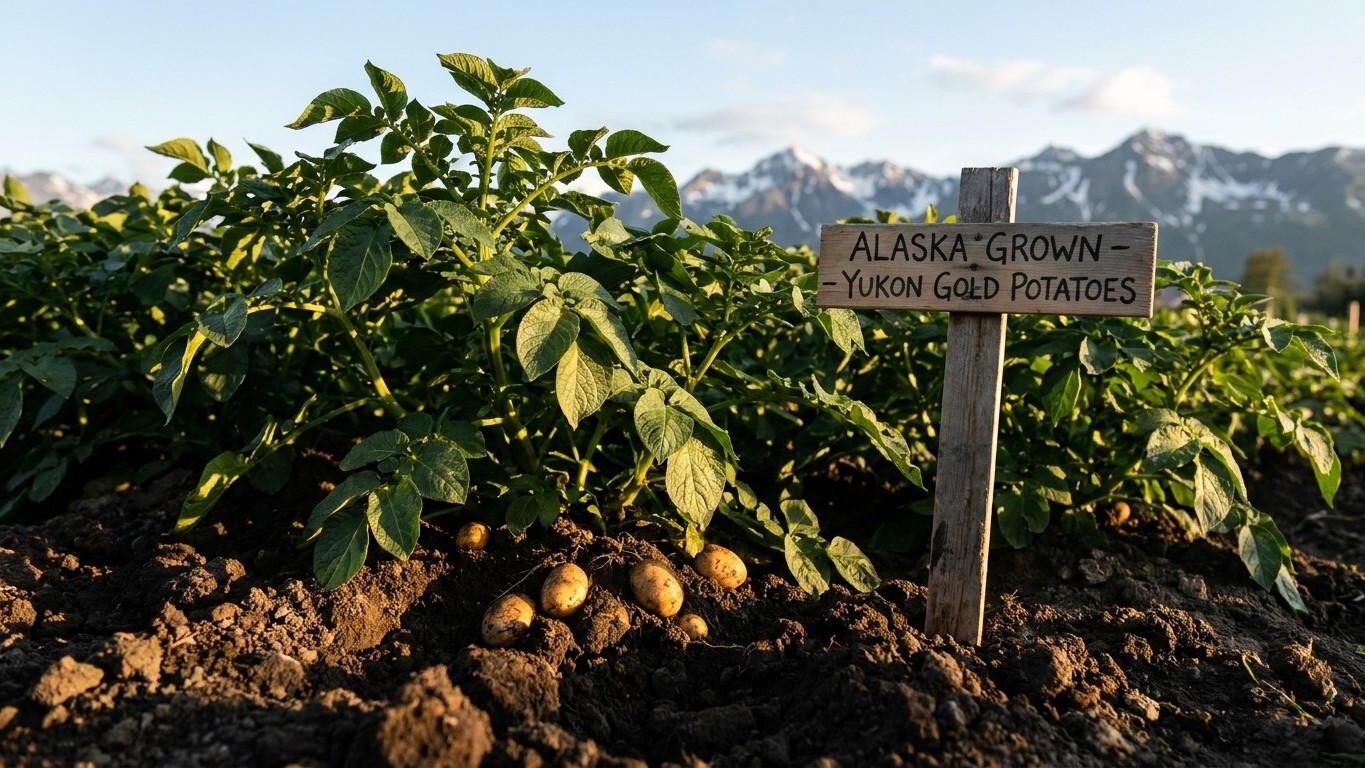

In Anchorage, the reference city for this state’s climate data, summer never gets hot enough to hurt a potato crop. Zero days a year above 90°F means the tuber-stopping heat ceiling that worries gardeners in Texas or Georgia simply doesn’t apply here. The frost window running May 3 to May 12 is what actually shapes the season, and it means Alaska gardeners plant for a short, cool summer, not a long, hot one.
The short answer

Start with the number that matters most: 0.0 days a year reach 90°F or higher at Anchorage, according to NOAA NCEI Climate Normals covering 1991-2020. Compare that to a hot-summer state where triple digits stack up for weeks, and the difference explains why Alaska potato growers face almost the opposite problem from most of the country. Utah State University Extension’s fact sheet on garden potatoes identifies 90°F soil temperature as the point where tuber set and fill shut down. In Alaska, that threshold is close to theoretical. The soil almost never gets there, so the crop’s ceiling isn’t heat. It’s daylight and cold.
Why the frost window does the real work
Anchorage’s last spring frost falls somewhere between May 3 and May 12, based on the 32°F freeze-probability data tied to station USW00026451. That gives the city roughly 143 frost-free days, which sounds thin next to a Southern growing season but is stretched by Alaska’s long summer daylight, a factor that partly makes up for the compressed calendar. Because the heat ceiling is a non-issue here, the entire planting strategy shifts toward getting the crop in the ground as early as the soil allows and getting it out before fall frost, rather than timing around a mid-summer heat spike.
That reshuffles priorities compared to a hot-climate garden. Instead of asking “will my potatoes stop sizing in July,” an Alaska gardener asks “did I plant early enough, and will fall frost beat me to the harvest.” For guidance on timing that decision, see When to Plant Potatoes in Alaska, and once the season winds down, Harvesting and Storing Potatoes in Alaska covers how to bring the crop in before that fall frost arrives. The table below sketches how season class connects to use, since Utah State and the University of Maine Cooperative Extension both publish season class and intended use, though neither publishes a days-to-maturity figure for any variety. For a closer look at which cultivars fit these season classes best, see this guide to Potato Varieties That Suit Alaska.
| Season class | Typical use | Alaska planting note |
|---|---|---|
| Early | Boiling, new potatoes | Best fit for a short frost-free window |
| Mid-season | Boiling or baking, general purpose | Workable where soil warms reliably by mid-May |
| Late | Baking, storage | Riskier statewide unless the local frost-free stretch runs long |
When to plant here
The planting date isn’t picked off a calendar. It’s counted backward from two things: the last frost window and the soil temperature. Here’s how that arithmetic works for a gardener near Anchorage, and how to redo it for any county.
- Start with the local last spring frost window. For Anchorage, that’s May 3 to May 12, per NOAA NCEI’s 1991-2020 normals.
- Utah State University Extension and the University of Maine Cooperative Extension both point to 50°F soil as the trigger for planting seed potatoes.
- Both sources place that 50°F soil mark 14 to 21 days before the last frost date, not after it.
- Counting back 14 to 21 days from May 3 lands in the second half of April; counting back from May 12 lands closer to the very end of April.
- That gives an Alaska gardener near Anchorage a working window in late April, provided the soil itself has actually reached 50°F, which matters more than the date on the wall.
- Check soil temperature directly with a soil thermometer at a 4-inch depth rather than trusting the calendar alone, since a cold, wet spring can push that 50°F mark later regardless of what the date arithmetic suggests.
A gardener in a different county redoes this same math with their own last-frost data, not Anchorage’s. The arithmetic is the tool; the local frost date is the input that changes everything.
What the heat does to the crop
The mechanism is simple, and it’s the single most important thing to understand about growing potatoes anywhere: once soil temperature climbs above 90°F, tuber set and fill stop. Utah State University Extension is explicit about this threshold. The plant doesn’t die, and the foliage may look fine, but the underground work of sizing tubers halts. Watering more doesn’t fix it, because the block isn’t a lack of moisture. It’s the soil temperature itself signaling the plant to stop investing in tubers.
Here’s why that mechanism barely touches an Alaska garden. With 0.0 days a year at or above 90°F at the Anchorage reference station, the soil essentially never crosses into that danger zone. A gardener in a hot state has to work around this ceiling by planting a spring crop early and digging before summer heat arrives, or by choosing a cooling strategy for a fall crop. An Alaska gardener doesn’t need either workaround. The entire growing window sits below the ceiling from planting to harvest.
That doesn’t mean Alaska’s climate hands over an easy season, just a differently shaped one. The constraint here isn’t too much heat, it’s too little accumulated warmth and a compressed number of frost-free days. A crop that would sail through summer heat stress in Alaska instead has to contend with cold, wet soil early on and the risk of a fall frost landing before the tubers finish sizing. The mechanism is real and worth understanding, but for this state it’s a non-factor rather than a planning problem.
What goes wrong here
- Uncertified seed potatoes. Seed saved from a grocery-store potato or an uncertified source can carry viruses that stunt the whole plant before it ever has a chance in a short Alaska season. Buying certified seed potatoes removes that risk from the start.
- Planting into cold, wet soil before it hits 50°F. Eagerness to get a jump on a short season often pushes gardeners to plant too early. Seed potatoes sitting in cold, waterlogged ground are prone to rot rather than sprout; checking actual soil temperature with a thermometer before planting is the fix.
- Skipping the hilling and ending up with green tubers. Tubers that push up near the surface and catch light turn green and develop solanine, making them unsafe to eat. Hilling soil up around the base of the plants as they grow keeps developing tubers covered and in the dark.
- Digging too early, before the plant has finished its work. With a short frost-free window, the temptation is to dig as soon as anything sizable turns up. Waiting until foliage naturally dies back, or accepting the tradeoff of an earlier harvest with smaller tubers, is a more deliberate choice than digging out of impatience.
Checking this against your own county
Anchorage’s numbers are a starting point, not a rule for the whole state. Alaska covers an enormous range of elevation and latitude, and the difference between a coastal garden and one in the Interior, or one at a higher elevation, can shift both the last frost date and the length of the frost-free season by weeks in either direction. A county further north or at higher elevation should expect a later last frost and a shorter window than Anchorage’s May 3 to May 12 range. Before finalizing a planting date, check local conditions directly with the University of Alaska Fairbanks Cooperative Extension Service, which tracks county-level and regional data across the state.
Common questions
Do Alaska summers ever get hot enough to hurt a potato crop?
No. The Anchorage reference station recorded 0.0 days a year at or above 90°F over the 1991-2020 period, so the heat ceiling that stops tuber set and fill in warmer states isn’t a practical concern here.
What soil temperature should trigger planting?
Utah State University Extension and the University of Maine Cooperative Extension both point to 50°F soil, checked directly with a soil thermometer, roughly 14 to 21 days before the local last spring frost date.
Should I choose an early, mid-season, or late variety for a short Alaska season?
Neither source publishes a days-to-maturity figure for any variety, but season class is published. An early-season class fits a short frost-free window more comfortably than a late-season class, which is better suited to a longer, storage-oriented growing season.
Why does my seed catalog warn against saving my own seed potatoes?
Uncertified seed can carry viruses invisible to the eye that stunt growth and reduce yield. Certified seed potatoes are tested and tracked specifically to avoid that risk, which matters even more in a short season with little room to recover from a slow start.