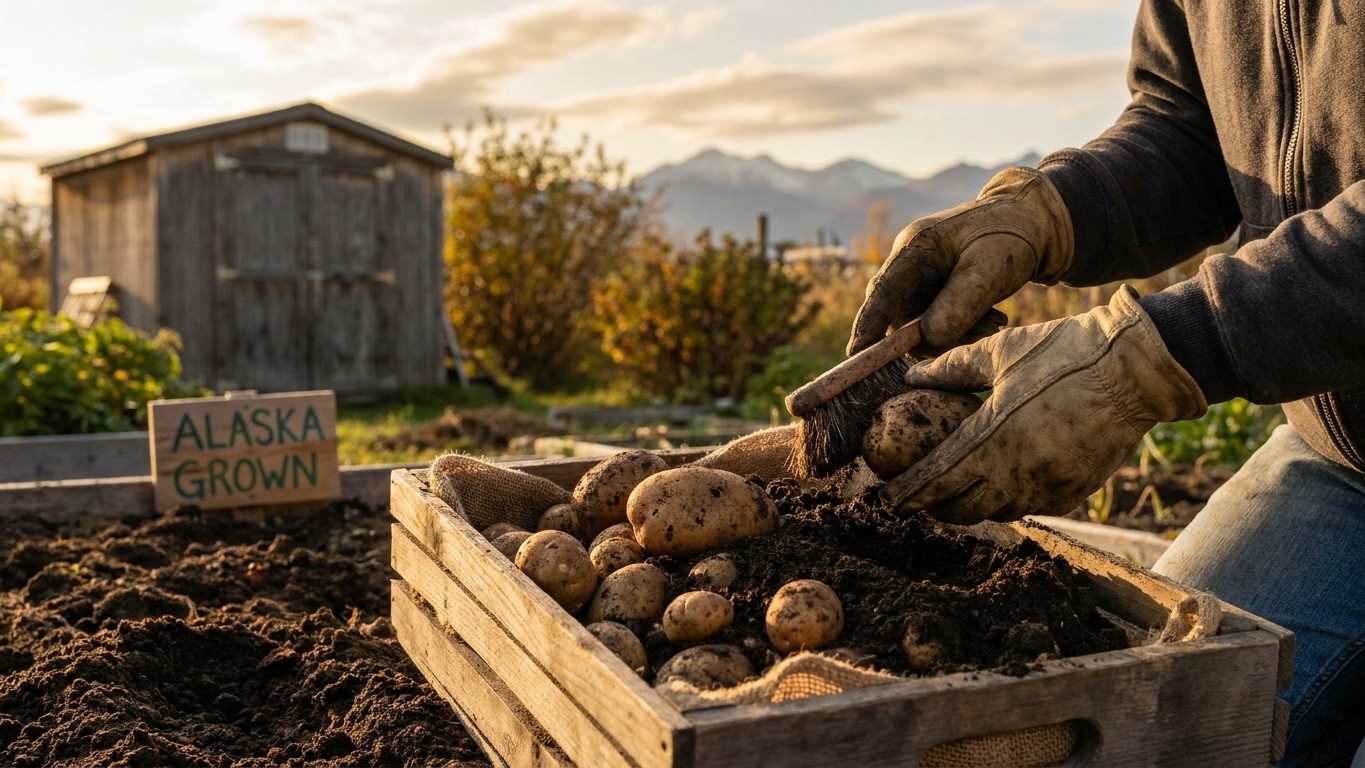

Alaska growers, especially around Anchorage, need to have potatoes out of the ground before the first fall frost, which NOAA NCEI Climate Normals place between September 22 and October 1. From there, the crop needs two to three weeks of warm curing before it goes into storage that stays above freezing all winter, since an unheated shed or garage in this climate will not hold the 40-45 F storage range Utah State University Extension calls for.
The short answer
Two numbers set the whole calendar here. The first is the fall frost window itself, September 22 to October 1, drawn from NOAA NCEI’s 1991-2020 Climate Normals at station USW00026451. The second is the mean daily minimum of the coldest month, which sits at 11.0 F. That second figure matters more than most gardeners expect, because it is not a record low or a single cold snap. It is the average low, night after night, through the coldest stretch of winter. A space that regularly drops toward 11 F is not marginal. It is solidly below freezing, and any potatoes left in it will freeze solid and turn to mush once thawed.
So the digging date follows the frost date closely. Most growers around Anchorage aim to have the crop out of the soil by late September, ahead of that first freeze, because frozen ground makes harvest difficult and frost-touched tubers store poorly even if they survive the initial cold. The growing season itself runs about 143 frost-free days here, which is short by national standards but long on daylight, since Alaska’s summer sun compensates somewhat for the compressed calendar. Anchorage is also one of the milder pockets of the state. Interior Alaska and points north see a shorter frost-free stretch and colder winters still, so anyone gardening outside the Anchorage area should treat these dates as a best-case reference, not a statewide rule.
The storage question is where this climate draws a hard line. An unheated garage, a detached shed, or an outbuilding without insulation will track close to outdoor air temperature through the winter months. With a coldest-month mean minimum of 11 F, that kind of space freezes routinely, not occasionally. Holding potatoes at the 40-45 F range Utah State University Extension recommends, or the 38 F and 95 percent humidity the University of Maine Cooperative Extension describes, requires a space with either insulation, a heat source, or both. A root cellar dug into the ground, an insulated basement corner, or a heated garage bay are realistic options. A plain unheated shed is not, no matter how well-ventilated it is.
Curing, and where
Curing is the step between digging and long-term storage, and it asks for conditions almost opposite to what Alaska’s late-September air delivers outdoors. Utah State University Extension specifies 55-60 F with high humidity, held for two to three weeks, to let cut or bruised skins heal over before the tubers go into cold storage. By the time potatoes come out of the ground here, ahead of that September 22 to October 1 frost window, outdoor daytime temperatures are already trending cool and nights are colder still. A shaded porch or an open shed, which might work for curing in a warmer climate, will not reliably hold 55-60 F in Alaska at that point in the season.
- Dig on a dry day and let the potatoes sit on top of the soil for an hour or two to shed loose dirt, without leaving them exposed to a hard frost.
- Move them indoors immediately to a space that can be kept near 55-60 F, since outdoor curing spots that work farther south are already too cold here by late September.
- Choose a heated basement, a mudroom, or an insulated garage bay with a supplemental heater, rather than an attached but unheated porch, which will often run 10-20 degrees cooler than needed once fall sets in.
- Hold humidity high by covering bins loosely with burlap or leaving them in a closed but not airtight room, since dry indoor heat from a furnace can pull moisture out of the air faster than in a naturally humid outbuilding.
- Give it two to three weeks before checking skins for a firm, set feel, and before moving the crop to its winter storage location.
The practical upshot is that curing in this climate is almost always an indoor project, not an outdoor or semi-outdoor one. Growers without a heated basement or garage corner sometimes use a spare room with a space heater set to hold the range, checking a thermometer daily rather than guessing. Skipping this step, or rushing it because the storage space is ready sooner, tends to show up later as soft rot in tubers whose cut surfaces never sealed.
Storing through this winter
Once cured, potatoes need a dark, cold, but not freezing space for the rest of the winter. Utah State University Extension puts the target at 40-45 F, while the University of Maine Cooperative Extension gives a slightly tighter figure of 38 F at 95 percent humidity. Either range sits well above the 11 F mean minimum this state’s coldest month delivers in an unconditioned space, which is the core problem Alaska storage has to solve. A cold frame, an attached but unheated garage, or a shed with only wall insulation and no heat source will drift down toward outdoor air temperature during a sustained cold snap, and once the storage space crosses into the low 30s or below, the tubers inside start to freeze.
Frozen potatoes do not recover. The cell structure breaks down, and thawed tubers turn soft, watery, and prone to rapid rot, often within days. That makes the margin between 40-45 F and freezing the single most important number in Alaska storage planning. A root cellar built partly below grade uses the ground’s natural insulation to buffer against outdoor swings, and it is one of the more workable options in a climate where outdoor lows regularly sit well under freezing for weeks at a stretch. A basement corner away from a furnace, kept dark with a curtain or box covering, can also hold the needed range if the rest of the house stays heated through winter, since basement temperatures generally track a few degrees above outdoor lows but well below main living space temperatures.
An insulated but heated garage, kept just warm enough to stay above freezing with a small heater on a thermostat, is another practical setup, particularly for growers without a true root cellar. The goal is not to keep the space warm in the way a living room is warm. It is to keep it just above freezing and no warmer, since temperatures pushing past the mid-40s encourage early sprouting, according to the same Utah State University Extension guidance that sets the lower bound. Darkness matters too. Light exposure during storage triggers greening and sprouting regardless of temperature, so any storage space, root cellar, basement corner, or garage bin, needs to block ambient light as well as hold the right temperature range.
What goes wrong here
- Digging after the first frost hits the foliage and soil. Waiting past the September 22 to October 1 window risks frozen ground and frost-damaged tubers that store poorly. Dig ahead of that date rather than after it, checking a local frost forecast rather than assuming the calendar date alone.
- Curing outdoors in a climate too cold for it. A porch or open shed rarely holds the 55-60 F Utah State University Extension calls for once fall arrives here. Move curing indoors to a heated room, basement, or garage bay instead.
- Storing in an unheated outbuilding through winter. With a coldest-month mean minimum of 11 F, an uninsulated shed or garage will freeze stored potatoes solid at some point in the season. Add insulation, a low-wattage heater on a thermostat, or move storage to a basement or root cellar.
- Storing too warm indoors. A heated living space, even a closet near an interior wall, often runs well above the 40-45 F target, which pushes tubers into early sprouting. Choose the coolest available indoor spot that still stays above freezing, such as an unheated but insulated entryway or a basement corner.
- Letting light reach stored tubers. A garage or basement with a window, or bins left uncovered under a bare bulb, will green potatoes over weeks of storage regardless of temperature. Cover bins with cloth or store them in opaque containers.
Common questions
How early can potatoes be planted in Alaska given the short frost-free season?
That planting-side timing is not covered by the frost and cold-month figures used on this page, since those describe the fall harvest and winter storage window, not spring planting dates. Check a companion page on this site for planting guidance specific to this climate.
Does the frost date differ much across the state?
The September 22 to October 1 window comes from a station reference point in the Anchorage area, one of the milder parts of Alaska. Interior Alaska and areas farther north see shorter frost-free periods and colder winters, so growers there should expect an earlier fall frost than this figure suggests.
Can potatoes be stored outside in a buried container instead of indoors?
A below-grade root cellar can work well in this climate because the surrounding soil buffers against the swings an above-ground shed experiences, but it still needs enough depth and insulation to stay above freezing through a coldest month averaging 11 F nightly lows. A shallow buried bin without that buffer risks freezing along with any unheated aboveground space.
What happens if potatoes are cured at too low a temperature?
Curing below the 55-60 F range Utah State University Extension recommends slows the skin-healing process, leaving tubers more vulnerable to rot once they move into cold storage. In this climate, that usually means the curing space needs supplemental heat rather than relying on ambient indoor temperature alone.