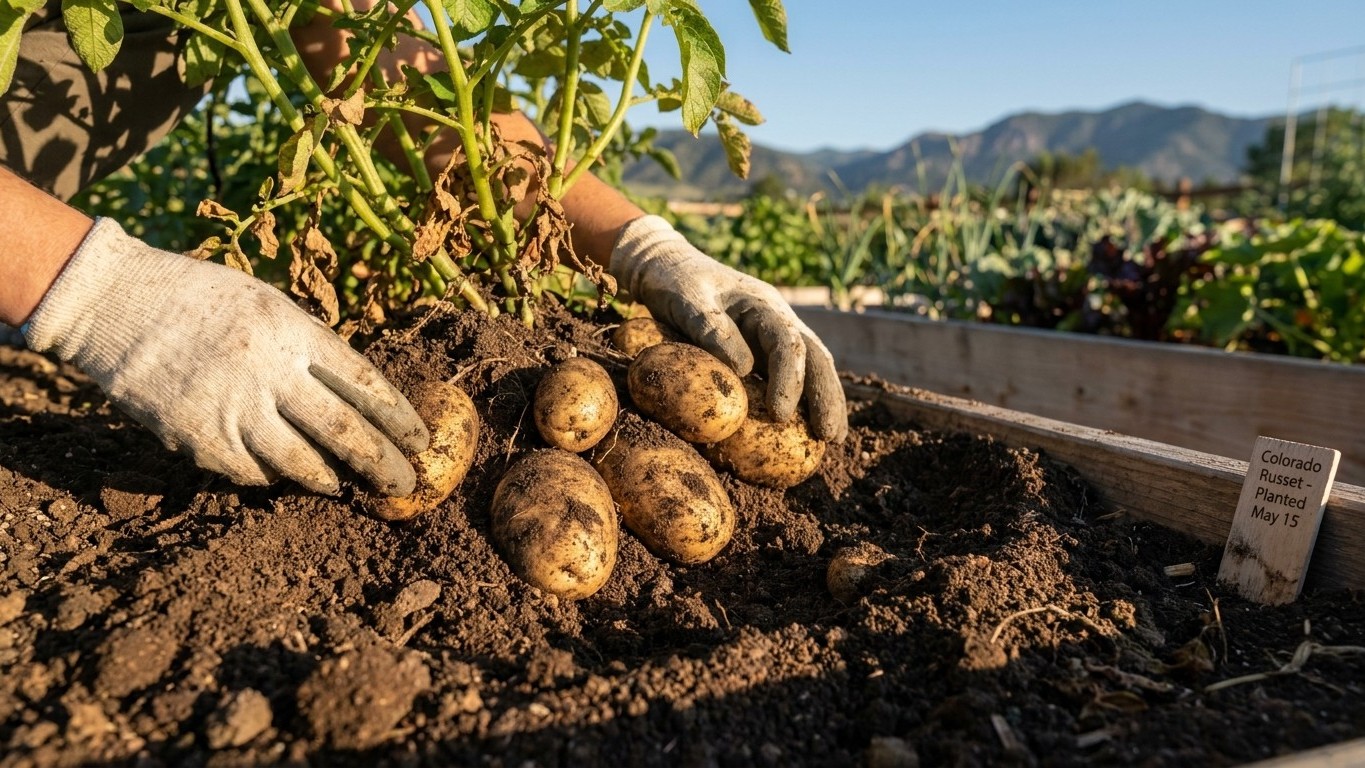

Yes, potatoes grow well on Colorado’s Front Range if you plant early and treat the season as spring-to-midsummer rather than a full summer run. Soil needs to hit 50°F before you plant, roughly two to three weeks ahead of the last frost near Denver. Above 90°F in the soil, tuber set and fill stall, and Denver logs an average of 39.6 such days a year. The fix isn’t more water. It’s timing.
The short answer

Two numbers decide whether this crop works in your yard. The first is heat load: Denver averages 39.6 days a year at 90°F or higher, according to NOAA NCEI Climate Normals covering 1991 to 2020. That’s not a handful of scorching afternoons you can water your way through. It’s more than a month, spread across a growing season, and it lands squarely in the window when tubers are supposed to be bulking up underground. The second number is the last spring frost, which falls between May 1 and May 11 at the Denver reference station, per NOAA’s 32°F freeze probability data.
Put those two figures side by side and the calendar answers itself. Plant in early-to-mid May, and the crop has roughly eight to ten weeks before Denver’s hottest stretch typically arrives in July. That’s enough time for an early or mid-season variety to set tubers and put on size before soil temperatures climb into the danger zone. Wait until Memorial Day to plant, though, and you’ve handed the plant its critical bulking period during the exact weeks when soil temperature is most likely to cross 90°F.
This is why Colorado gardeners who complain about “small potatoes” almost always planted late, not that they watered wrong or picked a bad variety. Choosing from among the Potato Varieties That Suit Colorado can help, but timing still matters more than cultivar. Utah State University Extension’s potato fact sheet is blunt about the mechanism: tuber set and fill are inhibited once soil temperatures climb above 90°F, and no amount of irrigation reverses that once it’s happening. Coloradans aren’t dealing with the heat load of a place like Phoenix, but 39.6 days a year at or above 90°F is enough to shut down growth mid-season if the crop is still small and unestablished when the heat arrives, which is also why knowing When to Plant Potatoes in Colorado matters just as much as the right approach to Harvesting and Storing Potatoes in Colorado.
So the short answer holds for most of the Front Range and eastern plains: yes, potatoes grow here, and yes, this is functionally a spring crop that finishes its heavy lifting before the hottest weeks hit. Gardeners at higher elevations, in the mountain valleys, or on the Western Slope are working with a different, usually cooler and shorter, season, which shifts these dates but doesn’t change the underlying math.
When to plant here
Counting backward from frost is more reliable than counting forward from an arbitrary “spring” date, because soil temperature, not the calendar, is what the plant responds to.
- Start with your last spring frost date. Near Denver, NOAA’s data puts that window between May 1 and May 11.
- Subtract 14 to 21 days. That’s the lag Utah State University Extension and the University of Maine Cooperative Extension both point to between soil reaching 50°F and the last frost, since bare soil warms ahead of the air.
- Land on a planting window. Fourteen to twenty-one days before May 1 puts you at roughly April 10 to April 17. Working from May 11, that same math lands around April 20 to April 27.
- Confirm with a soil thermometer before committing. Push it 4 inches down in the bed you’re planting, check it at the same time over a few mornings, and wait for a steady reading at or above 50°F rather than a single warm afternoon.
- Plant once that 50°F threshold holds. Seed potatoes tolerate a light frost on emerging foliage better than they tolerate sitting in cold, wet soil, which invites rot before the plant even breaks ground.
Run this same arithmetic for your own county rather than borrowing Denver’s dates outright. A gardener in Grand Junction or Pueblo, sitting at lower elevation with an earlier frost-free window, can often push planting into late March. Someone gardening at 7,000 feet in the mountains is working from a much later last-frost date, so the same 14-to-21-day backward count lands somewhere in late May or even June.
What the heat does to the crop
The mechanism is simple, and it’s the single fact that decides whether a Colorado potato patch produces a full harvest or a basket of golf balls. Potato plants set tubers in a band of soil temperature they’re comfortable in, and once that soil climbs above 90°F, the plant stops putting energy into swelling those tubers. Utah State University Extension states this directly: tuber set and fill are inhibited by soil temperatures above 90°F. The plant doesn’t necessarily die. It just stops doing the one thing you planted it for.
Here’s where Colorado’s specific numbers matter. Denver’s average of 39.6 days a year at 90°F or higher isn’t evenly spread across summer, it clusters in July and into August, which is exactly when a late-planted or late-maturing crop would still be trying to size up. A crop planted on schedule in April, using an early or mid-season variety, is typically already well into its bulking phase or close to harvest before that heat load peaks. A crop planted in late May or June, or one grown from a late-season variety, is still actively trying to set tubers right as the soil crosses that 90°F line.
This is the part that trips people up: watering more doesn’t reverse it. Extra irrigation cools the surface briefly and keeps foliage from wilting, but it doesn’t undo the plant’s internal response to soil heat, and overwatering compacted, hot soil can just as easily promote rot as help. The dependable fix is upstream of the problem: get the crop in the ground early enough, using a fast-starting variety, so that the bulk of tuber development happens before Denver’s heat count starts climbing in earnest. For Colorado’s climate, that means treating this as a defined spring-into-early-summer crop rather than something you tend all season long.
What goes wrong here
- Planting uncertified seed. Seed potatoes sold without certification frequently carry viruses that stunt plants and cut yield before the heat even becomes a factor. Buy certified seed potatoes specifically, not potatoes from a grocery bin, since certification is the only guarantee the seed piece is disease-tested.
- Planting into cold, wet soil. Rushing the calendar before soil reaches that 50°F mark invites the seed piece to rot in the ground rather than sprout. Check soil temperature with a simple probe thermometer rather than guessing from air temperature or the date on a calendar.
- Skipping the hilling and getting green tubers. Tubers that push up near the surface and catch sunlight turn green and develop solanine, a compound that makes them unsafe to eat. Hill soil up around the base of the plant as it grows, covering developing tubers as they form, and repeat as the plants get taller.
- Digging too early out of impatience with the heat. Worried about the coming 90°F stretch, some gardeners dig the whole bed the moment foliage starts to yellow, before tubers have finished sizing or their skins have set. Wait until foliage has substantially died back on its own, which signals the plant has finished bulking, rather than digging on a fixed date.
Checking this against your own county
Denver’s numbers are a starting point, not a substitute for what’s happening in your own soil. Elevation moves frost dates by weeks, not days: a mountain town can still see frost in July, while a lower, warmer pocket on the eastern plains might be safely past frost by mid-April. North-facing slopes, valley bottoms that trap cold air, and anywhere above about 6,000 feet will all run later than the Denver reference station used here.
Rather than guessing at how much to adjust, contact Colorado State University Extension (extension.colostate.edu), which maintains county offices with local frost data and planting guidance specific to your elevation and region. That’s the resource to lean on before locking in a planting date based on a statewide average.
Common questions
Can I grow a second potato crop later in summer in Colorado?
Given Denver’s average of 39.6 days a year at 90°F or higher, a second summer-planted crop faces the same heat ceiling on tuber set and fill described by Utah State University Extension. Most Front Range gardeners get better results treating this as one well-timed spring crop rather than trying for two.
Does mulching help offset the heat?
Mulch can moderate surface soil temperature swings and conserve moisture, which supports overall plant health, but it doesn’t change the underlying threshold at which tuber set and fill are inhibited. It’s a supporting practice, not a substitute for planting early.
Should I choose an early or late-season variety in Colorado?
Early and mid-season varieties are the better fit here, since they complete their bulking period before Denver’s heat load climbs toward its July peak. Neither Utah State University Extension nor the University of Maine Cooperative Extension publishes a days-to-maturity figure for specific varieties, so choose by season class, and by intended use such as baking or boiling, rather than by a maturity date.
What if my soil is still cold in late April?
Wait. Planting into soil that hasn’t reached 50°F risks seed-piece rot before sprouting even begins. Check with a soil thermometer rather than the calendar, and hold off until you get a steady reading rather than a single mild afternoon.