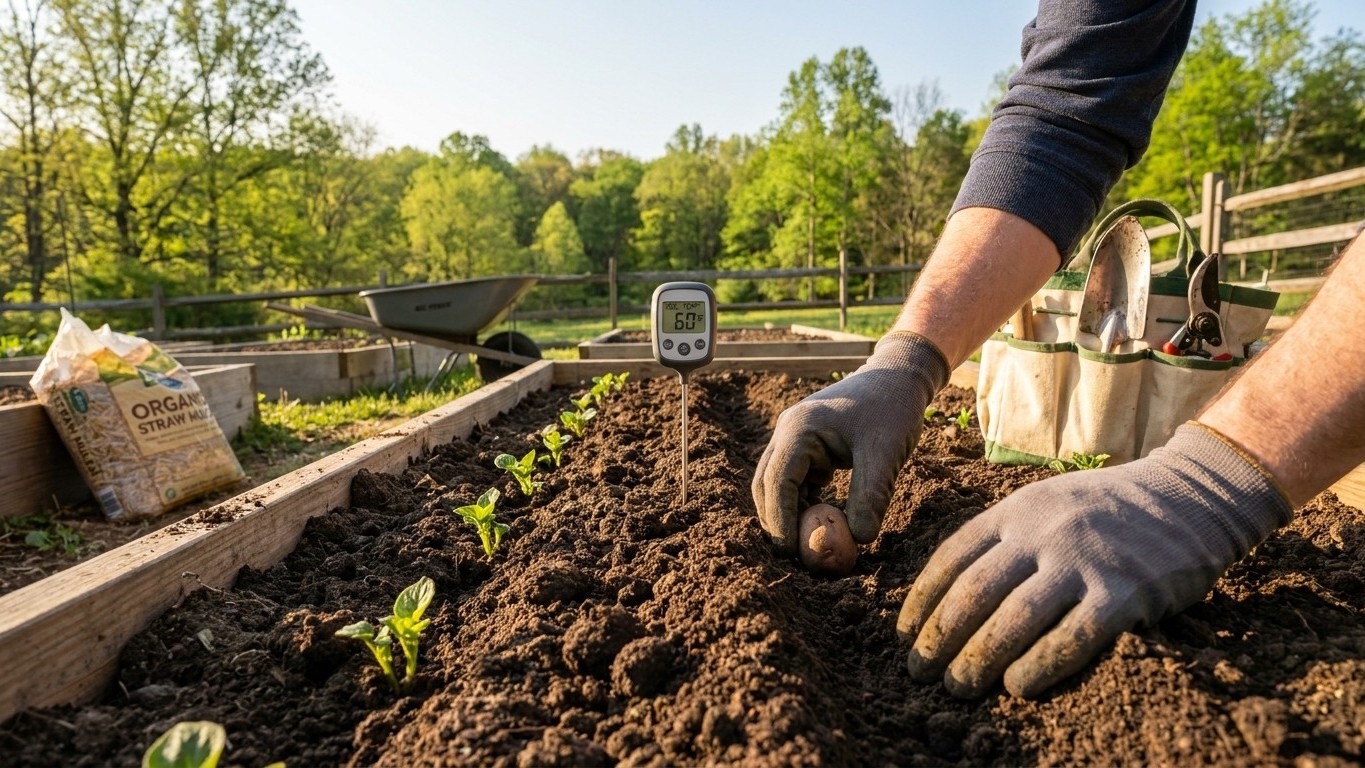

Pennsylvania sits in a comfortable middle ground for potatoes: summer heat rarely shuts tuber growth down for long, and the state’s frost calendar gives gardeners a workable spring planting window. The short version is plant early, based on soil temperature rather than the calendar, and pick a season class that matches how much time you have before the ground warms past the point that matters. For exact dates by region, When to Plant Potatoes in Pennsylvania breaks down the planting window in more detail.
The short answer

Two numbers decide whether a state can grow potatoes through a full season or only as a spring crop dug before summer arrives. The first is heat load: at the Philadelphia reference station, NOAA NCEI Climate Normals (1991-2020) put the average at 24.0 days a year reaching 90 F or more. The second is the frost window: the last spring freeze at that same station falls between March 29 and April 6, also per NOAA NCEI’s 1991-2020 normals.
Twenty-four days above 90 F a year is a moderate load. Compare it to states where triple-digit stretches run for weeks at a stretch, and Pennsylvania looks mild. That matters because, according to Utah State University Extension, tuber set and fill is inhibited once soil temperatures climb above 90 F. Air temperature and soil temperature aren’t the same thing, but a lot of 90 F air days in a row will push soil past that ceiling too, especially in exposed, unmulched rows.
With only 24 such days spread across a summer, most Pennsylvania gardens never see soil sit above that ceiling for long consecutive stretches. That’s good news: a full-season potato crop, planted early and left in the ground through midsummer, is realistic here in a way it isn’t in the hottest parts of the country. Knowing when to dig and how to cure the crop afterward matters just as much as the planting date, and Harvesting and Storing Potatoes in Pennsylvania covers that end of the season in detail. The catch is regional. Philadelphia is the mildest corner of the state. The northern tier and the Alleghenies run cooler in summer, which helps tuber set, but they also carry a frost window that lags Philadelphia by two to four weeks in spring, which pushes the whole planting schedule later.
What this means for variety choice
Because heat rarely forces an early dig here, gardeners can lean toward mid-season and late varieties, which use the longer window to keep sizing. Early varieties still make sense for anyone who wants a harvest before the hottest stretch of July or August, or who’s working with a short growing window at higher elevation. Neither Utah State University Extension nor the University of Maine Cooperative Extension publishes a days-to-maturity figure for named cultivars, so the useful way to plan is by season class, not by a specific day count; for a rundown of Potato Varieties That Suit Pennsylvania, matching class to your region is the place to start.
When to plant here
The planting date isn’t a fixed day on a calendar. It’s worked out backward from your local last frost date and confirmed with a soil thermometer. Here’s how the arithmetic runs for a Philadelphia-area garden, and how to adjust it for anywhere else in the state.
- Start with your last spring frost date. For the Philadelphia reference station, NOAA NCEI’s 1991-2020 normals put that window between March 29 and April 6.
- Count back 14 to 21 days from that date. Utah State University Extension and the University of Maine Cooperative Extension both frame planting this way: potatoes go in the ground 14 to 21 days before the last frost, not after it. For Philadelphia, counting back from late March to early April lands the planting window in mid-to-late March.
- Confirm with a soil thermometer, not the calendar. The actual trigger is soil reaching 50 F at planting depth, around 4 inches down. If a cold snap keeps soil below that mark past your calculated date, wait. If a warm spell brings soil to 50 F earlier than expected, you can plant sooner.
- Adjust the whole schedule for your region. The northern tier and the Alleghenies run two to four weeks later in spring than Philadelphia, so soil there will lag behind the 50 F mark by roughly the same amount. Push the entire countback later by that many weeks.
- Re-check soil temperature if a late cold snap hits. Seed potatoes planted into soil that dips back below 50 F after planting won’t be damaged the way tender transplants are, but rot risk rises if the soil is also wet.
What the heat does to the crop
The mechanism is the whole story here, and it’s worth understanding rather than guessing at. Above 90 F, soil stops supporting tuber set and fill, according to Utah State University Extension. The plant doesn’t die. It doesn’t even necessarily wilt. It just stops putting size on the tubers underground while the heat lasts, and that lost growth doesn’t get made up later in the season.
Pennsylvania’s 24.0 days a year above 90 F, measured at Philadelphia, is spread thin rather than stacked into one long heat dome most summers. That means a Pennsylvania potato bed is more likely to hit a few scattered hot days than a three-week stretch where soil sits above the ceiling continuously. Plants can generally recover growth once temperatures drop back down, which is a real advantage over states where 90-degree days run in long unbroken chains through July and August.
Watering more during a hot spell doesn’t change any of this. Soil moisture helps the plant cope with heat stress in general terms, but it doesn’t lower soil temperature enough to restart tuber sizing once the ceiling is crossed. The fix, if there is one, is timing: plant early enough that the bulk of tuber bulking happens before the hottest weeks land, and mulch rows heavily to keep soil temperature down closer to the surface where new tubers are forming. For gardeners in the warmer southeastern counties, treating the crop as a spring-to-early-summer harvest, dug before the peak heat rather than left in the ground through August, is the more reliable approach than hoping a late-season crop pushes through a heat wave.
What goes wrong here
- Planting uncertified seed potatoes. Seed saved from a grocery store potato or an unlabeled bag from a neighbor can carry viruses that stunt the plant and reduce yield without showing obvious symptoms early on. Buy certified seed potatoes each season from a garden supplier that labels them as such.
- Planting into cold, wet soil before it reaches 50 F. Seed pieces sitting in soil that’s still cold and saturated are prone to rot before they ever sprout. Wait for the soil thermometer to confirm 50 F at planting depth, even if that means planting a week or two later than the calendar countback suggests.
- Skipping the hilling. Tubers that form near the surface and get exposed to sunlight turn green and develop solanine, which makes them unsafe to eat. Hill soil or mulch up over the base of the plants as they grow, covering developing tubers as the row fills in.
- Digging too early. Pulling potatoes before the vines have died back, or before a spring crop has had its full window to size, means smaller tubers and thinner skins that don’t store well. Let vines die back naturally for a maincrop harvest, and let the skins set for a few days before storage.
Checking this against your own county
A statewide reading is a starting point, not a planting instruction. The Philadelphia figures used here, both the 24.0 days above 90 F and the March 29 to April 6 frost window, come from a single reference station in the mildest corner of Pennsylvania. Elevation changes things fast: a garden a few hundred feet higher, or one tucked into a valley that pools cold air, can run a full month behind on both frost dates and soil warming.
The northern tier and the Alleghenies are the clearest example, running two to four weeks later than Philadelphia in spring. Before committing to a planting date, check current soil temperature readings and frost risk for your specific county through Penn State Extension, which tracks conditions across the state’s varied growing regions rather than relying on one reference point.
Common questions
Can I grow potatoes all summer in Pennsylvania, or should I dig early?
With only 24.0 days a year above 90 F at the Philadelphia reference station, most Pennsylvania gardens can carry a full-season crop without extended heat stress. Southeastern counties with more heat exposure may still benefit from treating potatoes as an early-to-midsummer harvest rather than pushing into late August.
What’s the difference between an early and a late variety here?
Neither Utah State University Extension nor the University of Maine Cooperative Extension publishes a days-to-maturity number, but both describe season class. Early varieties are typically used for boiling and finish sizing faster in the season; late varieties, often used for baking, use a longer window to bulk up and tend to store better afterward.
Does mulching actually help against Pennsylvania’s hot days?
Mulch keeps soil temperature lower and more even, which matters most during the scattered hot spells the state does see. It won’t prevent every effect of a 90 F day, but it reduces how often soil near the surface, where new tubers form, actually crosses that threshold.
Why does certified seed matter so much for a home garden?
Seed potatoes carry viruses silently. A plant grown from infected seed can look normal for a season while yielding far less, and the virus persists in any tubers saved for next year’s seed. Certified seed is tested and is the only way to start a season without that risk baked in from day one.